Danshen & Heart Medication Interaction Checker
This tool checks for dangerous interactions between Danshen (red sage) and blood thinners. WARNING: Combining Danshen with any blood thinner can cause life-threatening bleeding. Always consult your doctor before taking any herbal supplement.
Select your medications and Danshen usage to see if there's a dangerous interaction.
Important Notes
Do not stop prescribed medication without consulting your doctor. This tool is informational only. Your doctor knows your full medical history. If you're experiencing unusual bleeding, seek emergency medical attention.
Many people turn to herbal supplements like Danshen is a traditional Chinese herb derived from the root of Salvia miltiorrhiza, commonly used for heart health and circulation. Also known as red sage, it has been used for over 2,000 years in Traditional Chinese Medicine to treat chest pain, heart attacks, and stroke. But here’s the problem: if you’re taking heart medication-especially blood thinners-Danshen could be putting you in serious danger.
What Danshen Actually Does in Your Body
Danshen isn’t just a harmless tea. Its active compounds-tanshinones and salvianolic acids-work hard inside your body. Studies show it reduces blood pressure, opens up coronary arteries, and most importantly, thins your blood. In lab tests, Danshen inhibited platelet clumping by up to 47% at common concentrations. That sounds helpful until you realize: it does this without any way to measure or control the effect.
Unlike prescription drugs, Danshen supplements vary wildly in strength. One bottle might have 0.05% tanshinones; another might have 5.2%. That’s a 100-fold difference. You can’t know how much you’re actually taking. The Chinese Pharmacopoeia confirms this inconsistency, and that’s why experts warn against using it as a substitute for regulated medicine.
The Dangerous Mix with Blood Thinners
If you’re on warfarin (Coumadin), the risks aren’t theoretical-they’re documented. Three well-known case reports from the Cleveland Clinic show what happens when Danshen meets warfarin:
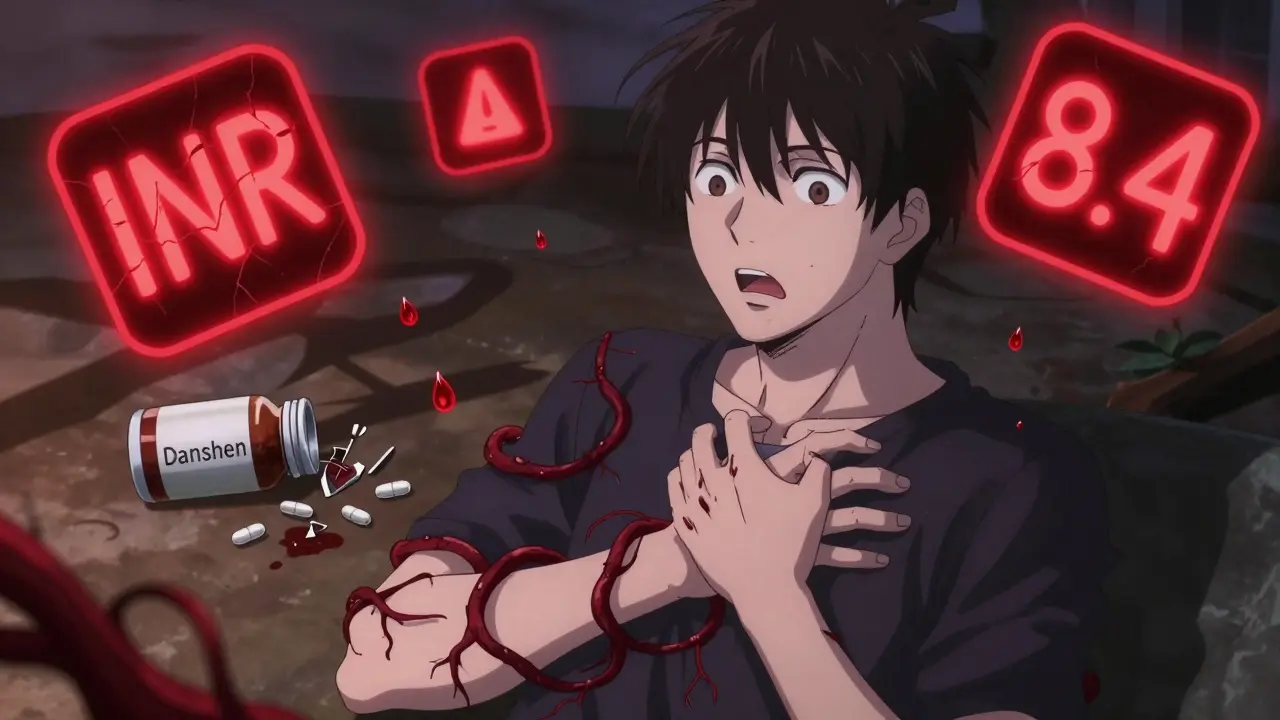
- A 62-year-old man on warfarin for a mechanical heart valve saw his INR jump from 2.5 to over 8.4 after two weeks of Danshen. His hemoglobin dropped to 7.6 g/dL-signaling dangerous internal bleeding.
- A 48-year-old woman’s INR climbed to 5.6 after taking Danshen every other day for a month. She was nearly three times above the safe range.
- A 66-year-old man with stable INR levels of 2.0 spiked to 5.5 after taking Danshen for just three days.
These aren’t rare accidents. A 2020 study in Taiwan found 17 more cases between 2015 and 2019. Every single one involved a spike in INR levels, with an average jump from 2.3 to 5.8. That’s not a glitch-it’s a pattern.
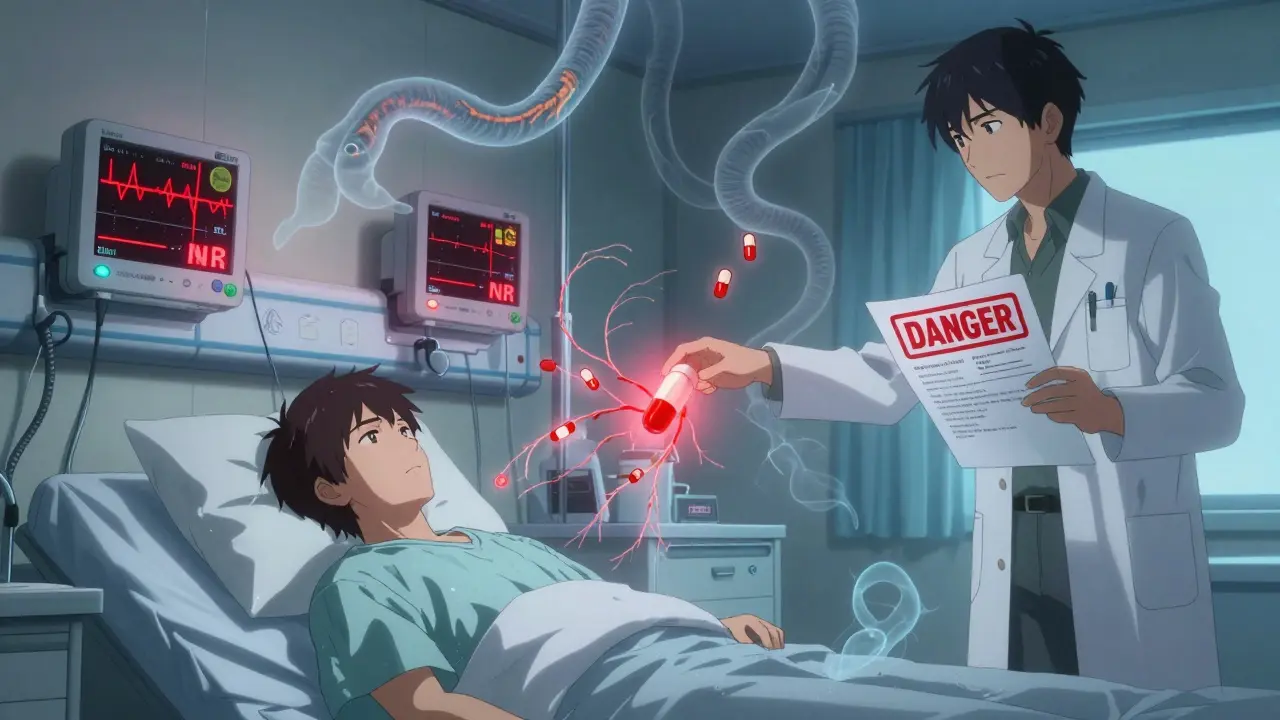
And warfarin isn’t the only danger. Newer anticoagulants like rivaroxaban (Xarelto) and apixaban (Eliquis) aren’t safe either. Research from the NIH in 2022 showed Danshen blocks the liver enzymes that break down rivaroxaban, causing it to build up in your blood. No one knows how much is too much. No reversal agent exists for Danshen-induced bleeding. If you start bleeding internally, doctors can’t just give you a pill to stop it like they can with some prescription drugs.
Why Patients Don’t Realize the Risk
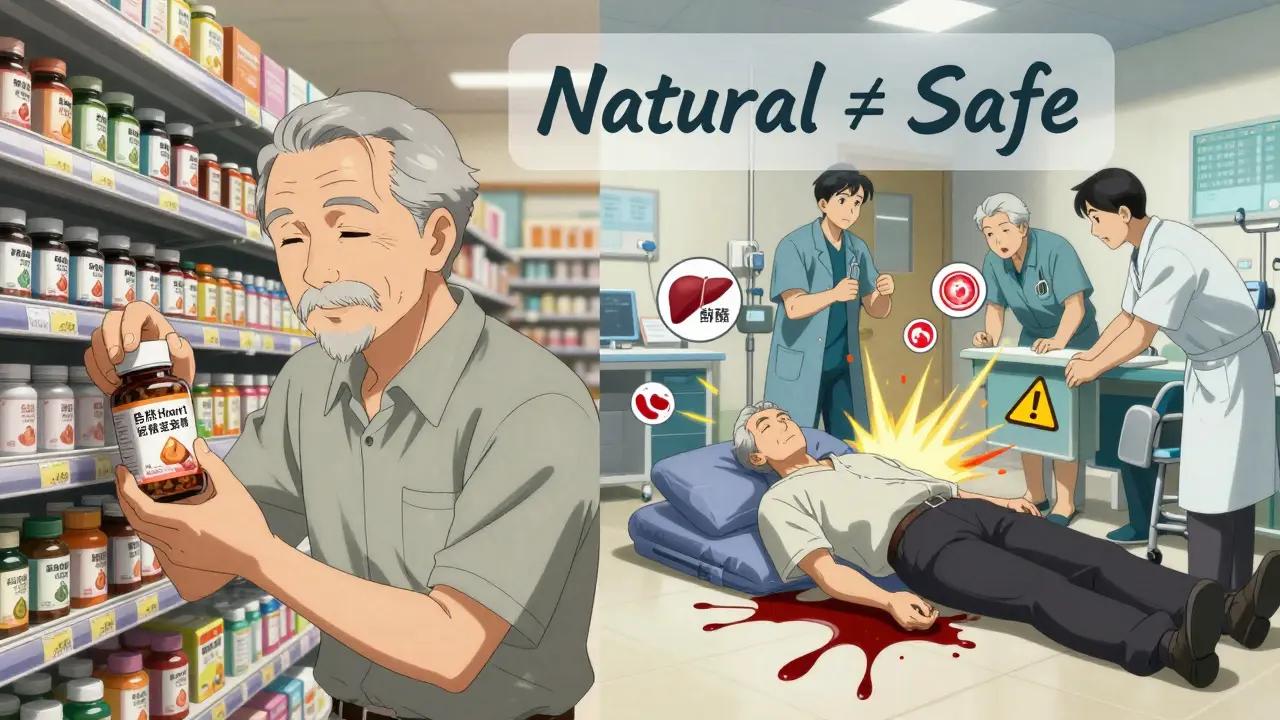
Most people don’t tell their doctors they’re taking herbal supplements. A 2019 survey in JAMA Internal Medicine found only 28% of patients disclosed their herb use. Why? Because they think “natural” means “safe.” That’s a deadly myth.
Danshen is sold in pharmacies, health food stores, and online as a “heart support” supplement. Labels rarely warn about interactions. In fact, many products don’t even list the exact amount of active ingredients. A Reddit thread from October 2022 had multiple users sharing ER visits after mixing Danshen with Eliquis or warfarin. One wrote: “My INR went from 2.5 to 6.0. Never again.”
Even more troubling: a 2021 study found 41.7% of Chinese immigrants in the U.S. regularly took Danshen while on heart medications-and only 32.4% told their doctors. Cultural traditions don’t make supplements safer. They make the risks harder to spot.
What Experts Are Saying
The warnings aren’t vague. They’re loud and clear:
- WebMD calls the interaction with warfarin “Major” and says: “Do not take this combination.”
- Cleveland Clinic states outright: “It is contraindicated to use warfarin and Danshen concurrently.”
- Dr. Edward Phillips at Mayo Clinic says Danshen “can interact strongly with some heart medicines” and “raise your risk of bleeding.”
- Natural Medicines Comprehensive Database rates it as “Major-Do not take this combination.”
- Dr. Jun Xu from Shanghai warned in The Lancet that Danshen’s complex mix of chemicals creates “unpredictable pharmacokinetic interactions that cannot be reliably anticipated.”
These aren’t opinions. These are clinical facts backed by case reports, lab studies, and decades of observation.
The Bigger Picture: A Growing Market, Growing Risks
The global Danshen market hit $1.23 billion in 2022 and is projected to grow to $1.84 billion by 2027. More people are using it. More pharmacies are selling it. More online sellers are marketing it as a “natural alternative” to prescription heart meds.
But while the market grows, so do the dangers. The CDC reports 2.9 million Americans were on warfarin in 2019. Another 1.6 million started newer anticoagulants each year. That’s millions of people at risk.
China approves Danshen injections for hospital use-because they’re controlled, sterile, and monitored. In the U.S. and Europe, you’re buying a supplement with no quality control. The FDA has issued multiple warnings about unapproved Danshen products. The European Medicines Agency requires warning labels on Danshen products sold there.
What You Should Do
If you’re on any heart medication-especially blood thinners-stop taking Danshen. Period. No exceptions. No “I’ll take less.” No “I’ll time it differently.” The science doesn’t support any safe combination.
If you’re already taking it:
- Stop immediately.
- Call your doctor or pharmacist. Tell them exactly what you took and for how long.
- If you’re on warfarin, get your INR checked right away. An INR above 4.0 is dangerous.
- Don’t replace it with another herb. Many others-like garlic, ginger, ginkgo, or ginseng-also thin the blood.
If you’re considering Danshen for heart health:
- Ask your cardiologist first. Not your herbalist. Not your friend. Not Google.
- Remember: natural doesn’t mean safe. The American Heart Association says it plainly: “Natural does not mean safe.”
- There are proven, regulated treatments for heart disease. Don’t gamble with unregulated herbs.
Final Warning
Danshen isn’t a supplement you can casually add to your routine. It’s a potent, unpredictable drug with documented, life-threatening interactions. For people on heart medications, especially anticoagulants, the risk isn’t just possible-it’s proven, repeated, and deadly.
The safest choice isn’t complicated: don’t mix them. Your heart will thank you.
Can I take Danshen if I’m on a low dose of warfarin?
No. Even low doses of warfarin can become dangerously elevated when combined with Danshen. Case studies show INR levels spiking well above safe limits even when warfarin was taken at minimal doses. There is no known safe threshold for combining the two. The interaction is unpredictable and can happen at any dose.
Is Danshen safe if I’m not on blood thinners?
Even if you’re not on blood thinners, Danshen can lower your blood pressure and affect blood flow. If you have a bleeding disorder, are about to have surgery, or take other medications that affect your liver or kidneys, it could still be risky. Always talk to your doctor before starting any new supplement, especially one with documented drug interactions.
What are the signs that Danshen is interacting with my medication?
Watch for unusual bruising, nosebleeds, bleeding gums, blood in urine or stool, unusually heavy menstrual bleeding, or dizziness and weakness. If you’re on warfarin and your INR suddenly spikes without explanation, Danshen could be the cause. Seek medical attention immediately if you notice any of these symptoms.
Are there any herbal alternatives to Danshen that are safer?
There is no herbal substitute that’s proven to be both effective and safe for heart conditions while taking anticoagulants. Many herbs-including garlic, ginger, ginkgo, and ginseng-also affect blood clotting. The safest approach is to rely on clinically tested, FDA-approved medications under medical supervision, not unregulated herbs.
Why is Danshen still sold if it’s so dangerous?
In the U.S., herbal supplements are regulated as food, not drugs. That means they don’t need to prove safety or effectiveness before being sold. Manufacturers aren’t required to list all ingredients or warn about interactions. The FDA can only act after harm is reported. This regulatory gap allows dangerous products to stay on shelves, even when evidence of harm is clear.






Buddy Nataatmadja
I've been taking Danshen for years for my circulation, never thought it'd clash with my meds. My doc never asked about supplements, just assumed I was on the script. Kinda scary how little they ask. I'm stopping it tomorrow. Thanks for the wake-up call.
Also, I'm Indonesian-American and my grandma swore by it for 'blood warmth'-but yeah, maybe tradition ain't always safe when science says otherwise.
mir yasir
The pharmacological incongruity between traditional herbal formulations and modern pharmacokinetic paradigms is profoundly concerning. The absence of standardized bioavailability metrics in botanicals renders their concomitant use with anticoagulants not merely risky-but epistemologically indefensible. One cannot reconcile empirical clinical evidence with unregulated phytochemical variability without invoking significant ethical imperatives in patient safety.
Stephanie Paluch
I had no idea 😳 I’ve been taking that stuff for my ‘heart support’ like it was a vitamin… I’m gonna call my doc right now. My INR’s been weird lately too. Thank you for spelling this out so clearly. I’m deleting all my Danshen bottles rn. 🙏💔
tynece roberts
So like, I get it, it’s a herb, right? But then you read how one bottle has 0.05% and another has 5% and you’re just like… how am I supposed to know what I’m even taking? I mean, I bought it at GNC like it was a protein shake. My friend’s mom had a bleed and they didn’t even connect it to the tea she drank every morning. I’m not even mad, just… shook. Why isn’t there a warning label bigger than a stop sign? I’m done with ‘natural’ as a buzzword. It’s not a vibe, it’s a chemical cocktail.
Hugh Breen
THIS IS WHY WE NEED BETTER REGULATION. 🚨 I’m so glad someone finally said this out loud. My cousin almost died from this exact combo. She didn’t tell her doctor because she thought ‘herbal’ = ‘harmless.’ We need mandatory labeling, mandatory doctor screening, mandatory education. This isn’t about tradition-it’s about people dying because of a loophole in the law. 🇺🇸💔 Let’s make this a national health priority. Tag your reps. This needs to change.
Byron Boror
This is why America is falling apart. You can’t just let foreigners’ old wives’ tales run wild in our pharmacies. We have FDA-approved meds for a reason. If you want to live like a 12th-century monk, go live in a cave. But don’t poison your neighbors with your ‘natural’ nonsense. Stop selling this crap. Period.
Lorna Brown
It’s fascinating how deeply we equate ‘natural’ with ‘moral’ and ‘safe.’ But nature doesn’t care about our intentions. Poison ivy is natural. Hemlock is natural. This isn’t about dismissing traditional medicine-it’s about recognizing that context, dosage, and pharmacological interaction matter. The real tragedy is that we treat supplements like harmless indulgences instead of potent bioactive compounds. We need better science literacy, not just better labeling.
Rex Regum
LMAO. So now we’re banning herbs because some people are dumb enough to mix them with prescription drugs? What’s next? Banning apples because someone ate one while on blood thinners? This is the epitome of nanny-state overreach. If you’re dumb enough to take Danshen with warfarin, you deserve what you get. The solution isn’t regulation-it’s education. And maybe a Darwin Award for the ones who don’t survive.