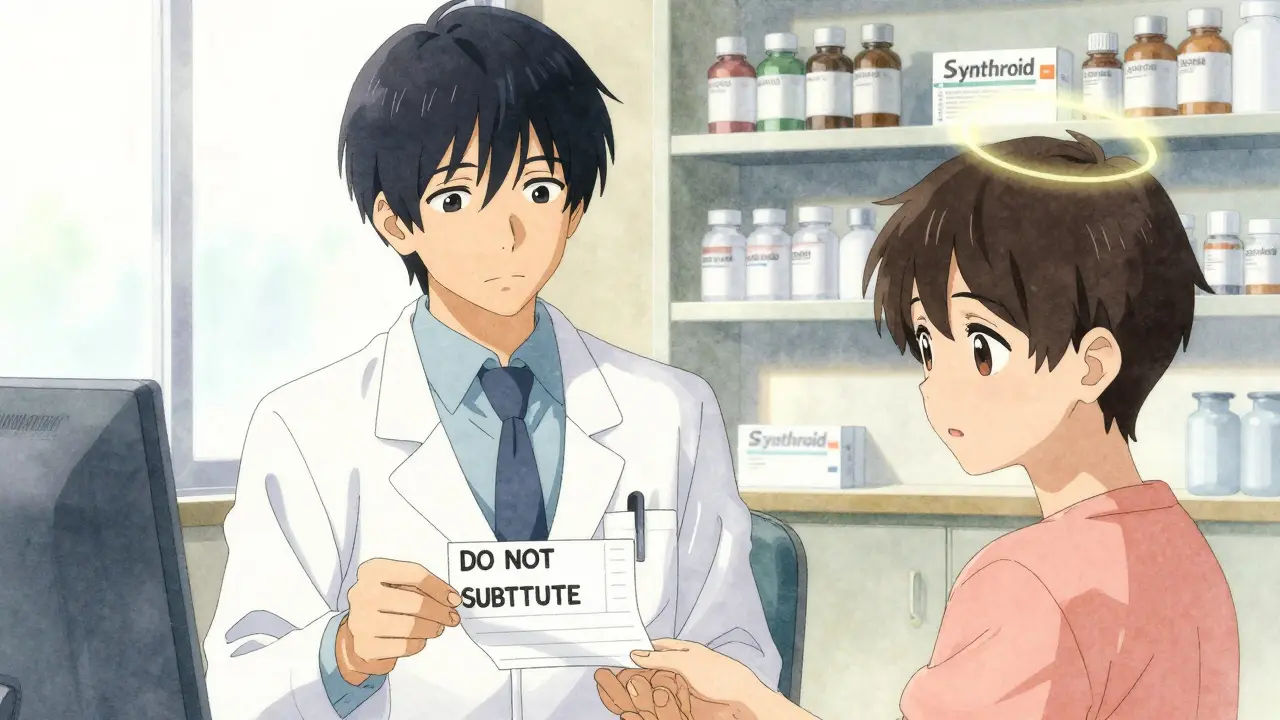
Most of the time, your doctor prescribes a medication and you pick up a little white pill with a generic label. It works. It’s cheaper. You move on. But sometimes, your doctor writes brand-name only on the prescription. And suddenly, the pharmacy can’t swap it out for the cheaper version-even if you’re begging them to. Why? Is it just about profit? Or is there a real medical reason behind it?
It’s Not About Brand Loyalty-It’s About Precision
Doctors don’t ask for brand-name drugs because they’re fans of the packaging. They do it when the difference between the brand and the generic could mean the difference between feeling okay and having a medical emergency. This happens most often with drugs that have a narrow therapeutic index-meaning the gap between a dose that works and a dose that’s dangerous is razor-thin.
Take levothyroxine, the thyroid hormone replacement. A small change in how much of the drug enters your bloodstream can throw your metabolism off. Too little? You’re tired, gaining weight, depressed. Too much? Your heart races, you lose bone density, you risk a stroke. The American Thyroid Association says you should stick with the same brand-usually Synthroid-because even though generics are FDA-approved, different manufacturers use slightly different inactive ingredients. These can affect how the pill dissolves in your stomach. One patient on Reddit said switching from Synthroid to a generic twice led to severe depression both times. That’s not anecdotal-it’s documented.
The same goes for antiseizure meds like levetiracetam (Keppra). A 2019 study followed 1,200 people with epilepsy who were switched from brand to generic. About 12.7% had breakthrough seizures. Only 4.3% did when they stayed on the brand. That’s a nearly threefold increase in risk. The American Academy of Neurology says this isn’t about generics being bad-it’s about how tiny variations in absorption can break the balance in the brain.
When Your Body Reacts to the Filler, Not the Drug
Generics have to contain the same active ingredient as the brand. But they don’t have to use the same fillers, dyes, or coatings. And for some people, those extra ingredients cause real problems.
Take ciprofloxacin, a common antibiotic. One generic might use a certain dye that irritates your stomach. Another might use a different binding agent that slows absorption. Patients on Drugs.com report nausea, bloating, and diarrhea after switching between generic versions of the same drug. These aren’t allergies-they’re intolerances to the non-active parts of the pill. When you’ve tried three generics and none work without side effects, your doctor has no choice but to go back to the brand.
Some medications have unique delivery systems too. Advair, for example, uses a Diskus inhaler that’s engineered to release the exact amount of medicine with each puff. Generic versions may have different inhaler designs, leading to inconsistent dosing. For someone with severe asthma, that’s not a risk they’re willing to take.
Legal Rules: What Your Doctor Has to Write
You can’t just ask your doctor to write “brand only” and expect it to stick. In 49 states and Washington D.C., pharmacists are legally allowed to swap generics unless the doctor says otherwise. So if your doctor wants you to get the brand, they have to write it clearly on the prescription.
They’ll write one of these phrases: “dispense as written,” “do not substitute,” or “brand medically necessary.” Without one of those, the pharmacy will give you the generic-and you might not even know it happened.
Some states make it even harder. California requires doctors to check a box on electronic prescriptions saying why the brand is needed. New York demands a written clinical note justifying the request. These rules exist to stop lazy prescribing. The goal isn’t to make life harder for doctors-it’s to make sure brand-only prescriptions are truly necessary.

Why Most People Don’t Need Brand-Name Drugs
Let’s be clear: for the vast majority of medications, generics are just as good. A 2020 JAMA study looked at 47 trials involving over 112,000 patients. It found no difference in outcomes between brand and generic versions of statins, blood pressure meds, antidepressants, and diabetes drugs.
Take lisinopril for high blood pressure. The brand name is Prinivil. The generic? Same exact molecule. Same effect. Same side effects. But the brand costs about $470 a month. The generic? Around $14. That’s not a savings-it’s a lifeline for people on fixed incomes.
And here’s the kicker: 90% of all prescriptions filled in the U.S. are generics. But they only make up 23% of total drug spending. That tells you something: brand-name drugs are expensive, and they’re being overused. A Harvard Medical School professor called inappropriate brand prescribing “a huge source of wasteful spending.”
Insurance and the Battle Behind the Scenes
If your doctor writes “brand medically necessary,” your insurance doesn’t just say yes. They make you jump through hoops.
Most insurers require prior authorization. That means your doctor has to fill out paperwork explaining why you need the brand. The average wait time? 72 hours. And approval rates vary wildly. For proton pump inhibitors (like omeprazole), only 45% of requests get approved. For antiepileptics? 89%. Why? Because the evidence for needing the brand is clear in epilepsy. For acid reflux? Not so much.
Patients who get stuck with brand-name prescriptions often pay hundreds more out of pocket. A 2021 Kaiser Family Foundation survey found 42% of patients paid more because their doctor prescribed a brand when a generic would’ve worked. That’s not just unfair-it’s dangerous. People skip doses. They stop taking meds altogether. And then they end up in the ER.
What You Can Do If You’re Asked to Pay More
Don’t just accept it. Ask questions.
- “Is this really necessary, or can I try the generic?”
- “Have you seen patients have problems with the generic version of this drug?”
- “Can we try the generic first, and if it doesn’t work, we switch back?”
Many doctors don’t realize how much cheaper generics are. A 2021 study found primary care doctors correctly identified available generics only 63% of the time. They’re not trying to overcharge you-they just don’t know the options.
If you’re on a tight budget, ask your pharmacist for a price check. Sometimes, even the brand-name version is cheaper with a coupon or discount program. GoodRx often has better prices than insurance.
And if you’ve had a bad reaction to a generic before, keep a written note. Bring it to your next appointment. Say: “I switched to generic X and had symptom Y. I need to stay on the brand.” That’s powerful evidence.
The Bigger Picture: Innovation vs. Access
Pharmaceutical companies argue that brand-name prescribing helps fund future drug development. But here’s the truth: most brand-name drugs are already off-patent. The companies making them aren’t investing in new research-they’re just milking the brand name for profit.
Meanwhile, generic manufacturers are stepping up. The FDA now requires them to match the brand’s size, shape, and color to reduce patient confusion. That’s a big step. And “authorized generics”-the brand company’s own generic version-are popping up. These avoid the variability between different generic makers.
The real solution? Better education. Better tools in electronic health records. And insurance policies that don’t punish patients for asking for the cheaper, equally effective option.
For now, if your doctor says you need the brand, make sure it’s for the right reason. If it’s because you’ve had problems with generics before, or it’s a drug with a narrow therapeutic window, then yes-stick with the brand. But if it’s just because that’s what they’ve always prescribed? Push back. Your wallet-and your health-will thank you.
Can a pharmacist refuse to give me the brand-name drug if my doctor wrote "do not substitute"?
No. If your doctor writes "dispense as written," "do not substitute," or "brand medically necessary," the pharmacy is legally required to give you the brand-name version. Pharmacists cannot switch it out, even if it’s more expensive. This rule applies in all 50 states and Washington D.C.
Are generics always cheaper than brand-name drugs?
In almost all cases, yes. On average, generics cost 80-85% less than brand-name drugs. For example, the brand-name drug Keppra can cost over $400 per month, while the generic levetiracetam runs about $15. But rare exceptions exist-like authorized generics or when insurance has a high copay for the generic. Always check prices with GoodRx or your pharmacy before filling.
Why do some people have bad reactions to generics but not the brand?
Generics must contain the same active ingredient, but they can use different inactive ingredients-like dyes, fillers, or coatings. For some people, these additives cause stomach upset, allergies, or changes in how the drug is absorbed. This is especially common with antibiotics, thyroid meds, and seizure drugs. If you notice side effects after switching to a generic, keep a record and tell your doctor.
Is it safe to switch between different generic brands of the same drug?
For most drugs, yes. But for those with a narrow therapeutic index-like levothyroxine, warfarin, or seizure meds-switching between generic manufacturers can cause problems. Even small changes in absorption can lead to side effects or loss of control. If you’re on one of these drugs, it’s best to stick with the same generic manufacturer or stay on the brand.
How can I find out if a generic is approved for my drug?
The FDA’s Orange Book lists all approved generic drugs and their therapeutic equivalence ratings. You can search it online or ask your pharmacist. If a generic is rated AB, it means it’s considered therapeutically equivalent to the brand. If it’s rated BX, it means the FDA doesn’t consider it interchangeable-often due to formulation issues.









paul walker
bro i switched from Synthroid to a generic and felt like i was drowning in molasses for 3 weeks. my doctor was like 'it's the same chem' but no it's not. my energy, my mood, my brain just... shut down. now i pay extra and i don't care. my life's not a cost-benefit analysis.
Alex Flores Gomez
Let me just say, if you’re taking a generic for levetiracetam and still having seizures, you’re not ‘unlucky’-you’re just trusting a pill made by someone who couldn’t afford a decent chemistry lab. The FDA approves generics based on statistical averages, not individual biology. Your body isn’t a spreadsheet.
Frank Declemij
There is strong evidence that for drugs with narrow therapeutic indices, brand consistency matters. Studies show measurable differences in bioavailability between generic manufacturers. This isn't opinion-it's pharmacokinetics. Patients deserve stability, especially when lives are on the line.
Pawan Kumar
Pharma companies control the brand names. They fund the studies. They lobby the FDA. The 'generic' you get? Often made by the same company, just in a different factory with cheaper dyes. You think this is about medicine? It's about monopolies disguised as savings.
Keith Oliver
Bro I tried switching my Keppra to generic and my seizures came back like a bad Netflix sequel. My neurologist was like 'it's the same molecule' but bro that molecule doesn't live in a vacuum. My brain knows the difference. I'm not risking another ER trip for $15.
Kacey Yates
I had a patient who went from brand to generic cipro and ended up in the ER with GI bleeding. Turns out the filler was triggering a reaction. Doctors don't know this stuff. Pharmacies don't tell you. Patients get screwed. If you have weird side effects after a switch, document it. Bring it to your doctor. Don't be quiet.
ryan Sifontes
whatever. i dont care. they all work fine. stop making it a thing. people just wanna be special.
Jasneet Minhas
So basically, if you’re rich, you get the real pill. If you’re poor, you get the one that might make you depressed or seize. 🤷♂️😂 At least the brand looks nice on the bottle, right? #PharmaDreams
Megan Brooks
There’s a deeper question here: Why do we allow a system where health outcomes are determined by insurance policies and corporate profit margins? If a drug’s efficacy hinges on the color of its coating, then our entire regulatory framework is built on a lie. We treat medicine like a commodity, but bodies aren’t widgets.
kabir das
And don't forget... the generic manufacturers? They're owned by the same corporations that make the brand names! They're just playing both sides! You think you're saving money? You're just paying the same people, but with less quality control! And they know it! They're laughing all the way to the bank!!!
Laia Freeman
OMG I switched my thyroid med to generic and started crying for no reason for 2 weeks?? Like full sobbing in the shower?? I thought I was depressed but it was the pill. Now I pay $60 extra and I'm not even mad. My mental health is worth it. #GenericWoes
rajaneesh s rajan
So we’re saying the system works for most people, but breaks for the few who need precision? That’s not a flaw-it’s a feature. Capitalism doesn’t optimize for rare cases. It optimizes for volume. The real tragedy? We’re supposed to be grateful for the 90% that works.
DHARMAN CHELLANI
Generics are fine. If you can't handle it, you're weak. Stop being a baby.