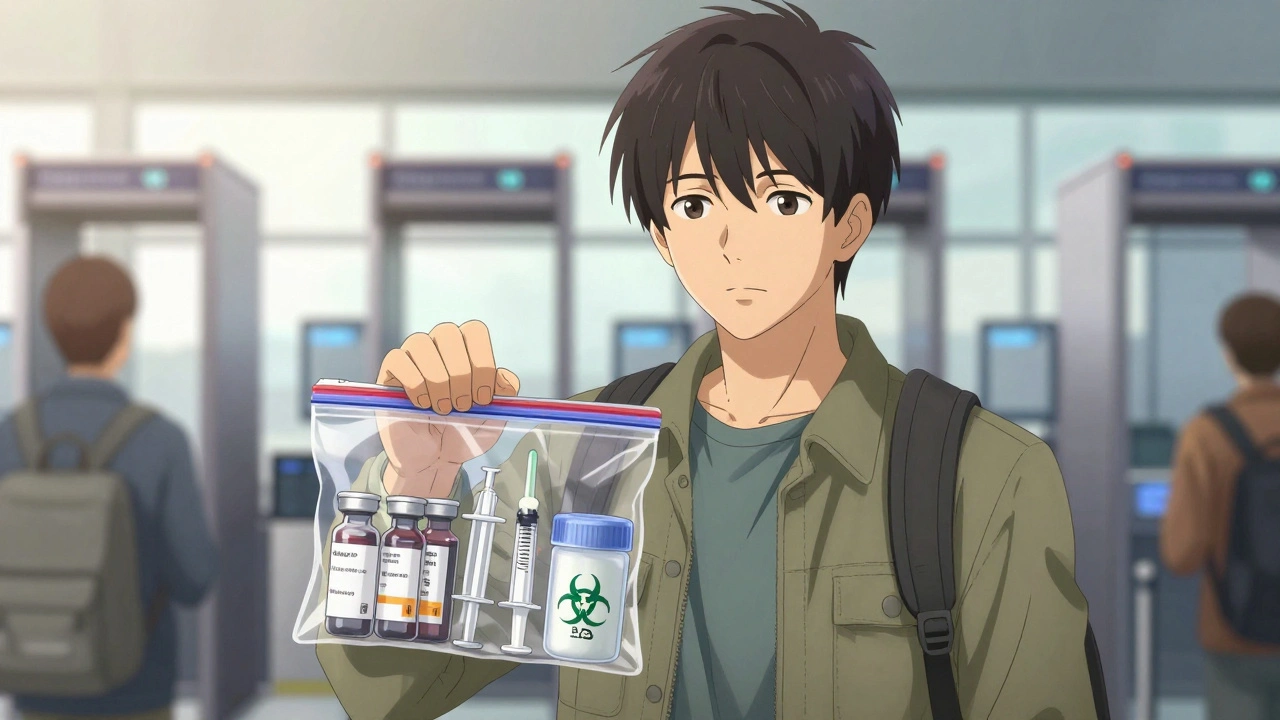
Traveling with injectable medications like insulin, EpiPens, or hormone treatments doesn’t have to be stressful-if you know what to do. Thousands of people fly with these supplies every day, but many still face delays, confusion, or even denial at security. The good news? The rules are clear. The challenge? Not everyone knows them. This guide cuts through the noise and gives you exactly what you need to get through security smoothly, whether you’re flying across the country or overseas.
What You’re Allowed to Bring
You can bring unlimited amounts of injectable medications and syringes on a plane, as long as they’re for personal medical use. The TSA doesn’t limit how many vials, pens, or needles you carry. That includes insulin, glucagon, testosterone, growth hormone, or any other prescribed injectable. Used syringes are also allowed, but they must be stored safely in a sharps container.
There’s one big exception: syringes without medication. If you have unused syringes with no corresponding drug, security may question them. Always keep your syringes with the medication they’re meant to use. TSA officers are trained to look for medical necessity-not quantity.
Liquids Over 3.4 Ounces? No Problem
The standard 3-1-1 rule for liquids doesn’t apply to medically necessary liquids. If your insulin vial is 2 ounces, 4 ounces, or even 8 ounces, you can bring it through security. You don’t need to fit it in a quart-sized bag. But you must declare it to the TSA officer at the checkpoint. Don’t wait until they ask-speak up before you reach the X-ray machine.
Keep your medication in its original pharmacy-labeled container. The label should show your name, the drug name, and the prescribing doctor. If the original bottle is too big or you’re traveling with multiple vials, transfer them to a clear, labeled container that still shows your name and the medication details. A pill organizer won’t cut it for liquids-use a small, clear vial with a printed label.
Sharps Containers: Not Optional
Used needles, lancets, or auto-injectors must go into a sharps container. Not a coffee cup. Not a soda bottle. Not a pill bottle with the cap screwed on. You need a rigid, puncture-resistant container that meets FDA and IATA standards. These are sold at pharmacies, medical supply stores, and online. Look for containers labeled “FDA-cleared” or “ANSI/ISEA Z308.1-2021 compliant.”
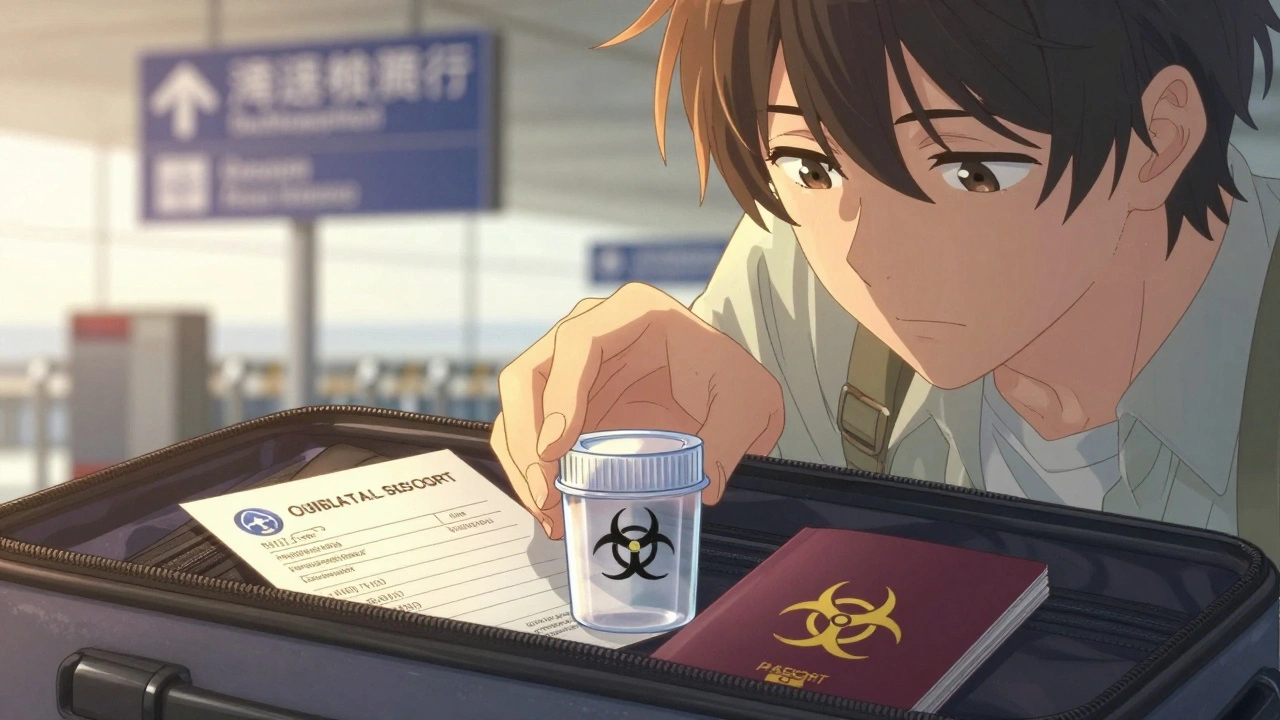
The container must have the universal biohazard symbol (the trefoil) on it. This isn’t just for show-it’s a legal requirement under OSHA rules. If your container doesn’t have it, TSA may flag it. Most travelers use small, portable sharps containers that fit in a purse or carry-on. They’re cheap, reusable, and designed for travel.
Temperature-Sensitive Medications
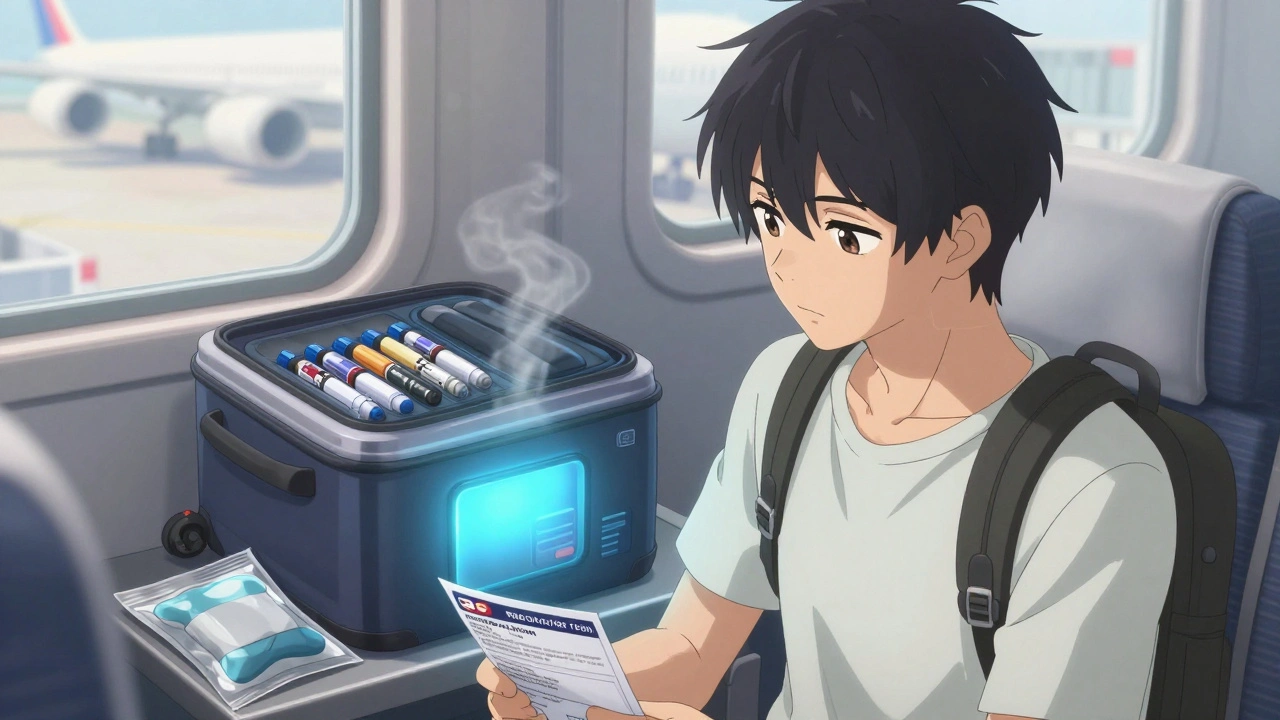
If your medication needs to stay cool-like insulin or certain biologics-you can bring ice packs, gel packs, or insulated bags. There’s no size limit. You can even bring frozen gel packs as long as they’re not completely solid when you get to security. If they’re frozen solid, TSA may ask you to thaw them for inspection. To avoid delays, let them partially melt before you leave home.
Never put your medication in checked luggage. Temperatures in the cargo hold can drop below freezing or rise above 86°F (30°C), which can ruin insulin and other sensitive drugs. Always keep injectables in your carry-on. If you’re worried about power outages or long layovers, pack an extra ice pack and a small cooler bag. Some travelers use portable cooling wallets designed for insulin-they’re battery-powered and last 8-12 hours.
Documentation: Do You Need It?
TSA doesn’t require a doctor’s note to carry injectables or syringes. But having one can save you time. A short note from your doctor-on letterhead, signed, and dated-stating that you require these items for medical treatment can help if an officer is unsure. It’s not mandatory, but it’s a smart backup.
Also, make sure your name on the medication label matches your ID. If your passport says “Jennifer Lee” but your insulin bottle says “J. Lee,” you might get questioned. Use the full name on your government-issued ID. If you’ve changed your name recently, bring a copy of your marriage certificate or legal name change document.
TSA offers a free Notification Card you can print and carry. It’s a one-page sheet that explains your medical needs in plain language. Over 29% fewer miscommunication incidents happen when travelers use it, according to TSA’s 2022 report. Print one, fold it, and keep it with your meds.
International Travel: Know the Rules
Domestic U.S. flights follow TSA rules. International flights? That’s different. Each country has its own laws. Japan requires a special permit for more than 10 syringes. Canada allows syringes but demands a prescription in English or French. The UK accepts them without paperwork, but you must declare them at customs. Australia allows injectables but requires a letter from your doctor if the medication is controlled.
Check your destination’s health ministry website or contact their embassy 30-60 days before you fly. Don’t wait until you’re at the airport. Some countries ban certain medications entirely-even if they’re legal in the U.S. For example, some ADHD medications or painkillers are classified as narcotics abroad. A quick search like “Australia import rules for insulin” will give you official info.
What Happens at Security
When you get to the checkpoint, say clearly: “I have medically necessary injectables and sharps.” Hand them over before you put your bag on the belt. Don’t wait to be asked. TSA officers are trained to handle medical items, but they’re busy. Being proactive cuts your wait time in half.
You might get a pat-down or a swab test for residue. That’s normal. Don’t argue. If you’re uncomfortable with X-ray machines for your insulin, you can request a visual inspection. TSA must accommodate that request. They’ll open the container and check it by hand. You can stay with your items the whole time.
PreCheck members often report faster screening for medical supplies. If you’re eligible, sign up. It’s not a guarantee, but it helps. In 2022, United Airlines introduced a dedicated medical screening lane at 12 major hubs. It reduced wait times by 37%. Ask if your airport offers it.
Real Stories: What Works
A traveler from Chicago told Reddit she flew to Bali with 12 insulin pens, 30 syringes, and two gel packs. She used a TSA Notification Card and kept everything in a clear zip-top bag with labels facing out. She was waved through in under 3 minutes.
Another person from Florida had his insulin ruined during a 14-hour layover in Dubai because he packed it in checked luggage. He ended up buying a new vial at the airport pharmacy-$120 out of pocket. He now always carries at least two extra days’ supply in his carry-on.
A survey of 2,145 travelers by TripAdvisor found that 82% who used proper sharps containers had no issues. Only 47% of those who used random containers made it through without delays.
What to Avoid
- Don’t wrap needles in tape or hide them in socks. That looks suspicious.
- Don’t bring syringes without medication. Even if you think you’ll need them later, don’t risk it.
- Don’t rely on airline staff to know the rules. They’re not trained to handle medical screening.
- Don’t assume all countries are the same. Always check local laws.
- Don’t forget to bring extra supplies. Flights get delayed. Baggage gets lost. Always pack at least 20% more than you think you’ll need.
Final Checklist
- ✅ All medications in original or clearly labeled containers with your name
- ✅ Syringes stored with their matching medication
- ✅ Used sharps in an FDA-approved, biohazard-labeled container
- ✅ Ice packs thawed or partially melted
- ✅ TSA Notification Card printed and ready
- ✅ Doctor’s note (recommended, not required)
- ✅ ID matching medication labels
- ✅ Extra supplies for delays or lost luggage
- ✅ Destination country’s rules checked and printed
Traveling with injectables isn’t about jumping through hoops. It’s about being prepared. Do the basics right, and you’ll breeze through security. Skip the steps, and you’ll waste hours. Your health matters more than your suitcase. Make sure it never gets left behind.
Can I bring insulin on a plane without a prescription?
Yes. The TSA allows insulin and other injectable medications without requiring a prescription or doctor’s note. However, the medication must be for personal use, and it’s strongly recommended to keep it in its original labeled container with your name on it. A doctor’s note isn’t mandatory but can help avoid delays if an officer has questions.
Do syringes need to be in a special container?
Used syringes must be stored in a sharps container that’s puncture-resistant and labeled with the biohazard symbol. TSA requires this for safety. Unused syringes can be carried loose with their matching medication, but it’s still safer to keep them in a small container. Never use a soda bottle, pill bottle, or coffee cup-they’re not approved and may cause delays.
Can I pack my insulin in checked luggage?
Never. Checked baggage can be exposed to extreme temperatures, which can destroy insulin and other temperature-sensitive medications. Always carry injectables in your carry-on bag. If you’re worried about theft or loss, keep them in a secure, labeled case inside your carry-on. Airlines and TSA don’t guarantee the safety of medical supplies in checked bags.
What if I’m flying internationally?
Rules vary by country. Some, like Japan and Australia, require a doctor’s letter or special permit for syringes or certain medications. Others, like the UK and Canada, are more lenient but still require you to declare your supplies. Always check the destination country’s health or customs website at least 30 days before your trip. Don’t assume U.S. rules apply overseas.
Can I bring ice packs for my insulin?
Yes. There’s no size limit for ice packs or gel packs used for medical supplies. But if they’re completely frozen solid, TSA may ask you to let them thaw a bit for inspection. Partially melted packs are easier to screen. Keep them in a sealed bag to avoid leaks, and declare them at the checkpoint along with your medication.
Will TSA X-ray my insulin?
TSA may X-ray your insulin, but you can request a visual inspection instead. Insulin and other biologics are not damaged by X-rays, but some travelers prefer to avoid it. Simply tell the officer, “I’d like a visual inspection for my medication.” They’re required to accommodate that request. You can stay with your items during the inspection.
What if I have an insulin pump?
You can wear your insulin pump through security. Don’t remove it. TSA officers will not ask you to take it off. You can request a pat-down instead of a body scanner if you prefer. Bring a manufacturer’s card or doctor’s note explaining the device if you want to avoid questions. Most travelers with pumps report smooth screening, especially if they declare it upfront.
Can I bring sharps containers on international flights?
Yes, as long as the container meets IATA and FDA standards and has the biohazard symbol. Most countries accept them in carry-on luggage. Some, like Japan, may ask for proof that the container is for personal medical use. Always keep your sharps container in your carry-on. Never check it. If you’re unsure, call the airline or embassy ahead of time.





zac grant
Just flew with my insulin pump and 4 pens last month-TSA agent actually thanked me for having the notification card. Pro tip: put everything in a clear ziplock with labels facing out. Makes their job easier and yours too. No drama, no delays. Seriously, do this and you’re golden.
Heidi Thomas
Why are people still asking if they can bring insulin on a plane like it’s 2015? The rules are posted on TSA’s website in bold letters. If you can’t read a government page, maybe don’t fly.
Jordan Wall
Oh darling, I simply *adore* how the TSA’s 2022 report cites that 29% reduction with the Notification Card-such a *fascinating* data point, isn’t it? I mean, really, the *epistemological* implications of bureaucratic efficiency in post-pandemic mobility are *chef’s kiss*. Also, I used a biodegradable sharps container from Berlin. It had a tiny 🌱 emoji. Very sustainable. 😌
Isabelle Bujold
For anyone traveling with temperature-sensitive meds, I can’t stress enough how important it is to use a cooling wallet with a built-in temperature logger. I’ve been using the SootheCase Pro for two years now-it’s battery-powered, holds charge for 10 hours, and even sends alerts to your phone if temps go outside the 2–8°C range. I’ve flown to Vancouver, Tokyo, and London with zero spoilage. Don’t just rely on ice packs-they’re unreliable if you’re stuck on a tarmac for 4 hours. Also, always pack an extra vial in a separate bag. Just in case.
John Filby
Anyone else use those little clear plastic cases with compartments for pens and syringes? I got mine from CVS and they’re like $8. Keeps everything organized and you can see what’s inside without opening it. Also, I always print the TSA card and stick it to the front with a rubber band. Works like a charm. 👍
Elizabeth Crutchfield
i used to put my needles in a lip gloss tube until i saw a vid of someone getting pulled aside for 20 mins. now i use a real sharps container and i dont even think twice. peace of mind is worth it.
Ashley Elliott
Just a gentle reminder that not everyone has access to FDA-approved sharps containers-some folks are on fixed incomes or live in rural areas without pharmacies nearby. If you’ve got extras, consider donating them to local diabetes support groups. And if you’re at the airport and see someone looking stressed about their meds? A simple ‘you got this’ goes a long way. We’re all just trying to get somewhere safely.
Augusta Barlow
Let’s be real-TSA is just a front for the pharmaceutical lobby. Why do they care so much about sharps containers? Because they don’t want you to know insulin costs $15 in Canada and $300 here. And why do they push the ‘notification card’? So you think you’re being helpful when you’re just feeding their surveillance infrastructure. I don’t carry anything labeled with my name. I use unlabeled vials and just say ‘vitamins.’ They don’t test for insulin. They test for compliance. And compliance is a business model.
Joe Lam
Wow. Another one of these ‘how to not get arrested while carrying medicine’ guides. Pathetic. You’re not a child. You’re an adult. If you can’t figure out that needles go in a box and insulin doesn’t go in checked luggage, maybe you shouldn’t be traveling alone. This post is a waste of bandwidth.
Jenny Rogers
While the logistical guidance herein is, on the surface, commendable, it fundamentally fails to interrogate the neoliberal medical-industrial complex that necessitates such elaborate travel protocols in the first place. One is left to ponder: why must personal health be subject to the whims of bureaucratic gatekeepers? The very existence of the Notification Card is a symptom of a system that commodifies bodily autonomy. I shall not be complicit.
Scott van Haastrecht
My sister got detained for 90 minutes because she had a syringe in her purse. TSA called the police. She had insulin. She was crying. They made her open her bag in front of 20 people. This isn’t ‘guidance.’ This is trauma dressed up as policy. And now you want me to ‘print a card’? No. I’m not playing along.
Chase Brittingham
Hey, I just want to say thank you for this. I’ve got type 1 and I used to dread flying. This guide actually helped me feel like I wasn’t some weirdo carrying weird stuff. I brought my pump through last week and the agent just nodded and said ‘good to go.’ Felt like a human for once. Really appreciate the detail on the cooling wallets too. I’m getting one now.
Ollie Newland
For international travel, I always check the destination country’s medicines portal. The UK’s MHRA site is surprisingly user-friendly. And yes, the biohazard symbol matters-got flagged in Frankfurt because mine was printed on paper, not embossed. Turned out to be a 20-minute delay, but now I buy the pre-certified ones from Medisafe Supplies. Worth the extra £5. Also, never, ever try to hide a syringe in a toothpaste tube. Someone tried that in Heathrow. It didn’t end well.