
Imagine you are a nurse in a busy emergency department. It is 3 AM, the lights are dim, and you have just received an order for prednisone. You reach for the vial, but your hand freezes. On the shelf right next to it sits prednisolone. They look identical. They sound nearly identical. One mistake here could mean giving a patient a steroid that is too strong or not strong enough for their condition.
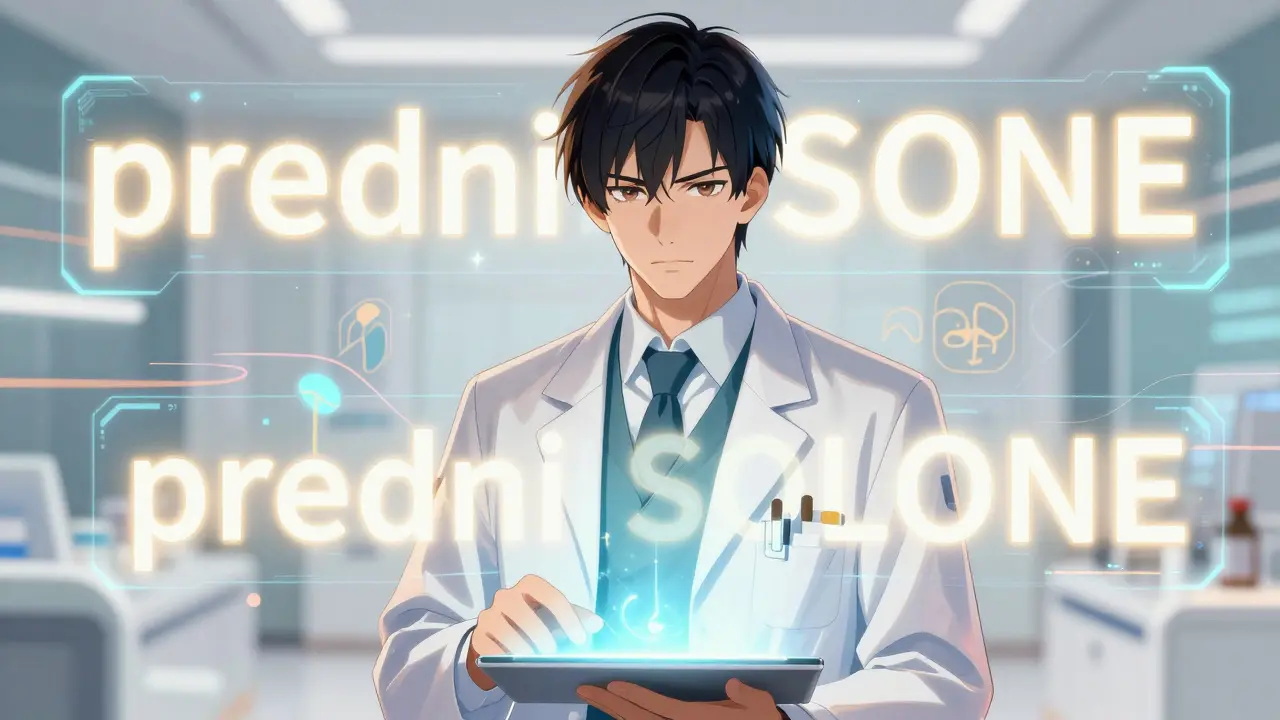
This is exactly why healthcare systems use tall-man lettering, a typographic technique that uses selective capitalization within drug names to differentiate look-alike, sound-alike medications. By writing "predniSONE" and "predniSOLONE," we create a visual break in the pattern of letters. This simple change forces your brain to stop skimming and start reading. It is one of the most effective, low-cost tools we have to prevent dispensing errors.
What Is Tall-Man Lettering?
Tall-man lettering is not just random capitalization. It is a specific safety protocol designed to highlight the parts of drug names that differ from each other. The term was coined by the Institute for Safe Medication Practices (ISMP) in 1999. Before this, hospitals struggled with a staggering statistic: approximately one medication error per 1,000 orders filled resulted directly from drug name confusion.
The concept is straightforward. Take two chemotherapy drugs: vinblastine and vincristine. In standard text, they blend together. With tall-man lettering, they become vinBLASTine and vinCRISTine. The capitalized letters jump out at you. Your eyes catch the difference before your fingers click the wrong button on the computer screen.
This technique addresses what experts call LASA drugs, Look-Alike Sound-Alike medications that pose a high risk for selection errors due to similar spelling or pronunciation. These drugs are everywhere in medicine, from antibiotics to heart medications. Without a visual cue, human error is almost inevitable under pressure.
Why Do We Need It? The Risk of LASA Drugs
You might think, "I know my drugs. I won't mix them up." But research shows us otherwise. A 2004 eye-tracking study conducted by ISMP revealed that healthcare providers made 35% fewer selection errors when presented with tall-man lettering compared to standard lowercase names. That is a massive improvement in a field where seconds count.
The problem isn't just ignorance; it's cognitive overload. When you are tired, stressed, or interrupted, your brain relies on pattern recognition. If two words share the same starting letters and length, your brain assumes they are the same until proven otherwise. Tall-man lettering breaks that pattern. It acts as a forced pause.
Consider CISplatin and CARBOplatin. Both are platinum-based chemotherapy agents. Both end in "-platin." If you rush, you might grab the wrong one. The dosage and side effects differ significantly. By capitalizing the unique prefixes, we reduce the chance of a catastrophic mix-up.
Key Lists and Regulatory Guidelines
You cannot just make up your own capitalization rules. Consistency is critical. If one hospital writes "ALPRAZolam" and another writes "alprAZOlAm," you create more confusion than you solve. That is why major health organizations maintain official lists.
| Organization | List Size (Approx.) | Update Frequency | Primary Focus |
|---|---|---|---|
| FDA | 72 pairs | Quarterly | Postmarket safety data |
| ISMP | 252 pairs | Quarterly | Clinical practice safety |
| Australian Commission | 192 pairs | Annual/As needed | National mixed-case standards |
The U.S. Food and Drug Administration (FDA) launched its Name Differentiation Project in 2001. Their list focuses on drugs where postmarketing reports showed significant confusion. The Institute for Safe Medication Practices (ISMP) maintains a broader list, updated quarterly, which many hospitals prefer because it covers more edge cases.
In Australia, the National Mixed-Case Lettering List serves the same purpose. As of its 2022 revision, it included 192 drug name pairs. Whether you are in Adelaide, New York, or London, sticking to these established lists ensures that every clinician sees the same visual cues.
How to Implement Tall-Man Lettering Correctly
Implementing this system is not just about changing a font setting. It requires a structured approach across all your digital systems. Here is how to do it right:
- Form a Working Group: Gather pharmacists, IT specialists, and clinical staff. You need input from those who prescribe, dispense, and administer drugs.
- Select Your Source List: Decide whether to follow FDA, ISMP, or your national equivalent. Do not mix and match arbitrarily.
- Audit Your Systems: Identify every place drug names appear. This includes Electronic Health Records (EHR), Computerized Provider Order Entry (CPOE), automated dispensing cabinets (like Pyxis or Omnicell), and prescription labels.
- Apply Consistently: Update all systems simultaneously. If your EHR shows "FLUoxetine" but your dispensing machine shows "fluoxetine," you defeat the purpose.
- Train Staff: Educate your team on why the capitalization exists. Explain that it is a safety feature, not a stylistic choice.
- Monitor Results: Track near-misses and errors related to LASA drugs before and after implementation.
A 2022 study published in Pharmacology Research & Perspectives documented this process in detail. They found that updating 13 different information systems took an average of 16.3 weeks for a large hospital. It is a significant IT project, but the payoff in safety is worth it.
Common Pitfalls and Challenges
Tall-man lettering is powerful, but it is not magic. It has limitations, and if implemented poorly, it can cause problems.
Inconsistent Application: This is the biggest issue. Many organizations update their internal hospital systems but fail to ensure that community pharmacies or external labs use the same format. A pharmacist named David Kim reported in a survey that his hospital used "PARoxetine" while the community pharmacy used a different pattern. This inconsistency creates cognitive dissonance for clinicians who work in multiple settings.
Font Readability: Not all fonts handle tall-man lettering well. Some electronic health record interfaces use small, thin fonts where the capitalized letters do not stand out enough. Ensure your IT department tests the visibility of the capitalization on all devices, including handheld scanners and mobile tablets.
False Sense of Security: Dr. Michael Cohen, President of ISMP, warns that tall-man lettering is "not a panacea." It should be one layer in a defense-in-depth strategy. You still need barcode scanning, independent double-checks for high-risk meds, and robust alert systems. Relying solely on capitalization is dangerous.
Similar Starting Syllables: Tall-man lettering works best when the difference is in the middle or end of the word. For drugs like "metoprolol" and "methyldopa," where the first syllable is similar, capitalization helps less because our eyes read left-to-right. In these cases, grouping drugs differently on shelves or using separate order sets may be more effective.
Real-World Examples of High-Risk Pairs
To see this in action, let’s look at some common LASA pairs that frequently cause errors:
- HYDROmorphone vs. morphINE: One is a potent opioid agonist; the other is also an opioid but with different potency profiles. Confusing them can lead to respiratory depression or inadequate pain control.
- ALPRAZolam vs. LORazepam: Both are benzodiazepines used for anxiety, but they have different half-lives and dosing schedules. Mixing them up can affect a patient’s sedation level unpredictably.
- WARFARin vs. warfarIN: Wait, that’s the same drug. Let’s try WARFARin vs. Heparin. While not always formatted with tall-man lettering against each other, anticoagulants require extreme vigilance. Often, CISapride and CisPLATin are the classic example here.
- PROPAthiOramide vs. PROCAinamide: One treats seizures/migraines; the other treats arrhythmias. A swap here could be fatal.
Notice how the capitalization highlights the unique part of the name. When you see "PROPathioramide," your brain registers the "athio" cluster. When you see "PROCainamide," it registers "ain." These visual anchors save lives.
The Future of Medication Safety Technology
We are moving toward a more integrated future. The global medication safety technology market is projected to reach $7.24 billion by 2028. Tall-man lettering remains a cornerstone of this growth, but it is evolving.
Artificial Intelligence is beginning to play a role. Epic Systems piloted an AI-enhanced system in 2023 that dynamically adjusts capitalization based on real-time error data. If a specific hospital notices frequent mix-ups between two drugs, the AI can emphasize the differentiation even more aggressively for that location.
However, experts like those at the Agency for Healthcare Research and Quality (AHRQ) note that while voice recognition and barcode scanning will improve, tall-man lettering will remain relevant through 2030. Why? Because humans still read screens. Even in highly automated systems, a visual safeguard provides a final check before a dose is administered.
The Joint Commission’s National Patient Safety Goal NPSG.01.01.01 mandates the differentiation of look-alike drug names. This regulatory requirement ensures that tall-man lettering stays top-of-mind for accreditation and compliance teams.
Conclusion: A Simple Tool with Big Impact
Tall-man lettering is a small change with a huge impact. It costs very little to implement-averaging AU$1,200 per hospital system according to Australian data-but it saves countless patients from harm. It respects the limits of human attention and works with our biology rather than against it.
If you are involved in medication management, audit your systems today. Are you using consistent tall-man lettering? Are you following the latest ISMP or FDA lists? Don’t wait for an error to happen. Make the difference visible now.
What is the primary purpose of tall-man lettering?
The primary purpose of tall-man lettering is to visually differentiate Look-Alike Sound-Alike (LASA) drug names to prevent medication selection errors during prescribing, dispensing, and administration.
Which organization maintains the most comprehensive list of tall-man lettering recommendations?
The Institute for Safe Medication Practices (ISMP) maintains a widely used list containing over 250 drug name pairs, updated quarterly. The FDA also provides a list, though it is smaller, focusing on drugs with significant postmarket safety issues.
Does tall-man lettering eliminate all medication errors?
No. Tall-man lettering reduces selection errors for look-alike drugs but does not address other types of errors like dosing mistakes or route errors. It should be used alongside other safety measures like barcode scanning and double-checks.
Is tall-man lettering required by law?
While not always a federal law, it is strongly mandated by accrediting bodies like The Joint Commission in the U.S. and recommended by health authorities in countries like Australia and the UK as a best practice for patient safety.
How long does it take to implement tall-man lettering in a hospital system?
Implementation varies by size and complexity, but studies suggest an average of 16 weeks for a large hospital to update all relevant information systems, including EHRs and dispensing cabinets.
What are some examples of high-risk LASA drug pairs?
Common high-risk pairs include predniSONE/predniSOLONE, vinBLASTine/vinCRISTine, HYDROmorphone/morphINE, and ALPRAZolam/LORazepam.








Mollie Louise
Oh my gosh, this is such an incredibly important topic and I am so glad we are talking about it because honestly, patient safety should be the absolute number one priority in every single healthcare setting everywhere! 🌟 I have worked in a busy ER for over ten years now and I can tell you from personal experience that those late night shifts are absolutely brutal on your brain when you are trying to stay focused while also dealing with constant interruptions and noise. It is wild to think that something as simple as changing the capitalization of a few letters can actually save lives by forcing our eyes to slow down and really process what we are looking at instead of just skimming past similar words. I always try to keep my team motivated by reminding them that these small details matter so much more than they might realize at first glance, and using tall-man lettering is just one of those brilliant examples of how design can directly impact human cognition and error reduction. We need to keep pushing for better systems and training because every single person deserves to feel safe when they are receiving care, and that starts with us being hyper-aware of these potential pitfalls in our daily routines. Let's keep supporting each other and sharing these kinds of insights because collaboration is key to making our workplaces safer for everyone involved! 💪✨
Anthony Red
Hey folks, just wanted to chime in here since I see a lot of people working in healthcare or interested in med safety. I'm a pharmacist myself and yeah, tall-man lettering is pretty standard stuff now but it's crazy how many places still mess it up. I remember early in my career we had a whole audit where half our labels were inconsistent and it was a nightmare to fix. The key is definitely consistency across all systems like the post says. If your EHR says one thing and the pyxis machine says another, you're gonna get confused no matter how smart you are. Just keep it chill and double check everything though, technology ain't perfect.
Christina Moran
this is soo interesting!! i never knew there was a specific term for this like tall-man lettering lol. i work in a clinic and sometimes i see weird caps on meds but didnt know why. its kinda cool how it helps prevent mistakes. do u guys use it all the time? i feel like i would mix up drugs if i wasnt careful anyway. thanks for sharing this info!
Danny S
The real issue isn't the font, it's the corporate greed driving cost-cutting measures that lead to understaffing and fatigue. They want you to read faster so they can cut hours. Tall-man lettering is a band-aid on a bullet hole. The FDA and ISMP are in bed with pharma companies who profit from confusion and litigation avoidance. Don't believe the hype. They want you dependent on their 'safety protocols' while ignoring the root cause: systemic exploitation of healthcare workers. 🚫👁️
Kris Wong
LMAO oh wow, look at this conspiracy theory unfolding right here 😂. Danny S thinks the government is out to get us with fonts? Bro, the only thing they're greedy for is not getting sued into oblivion. You think pharma companies care about your 'systemic exploitation'? They care about margins. But hey, keep dreaming that the alphabet is a psy-op. Meanwhile, actual nurses are saving lives because they can tell the difference between predniSONE and predniSOLONE without having a stroke. Stay woke, buddy. 🙄💊
Jeremiah Cassandra
Bloody hell, some of you are taking this way too seriously. It's just capital letters, not a secret code from the Illuminati. Look, I'm a clinical pharmacologist in the UK and yes, we use mixed-case lettering extensively here too. The Australian list mentioned is actually quite robust. However, let me tell you, nothing beats a good old-fashioned barcode scan. If you rely solely on your eyes, you're already halfway to a lawsuit. Tall-man lettering is a nice visual cue, sure, but don't pretend it replaces proper verification processes. And please, stop blaming 'corporate greed' for everything; sometimes people just make stupid mistakes because they're tired. 😅
charles robert
In the grand tapestry of existence, the capitalization of a syllable becomes a metaphor for the fragility of human perception. We construct elaborate systems of meaning, yet a single shift in case can unravel the very fabric of safety. Is it truly the letters that deceive us, or is it the illusion of control we place upon them? The mind seeks patterns, and in its desperation for order, it creates chaos. Tall-man lettering is merely a scaffold for our failing cognitive architecture, a temporary bridge over the abyss of error. We must contemplate not just the drug, but the self that administers it. 🌌💭
Warren Brewer
Yeah, it's pretty simple stuff really. You just need to make sure the parts that are different stand out. I teach new techs how to check meds and I tell them to look for the big letters. It helps a lot. Don't overthink it. Just follow the rules and check twice. That's all there is to it.
Kathryn Byrd
I find the statistical data presented in the article quite compelling, particularly the reference to the 2004 eye-tracking study which demonstrated a significant reduction in selection errors. It is interesting to note the disparity between the FDA's list and the ISMP's list, with the latter being substantially larger. This suggests that regulatory bodies may be lagging behind practical clinical needs. Consistency remains the most critical factor, as highlighted by the anecdote regarding David Kim's experience with inconsistent formatting across different settings. One must consider the broader implications for international standards and interoperability of health information systems.
Javier Arauz
This is typical American inefficiency. Why do we need special fonts when other countries just train their staff properly? Our system is broken because we rely on gimmicks instead of discipline. The Joint Commission mandates this crap because they can't trust anyone to do their job right. It's embarrassing. We should focus on merit and hard work, not fancy lettering tricks. Fix the culture, not the font.