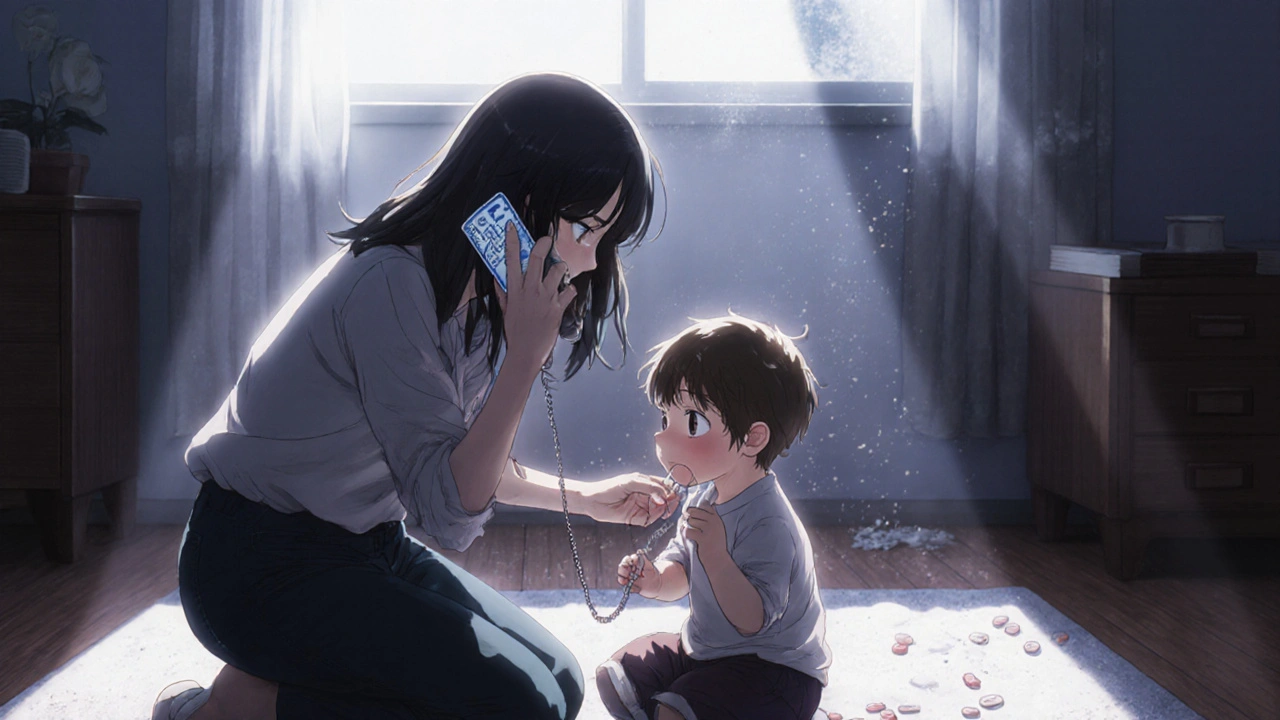
If your child swallows the wrong medication, time is everything. Every second counts. You won’t have time to panic, search online, or wait to see if they "seem fine." The right actions in the first few minutes can mean the difference between a quick recovery and a life-threatening emergency. This isn’t theoretical. In the U.S., over 60,000 children under 5 end up in emergency rooms every year because of accidental medication ingestion. In Australia, it’s just as common. Most of these cases involve painkillers, cold medicine, or even a single pill from a parent’s pillbox. But here’s the truth: you don’t need to be a doctor to handle this. You just need to know what to do-and what not to do.
Step 1: Call Poison Control Immediately
Do not wait. Do not call your pediatrician first. Do not Google symptoms. Pick up the phone and call 13 11 26-Australia’s Poison Information Centre. This number is free, available 24/7, and staffed by toxicology experts who know exactly what to do. They’ll ask you for the name of the medication, how much was swallowed, when it happened, and your child’s age and weight. Write this down ahead of time. Keep a list of all medications in your home near the phone. You’ll thank yourself later.
Don’t assume it’s "just a small amount." A single 10 mg amlodipine tablet (a blood pressure pill) can send a toddler into cardiac arrest. A few chewable antihistamines can cause extreme drowsiness, seizures, or even breathing problems. Poison Control doesn’t guess. They use real-time data to give you precise instructions. In fact, families who call Poison Control right away are 43% less likely to end up in the hospital.
Step 2: Remove Any Remaining Medication from Their Mouth
While you’re on the phone with Poison Control, quickly check your child’s mouth. Use your fingers to gently remove any pills, liquid, or patches. Don’t force it. Don’t stick your finger deep down their throat. Just clear what’s visible. If it’s a medicated patch-like fentanyl or nicotine-check their skin, gums, and even the roof of their mouth. Patches can stick to soft tissues and keep releasing poison for hours.
Do NOT try to make them vomit. Not ever. Not even if the label says "in case of overdose." Syrup of ipecac has been banned from home first aid kits since 2004. It doesn’t work well, and it can cause more harm. Vomiting increases the risk of choking or inhaling the substance into the lungs, which can lead to pneumonia. It also makes it harder for doctors to treat them later. Poison Control will tell you if anything needs to be removed-never do it yourself unless they say so.
Step 3: Watch for These Warning Signs
Some reactions happen fast. Others take hours. Either way, you need to know what to look for. Call 000 immediately if your child shows any of these:
- Difficulty breathing or stopped breathing
- Loss of consciousness or extreme drowsiness
- Seizures or uncontrolled shaking
- Pupils that are unusually large or tiny
- Blue lips or fingernails
- Heartbeat that’s too slow (under 50 beats per minute) or too fast
Other red flags include excessive drooling, persistent vomiting, extreme lethargy lasting more than 20 minutes, or sudden confusion. Even if your child seems okay, don’t assume they’re safe. Acetaminophen (paracetamol) overdoses can look harmless at first-but liver damage starts within hours. Sugar-free cough syrups with xylitol can crash blood sugar in minutes. The body doesn’t always show signs right away.
Step 4: Don’t Give Anything Unless Told To
Don’t give water. Don’t give milk. Don’t give activated charcoal from the pharmacy. Don’t give anything unless Poison Control tells you to. Some substances react badly with liquids. Others need to be flushed out in a hospital with IV fluids. Giving the wrong thing can make things worse. Even if you think you’re helping, you might be blocking the treatment doctors need to give later.
One parent I spoke to gave her 3-year-old water after she swallowed a handful of children’s ibuprofen. The child threw up-and aspirated. She ended up in ICU for three days. The poison specialist later said: "Water was the wrong call. We would have given them nothing until we knew the exact drug."
Step 5: Bring the Medication Container
When you go to the hospital-or even if you’re just waiting for Poison Control to tell you what to do-bring the bottle. Don’t rely on memory. Don’t say "it was blue pills." Show them the label. The active ingredients, dosage, expiration date, and even the manufacturer’s contact info matter. Hospitals need this to choose the right antidote.
Some medications need specific treatments:
- Opioids (like codeine or oxycodone): Naloxone can reverse the effects. It’s given as a nasal spray or injection.
- Sulfonylureas (diabetes pills): These can cause dangerous low blood sugar. Doctors will monitor glucose every 30 minutes and give glucose IV if needed.
- Tricyclic antidepressants: These can cause heart rhythm problems. Sodium bicarbonate is often used to stabilize them.
- Iron supplements: These can burn the gut and cause shock. Doctors use a special chelating agent called deferoxamine.
You won’t know which one it is. But the hospital will. Your job is to get the container there as fast as possible.
Step 6: Stay Calm and Follow Instructions
It’s normal to feel terrified. Your heart is racing. Your hands are shaking. But your child is watching you. If you panic, they panic. Take a breath. Breathe with them. Speak slowly. Say, "I’ve got you. We’re going to fix this." Poison Control will tell you whether to wait at home or go to the ER. Some cases can be managed safely at home with close monitoring. Others need immediate transport. Trust their judgment. They’ve seen thousands of these cases. They know the difference between "watch and wait" and "go now."
What Happens in the Hospital?
If you’re taken to the ER, your child will be monitored closely. Vital signs-heart rate, breathing, blood pressure, oxygen levels-will be checked every 15 minutes for the first hour. Blood tests will be done to check for drug levels and organ damage. An IV line will likely be started. If it’s been less than an hour since ingestion, they might give activated charcoal to soak up the remaining poison. But only if it’s safe to do so.
For some drugs, like heart medications or diabetes pills, they’ll keep your child under observation for at least 12 hours-even if they seem fine. That’s because some poisons have delayed effects. One study found that 18% of children who looked okay after 4 hours ended up needing treatment later.
Prevention: Stop It Before It Happens
Most of these emergencies are preventable. Here’s what works:
- Lock it up. Use childproof cabinets or locks on medicine drawers. Even if you think your child can’t open them, they can. A 2021 CDC study found homes with locked storage had 85% fewer incidents.
- Keep it in its original bottle. Never transfer pills to snack jars, makeup cases, or pill organizers. Kids are curious. They’ll eat anything that looks like candy.
- Use flow restrictors. All liquid medications sold in Australia now come with these small plastic inserts that limit how much can pour out. They reduce accidental doses by 58%.
- Get rid of old meds. Don’t store expired or unused drugs. Take them to your pharmacy for safe disposal. Don’t flush them. Don’t throw them in the trash.
- Teach your kids. Even toddlers can learn: "Medicine is not candy. Only grown-ups give medicine."
There are smart pill bottles now-like Hero Health-that beep if someone opens them, track doses, and even send alerts to your phone. They cost about $90 a month. Not everyone can afford them. But locking your meds in a high cabinet? That’s free. And it works.
Common Myths That Can Kill
Let’s clear up the dangerous lies:
- Myth: "I’ll make them throw up." Truth: It’s dangerous and rarely helps. Poison Control says: Don’t.
- Myth: "They’re fine-they’re sleeping." Truth: Sedatives can cause breathing to stop. Sleep isn’t safety.
- Myth: "It was just one pill." Truth: One pill can be enough. A single adult-strength painkiller can be deadly for a toddler.
- Myth: "I’ll wait to see if they get worse." Truth: Waiting is the biggest mistake. Call Poison Control now.
What should I do if my child swallows a pill but seems fine?
Call Poison Control at 13 11 26 immediately-even if they seem fine. Many dangerous medications don’t cause symptoms right away. Acetaminophen, for example, can cause liver damage 24 to 48 hours after ingestion. Waiting could cost your child their health. Poison Control will tell you whether to monitor at home or go to the hospital.
Can I use syrup of ipecac to make my child vomit?
No. Syrup of ipecac is no longer recommended for home use. It hasn’t been part of medical guidelines since 2004. It doesn’t reliably remove poison and can cause serious side effects like aspiration, seizures, or worsening symptoms. Always follow the instructions from Poison Control instead.
What if I don’t know what pill they swallowed?
Call Poison Control anyway. They can help you identify the pill based on color, shape, or markings. Bring the container or any remaining pills to the hospital. Even if you’re unsure, the experts can still guide you through the next steps. Don’t wait to find out what it was-act now.
How long should I monitor my child after a suspected ingestion?
At least 12 hours, even if they seem fine. Some medications, like heart drugs or diabetes pills, have delayed effects. Hospitals often keep children under observation for this reason. If Poison Control says you can go home, check on them every 15-30 minutes for signs of drowsiness, breathing changes, or vomiting. Don’t leave them alone.
Are child-resistant caps enough to prevent accidents?
No. Child-resistant caps are designed to slow kids down-not stop them. Many children can open them in under 30 seconds. The only reliable method is storing medications in a locked cabinet or container, out of sight and reach. Even then, keep them high up-not on a shelf they can climb to.
Final Thought: You’re Not Alone
This happens more than you think. A mother in Adelaide once called Poison Control because her 2-year-old swallowed a single aspirin. She was terrified. The specialist walked her through every step. The child was fine. She later said: "I thought I’d failed as a parent. But they said, ‘This is a common mistake. You did everything right by calling.’"
You’re not a bad parent for this happening. You’re a parent who cares enough to learn. And now, you know what to do. Keep the Poison Control number saved in your phone. Put it on the fridge. Tell your partner, your babysitter, your grandma. Because the next time someone’s child swallows the wrong thing-it might be yours. And when it is, you’ll be ready.




King Over
Just saved the Poison Control number in my phone. Been meaning to for years. Better late than never.
Nosipho Mbambo
Okay, but why is this even a thing? I mean, why do we have so many pills lying around? And why are they all shaped like candy? Someone’s not trying hard enough.
daniel lopez
Let me guess-this post was written by a parent who didn’t lock up their meds and now wants to feel better about it. Newsflash: if your kid gets into medicine, you’re already a terrible parent. No amount of ‘call Poison Control’ fixes that. You didn’t supervise. You didn’t secure. You didn’t care enough. And now you’re sharing a checklist like it’s some kind of parenting badge of honor. Sorry, but this isn’t a guide-it’s damage control with a pretty font.
And don’t even get me started on the ‘just one pill’ myth. That’s not a myth-that’s a death sentence waiting to happen because you thought your kid was ‘too smart’ to eat pills. Wake up. Kids are curious. They’re not little philosophers. They’re tiny explorers with zero sense of danger. You think your lockbox is enough? Ha. I’ve seen toddlers open childproof caps faster than their parents can say ‘oh no.’
And why are we still using ‘child-resistant’ as a marketing term? It’s a lie. It’s not resistance-it’s delay. A 3-year-old with determination and a butter knife can get into anything. The only thing that works is a locked cabinet, bolted to the wall, with a code and a camera. And even then, you’re still gambling.
And what about the ‘don’t give water’ rule? That’s great, until your kid’s choking on a pill and you’re standing there paralyzed because you’re afraid to help. Do you know how many parents freeze in panic? They don’t call Poison Control-they call their mom, then their sister, then Google. And by then, it’s too late.
Also, why is this post so long? Did you really need 12 steps to say ‘call 13 11 26 and don’t let your kid near pills’? This feels like a corporate pamphlet written by someone who’s never held a crying toddler.
And the part about ‘you’re not a bad parent’? That’s the most toxic part. It lets people off the hook. You are a bad parent if you didn’t secure your meds. Period. No sugar-coating. No ‘we’ve all been there.’ We haven’t. We didn’t let our kids turn our medicine cabinet into a snack bar.
And don’t even get me started on those smart pill bottles. $90 a month? Are you kidding me? That’s a luxury. Most people can’t afford it. So you’re telling me the only safe way to parent is to buy tech? That’s not prevention-that’s capitalism pretending to care.
And the ‘teach your kids medicine isn’t candy’ thing? Cute. But your 2-year-old doesn’t care about your lesson. They care about the shiny thing that tastes like grape. You think a 2-year-old gives a damn about your ‘only grown-ups give medicine’ mantra? They don’t. They just want the thing that makes their mouth feel funny. You can’t teach safety to a toddler. You have to engineer it.
So yeah. Call Poison Control. But first? Lock it up. Like, really lock it up. Not ‘oh I put it on the top shelf.’ I mean, bolt it. Hide it. Make it harder than opening a safe. Because if you don’t, you’re not a good parent. You’re just lucky.
Katie Magnus
Ugh. Another ‘parenting guilt trip’ disguised as helpful advice. I’m supposed to feel bad because my kid once ate a gummy vitamin? Like, wow. So now I’m a monster because I didn’t install a biometric lock on my bathroom cabinet? This is why I don’t read parenting blogs. It’s all fearmongering with a side of ‘you’re doing it wrong.’
Also, why is everyone so obsessed with ‘Poison Control’? It’s not like they’re going to magically appear with a white coat and a magic wand. They’re just some guy on the phone who says ‘don’t vomit.’ I’ve done that before. It’s not rocket science.
And why are we treating every pill like it’s nuclear material? My grandma took a whole bottle of aspirin in the 70s and lived to tell the story. Kids are tougher than you think.
Johannah Lavin
Thank you for this. 💙 I just had a panic moment last week when my 2-year-old grabbed a random pill off the counter. I didn’t know what to do. I called Poison Control (13 11 26 saved in my phone now!) and they walked me through everything. We didn’t even have to go to the hospital. They’re angels. 🙏
Also-locked cabinet. Now. No excuses. I used to think ‘it’s just one drawer’… until it wasn’t. Now my meds are in a lockbox under the sink. My kid can’t even reach the drawer. And I tell him every night: ‘Medicine is not candy.’ He says ‘no candy’ and high-fives me. 😭❤️
Everyone reading this-save the number. Put it on your fridge. Tell your babysitter. Your grandma. Your neighbor. This could save a life. And it’s free. No app. No subscription. Just a phone call.
Ravinder Singh
Beautifully written. I’ve worked in rural clinics in India where parents bring their kids in after swallowing antihistamines from a candy jar. No one knew it was medicine. No one had a phone number. No one knew what to do.
So I printed this out. Laminated it. Put it up in the community center. Now every mom who comes in sees it. Some can’t read English, but they know the number. We’ve had three near-misses since. All because someone called before panicking.
Lock it. Save the number. Teach the kids. It’s not about fear. It’s about love in action.
And yes-no ipecac. Ever. I’ve seen kids aspirate because someone ‘thought they were helping.’ Don’t be that person.
Russ Bergeman
Why is this even a post? Everyone knows you don’t let kids near pills. This is like writing a guide on ‘what to do if your kid runs into traffic.’ DUH. Also, you say ‘don’t give water’ but then you say ‘bring the bottle’-so what, you want them to choke on the bottle? This is all common sense. Why are we making this a whole thing?
Dana Oralkhan
I just want to say thank you to the person who wrote this. I’m a single mom. I work two jobs. I don’t have time to be perfect. But I do have time to call 13 11 26. I’ve saved that number in my phone under ‘EMERGENCY’ with a red flag. I didn’t know it was free. I thought it was a hotline with charges. Thank you for making it clear.
Also-I locked my meds last week. It felt weird. Like I was admitting I was a bad parent. But now I feel safer. Not because I’m perfect. But because I’m trying.
Jeremy Samuel
mate, poison control is 13 11 26? nah mate, that’s the national helpline for mental health. poison control is 1800 818 872. you got it wrong. this whole post is useless now. i mean, imagine if someone actually called 13 11 26 thinking it was poison control and got a counsellor instead? lol. someone shoulda fact checked this.
Destiny Annamaria
OMG I JUST REALIZED I LEFT MY MOMP’S BLOOD PRESSURE PILLS ON THE KITCHEN COUNTER LAST WEEK. 😱 I’m so sorry I didn’t read this sooner. I’m locking everything tonight. I’m telling my sister. I’m telling my cousin. I’m telling my entire WhatsApp group. This is the most important thing I’ve read all year. Thank you. 🙏❤️
Ron and Gill Day
Wow. Another ‘parenting fear porn’ article. Do you know how many children die from choking on candy? Or falling off couches? Or getting hit by cars? But no-this is the crisis we’re all supposed to panic about. Because pills are the real danger? Please. This is just fear-mongering wrapped in a ‘you’re not alone’ bow. And the ‘don’t give water’ advice? That’s from a 1990s manual. Modern toxicology says hydration can help flush some toxins. You’re giving outdated info with a moralistic tone. This isn’t helpful. It’s manipulative.
Alyssa Torres
My sister’s 18-month-old swallowed a fentanyl patch. She didn’t know it was a patch. Thought it was a sticker. Called Poison Control. They said: ‘Don’t touch it. Don’t remove it. Don’t panic. We’re sending an ambulance.’
She didn’t move. She just held her baby and whispered, ‘I’ve got you.’
They got to the hospital in 12 minutes. The patch was removed. She’s fine now.
This post? It’s not just advice. It’s a lifeline.
Save the number. Lock the cabinet. Breathe. You’ve got this.
Summer Joy
Okay but what if the kid swallowed a pill and then threw up… and then you gave them water… and then they had a seizure… and then you called Poison Control… but they were on hold for 17 minutes… and then the hospital said ‘you should’ve called sooner’… and now your kid is in the ICU… and you’re sobbing in the hallway… and everyone’s looking at you like you’re a monster…
WHY DIDN’T YOU JUST LOCK THE PILLS?!?!?!
…I’m sorry. I’m just… I’m just… I’m still crying. I’m not okay. I’m not okay. I’m not okay.
Aruna Urban Planner
From a systems perspective, this post reflects a failure of pharmacovigilance infrastructure in domestic environments. The burden of prevention is disproportionately placed on caregivers rather than on regulatory enforcement or product design. The existence of child-resistant packaging, flow restrictors, and smart dispensers indicates that technological solutions exist-but their adoption remains voluntary and economically stratified.
The emotional framing of ‘you’re not a bad parent’ is psychologically necessary, but structurally insufficient. A true prevention strategy would mandate child-safe packaging for all non-prescription pharmaceuticals, subsidize smart lockboxes for low-income households, and integrate medication safety into early childhood education curricula.
Until then, we are treating symptoms, not causes.
daniel lopez
And now I’m reading the comments and people are crying about it? Good. Maybe now you’ll lock your meds. Maybe now you’ll stop pretending your kid is ‘too smart’ to eat a pill. Maybe now you’ll stop thinking ‘it won’t happen to me.’
It already did. And you’re still reading this instead of locking the cabinet.