Topical Steroid Risk Assessment
Assess Your Risk
This tool helps you understand your personal risk of skin atrophy based on your steroid treatment patterns.
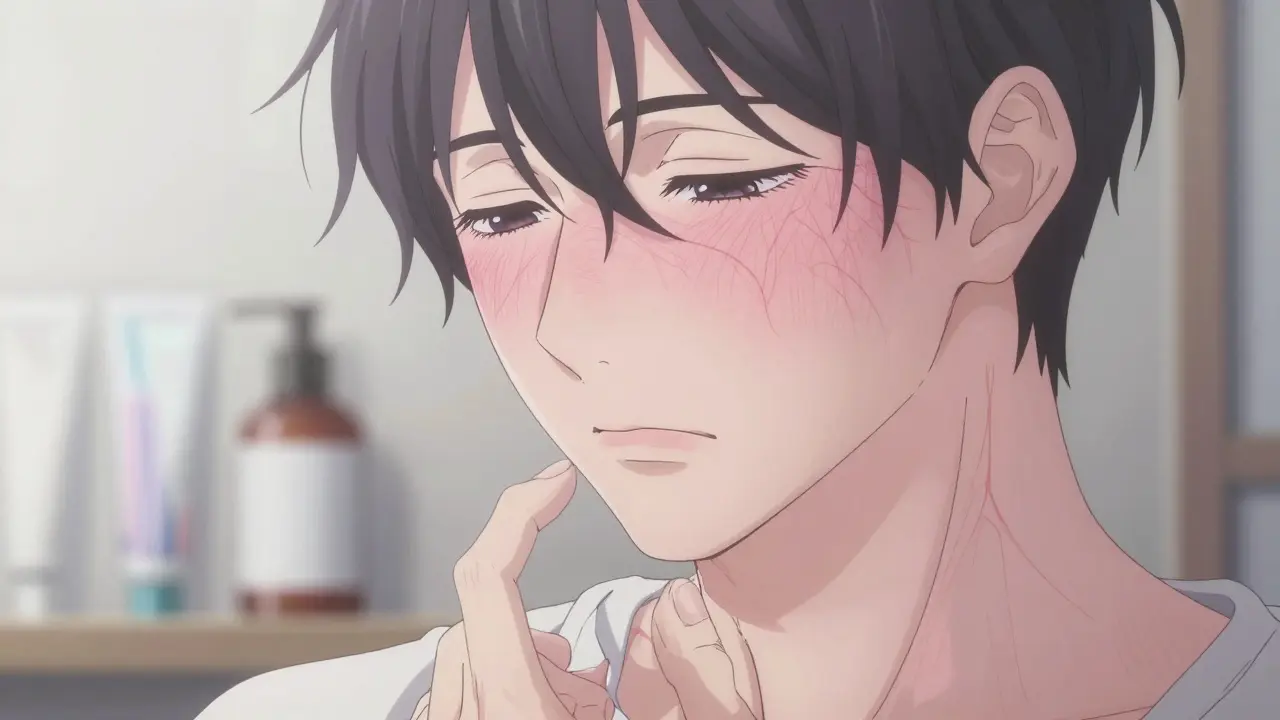
When your eczema flares up, a quick dab of steroid cream can feel like magic. The redness fades, the itching stops, and life gets back to normal. But what if that relief comes with a hidden cost? Over time, some people notice their skin getting thinner, tighter, or even shiny. Tiny red lines appear. Burning doesn’t go away-even after stopping the cream. This isn’t just a bad reaction. It’s skin atrophy-a real, measurable breakdown of your skin’s structure caused by too much or too strong topical corticosteroids.
How Steroids Thin Your Skin
Topical corticosteroids work by calming down your immune system. That’s why they’re so effective for eczema, psoriasis, and allergic rashes. But your skin isn’t just inflammation-it’s a living, layered barrier made of cells, proteins, and fats. Corticosteroids don’t just quiet the immune response. They shut down the very machinery that keeps your skin strong. They reduce collagen production. Collagen is the scaffolding that gives skin its thickness and bounce. When steroid use goes on too long, fibroblasts-the cells that make collagen-slow down. Procollagen genes get switched off. The result? Skin that looks normal on the surface but is literally crumbling underneath. Studies show this can happen in as little as three days with potent creams. At the same time, your skin’s natural oils-ceramides, cholesterol, fatty acids-are suppressed. These lipids form the protective seal between skin cells. Without them, water escapes. Your skin dries out. It cracks. It becomes more vulnerable to germs and irritants. That’s why people on long-term steroids often get infections: bacterial, fungal, even viral like herpes simplex. The barrier is gone. The defense is down.What Skin Atrophy Actually Looks Like
It’s not always obvious at first. You won’t wake up with a hole in your skin. But over weeks or months, subtle signs creep in:- Thinner, translucent skin-especially on the face, armpits, or groin
- Visible blood vessels (telangiectasia), like fine red spiderweb lines
- Stretch marks (striae) that don’t fade, even if you lose weight
- Easy bruising or purple patches (purpura) from minor bumps
- Acne-like bumps or rosacea-like redness around the mouth
- A feeling of tightness or burning that doesn’t match what you see
Who’s Most at Risk
Not everyone who uses steroid cream gets atrophy. But some people are far more vulnerable:- People using high-potency steroids (Class I-IV) for more than two weeks
- Those applying steroids to thin skin areas: face, neck, eyelids, genitals, armpits
- Children and older adults, whose skin is naturally thinner
- Anyone using large amounts-covering big areas or applying multiple times a day
- People who’ve used steroids for months or years without breaks
The Hidden Trap: Steroid Withdrawal
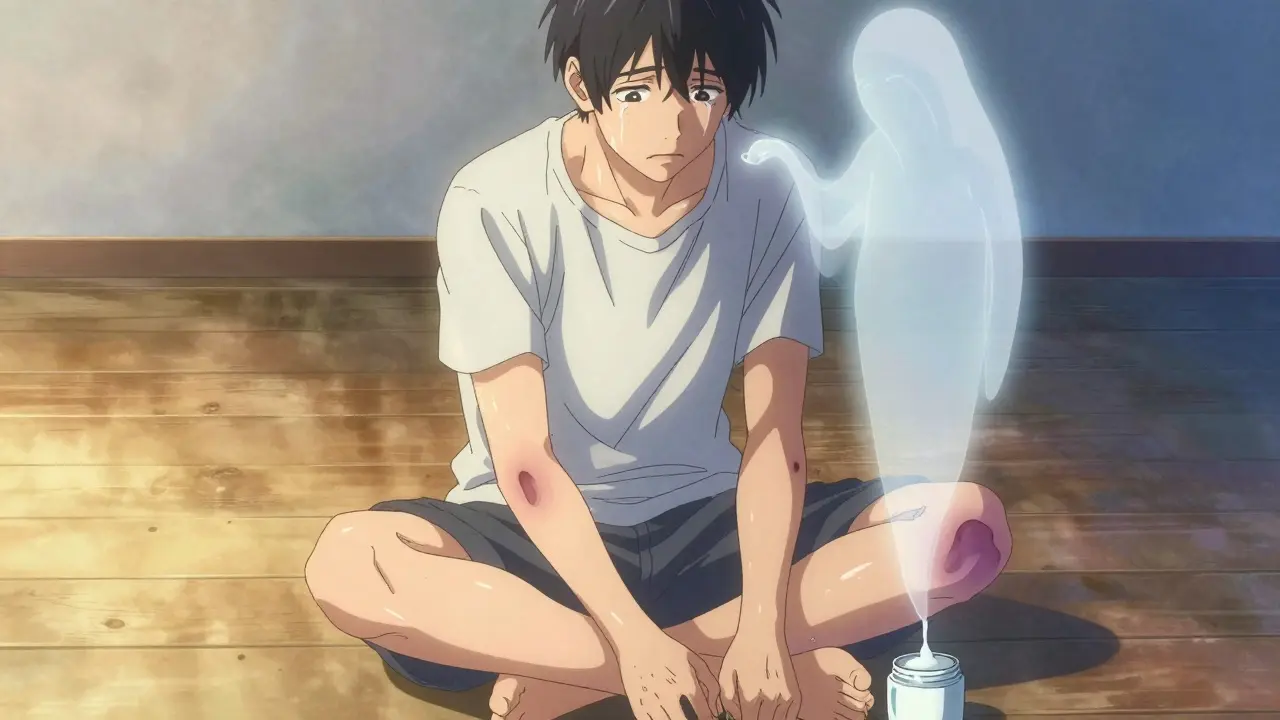
Stopping steroids suddenly after long-term use doesn’t just mean the rash comes back. It often gets worse. This is called Topical Steroid Withdrawal (TSW), or “red skin syndrome.” It starts with burning, stinging, or itching that feels way worse than the original rash. Then redness spreads. Skin flakes. Pimples appear. You might feel feverish or anxious. This isn’t an allergy. It’s your skin’s nervous system going haywire after being suppressed for too long. In a study of 127 patients, the withdrawal phase lasted weeks to months. The longer they’d used steroids, the longer recovery took. One Reddit community with over 4,300 members found that average recovery time was 8.2 months. Some took over two years. This isn’t rare. A 2021 meta-analysis of 8,342 patients found that 17% of long-term users developed skin atrophy. Another 7.2% got striae. Perioral dermatitis and acneiform eruptions were common too. These aren’t side effects. They’re predictable outcomes of misuse.How to Prevent It
The best way to avoid skin atrophy? Don’t let it happen in the first place.- Use the lowest potency steroid that works. Start with Class V or VI unless your doctor says otherwise.
- Apply only twice a day-never more.
- Limit use to 2-4 weeks on sensitive areas like the face. For body use, no more than 4-6 weeks without a break.
- Never use steroid cream on broken skin unless directed.
- Keep a log: write down what you used, how much, and for how long.
- Never buy steroid creams over the counter without knowing the strength.








Donna Peplinskie
I’ve been there-used a potent steroid for my eczema for six weeks straight because I was desperate, and then… my face just… changed.
It felt like my skin forgot how to be skin. Shiny, tight, burning even when I didn’t touch anything.
I didn’t realize it was atrophy until I saw a photo of myself from before and after.
It’s not just about the rash coming back-it’s like your skin remembers the trauma.
I started using ceramide creams, and honestly, it’s been the slowest healing I’ve ever done.
But I’m 14 months in, and the redness is fading. The spider veins? Still there, but less angry.
Don’t wait until you’re in full TSW to listen.
It’s not weakness to need help. It’s wisdom to ask for it before your skin breaks.
And yes, I cried a lot.
It’s okay to cry about your skin.
You’re not alone.
And no, you’re not crazy for feeling like your body betrayed you.
It didn’t-it was just misused.
Be gentle with yourself now.
Healing isn’t linear, but it’s possible.
Olukayode Oguntulu
Let’s deconstruct the hegemonic medical paradigm here.
Topical corticosteroids are not ‘drugs’-they’re biochemical instruments of colonial biopower, deployed by Big Pharma to pathologize natural dermal variability.
One must interrogate the epistemic violence embedded in the ‘atrophic’ label-it’s a construct designed to pathologize resistance to chemical homogenization.
Collagen? A neoliberal myth of youthful perfection.
The skin, in its raw, unregulated state, is a site of radical autonomy.
Why are we pathologizing resilience?
Perhaps the ‘burning’ isn’t damage-it’s awakening.
And the ‘spider veins’? Merely the capillaries screaming for liberation.
Stop medicating your epidermis.
Embrace the raw.
Let the skin be.
It’s not broken-it’s been colonized.
jaspreet sandhu
You people are overreacting.
My uncle used steroid cream for ten years and never had problems.
He lived to 89.
Doctors say use it as directed.
Don’t use too much.
Don’t use on face.
Simple.
But you read one article and think your skin is dying.
It’s not.
It’s just lazy skin.
Stop blaming the medicine.
Blame yourself for being weak.
My skin never burned.
Never thinned.
Because I didn’t use it like a drug.
I used it like a tool.
Same as hammer.
Not magic.
Tool.
Stop crying.
Go outside.
Touch grass.
Then come back.
Maybe your skin will grow up.
Alex Warden
Why is this even a thing in America?
Everyone’s on steroids for everything.
My cousin’s kid had a rash and the doctor gave him a steroid cream.
Three months later, the kid’s face looked like a balloon.
They didn’t even warn them.
Here in India, we don’t just hand out steroids like candy.
We use neem, turmeric, aloe.
Traditional medicine knows what it’s doing.
Why are we letting Big Pharma make our skin weak?
It’s not science.
It’s profit.
And now everyone’s scared of their own face.
Pathetic.
Just use less.
That’s it.
Problem solved.
No need for fancy ceramides or ‘barrier repair’ nonsense.
Just stop using the damn cream.
LIZETH DE PACHECO
I want to say thank you for writing this.
I didn’t know what was happening to my skin until I read this.
I thought I was just getting older.
Then I saw the red lines.
And the bruising from a hug.
I stopped the cream cold turkey because I was scared.
And then everything got worse.
So much worse.
It took me three months to find a dermatologist who knew about TSW.
She didn’t judge me.
She just said, ‘Let’s rebuild.’
We started with ceramide moisturizer.
SPF 50 every morning.
And slow tapering.
It’s been 11 months.
I still have some redness.
But I can wear makeup again.
I can hug my daughter without fear.
You’re not alone.
And you’re not broken.
You’re healing.
And that’s brave.
Bill Medley
The clinical evidence presented is robust and aligns with current dermatological literature.
Topical corticosteroid-induced atrophy is a well-documented iatrogenic condition.
Prevention protocols-limited duration, low potency, avoidance of facial use-are standard of care.
Barrier restoration with lipid-replenishing emollients has Level 1 evidence.
Withdrawal syndromes are underrecognized but increasingly validated in peer-reviewed studies.
Recommendation: Consult a board-certified dermatologist before initiating or discontinuing long-term topical steroids.
Self-management without oversight carries significant risk.
Thank you for this thorough, evidence-based summary.
Richard Thomas
It’s strange how we treat skin like a surface when it’s actually a living, breathing interface between us and the world.
It doesn’t just protect us-it communicates with us.
When it burns, it’s not just irritation-it’s a language.
And we’ve spent decades silencing it with chemicals.
We don’t listen to our skin until it screams.
Then we panic.
But the screaming was always there.
That tightness? That’s your skin saying, ‘I’m not made for this.’
That shine? It’s the loss of its soul.
Collagen isn’t just protein-it’s memory.
Each time you apply that cream, you’re erasing a layer of your body’s history.
And now you’re asking it to rebuild.
But what if it doesn’t remember how?
Maybe healing isn’t about fixing.
Maybe it’s about listening.
And waiting.
And letting the skin speak again.
Even if it takes years.
Even if it never looks the same.
It’s still yours.
And it’s still alive.
Paul Ong
I stopped using steroids cold turkey after 8 months and it was hell but I did it and now my skin is better than ever just sayin