
More than 1 in 4 pregnant women take herbal supplements. Not because they’re reckless, but because they’re told it’s natural - and natural feels safer. But when it comes to pregnancy, herbal supplements aren’t just harmless teas or tinctures. They’re powerful plant chemicals with real, sometimes dangerous, effects on your body and your baby - and we still don’t know enough about most of them.
Why Herbal Supplements Are So Common in Pregnancy
Nausea hits hard in the first trimester. Sleep vanishes. Anxiety creeps in. And when you can’t take the usual meds, it’s easy to turn to what feels like a gentler fix: ginger tea, chamomile, raspberry leaf. In Catalonia, 28% of pregnant women used ginger. In Korea, nearly 6 out of 10 women rely on traditional herbal remedies. Globally, about 29% of pregnant women use some kind of herbal product. It’s not just about symptoms. It’s about culture. It’s about trust. Many women believe herbs are safer than pills because they’re ‘natural.’ But that’s a myth. Natural doesn’t mean harmless. A plant can be just as potent - or more - than a pharmaceutical drug. And unlike prescription meds, herbal supplements aren’t tested for safety in pregnancy.What We Know: The Only Herbs With Solid Evidence
Ginger is the standout. Multiple studies, including a 2023 Cleveland Clinic review, show it’s effective for nausea and vomiting - and safe when taken under 1,000 mg per day. It works as well as some anti-nausea drugs, without the side effects. That’s why it’s recommended by the American Academy of Family Physicians. Cranberry supplements are another candidate. They may help prevent urinary tract infections (UTIs), which are common in pregnancy. But here’s the catch: some women report spotting in the second or third trimester after taking them. That’s not normal. And while cranberry is safer than antibiotics like nitrofurantoin (which has its own risks later in pregnancy), it’s not a guaranteed fix. That’s it. That’s the short list.The Herbs That Could Be Dangerous - Even If They’re Popular
Raspberry leaf is the most confusing one. For generations, midwives and doulas have recommended it to ‘tone the uterus’ and prepare for labor. It’s sold as a tea, often in the third trimester. But the American Academy of Family Physicians says it’s likely unsafe if used to induce labor. One study linked it to a higher chance of cesarean delivery. Why? Because it can trigger contractions - and if those start too early, it’s not preparation. It’s preterm labor. Chamomile is another big one. It’s in so many pregnancy teas. People use it for sleep, for calm, for digestion. But the same AAFP review warns it could interfere with the closure of the fetal ductus arteriosus - a blood vessel critical for fetal circulation. It’s also tied to higher rates of preterm birth and low birth weight in some studies. And yet, it’s still widely available, often labeled as ‘safe for pregnancy.’ Rosemary? If you’re using it as a spice in food, you’re fine. But if you’re drinking rosemary tea or taking capsules? That’s a different story. The American Pregnancy Association calls it ‘possibly unsafe’ when taken in medicinal amounts because it can stimulate the uterus. Same goes for pennyroyal and blue cohosh - both are outright banned in pregnancy because they can cause miscarriage.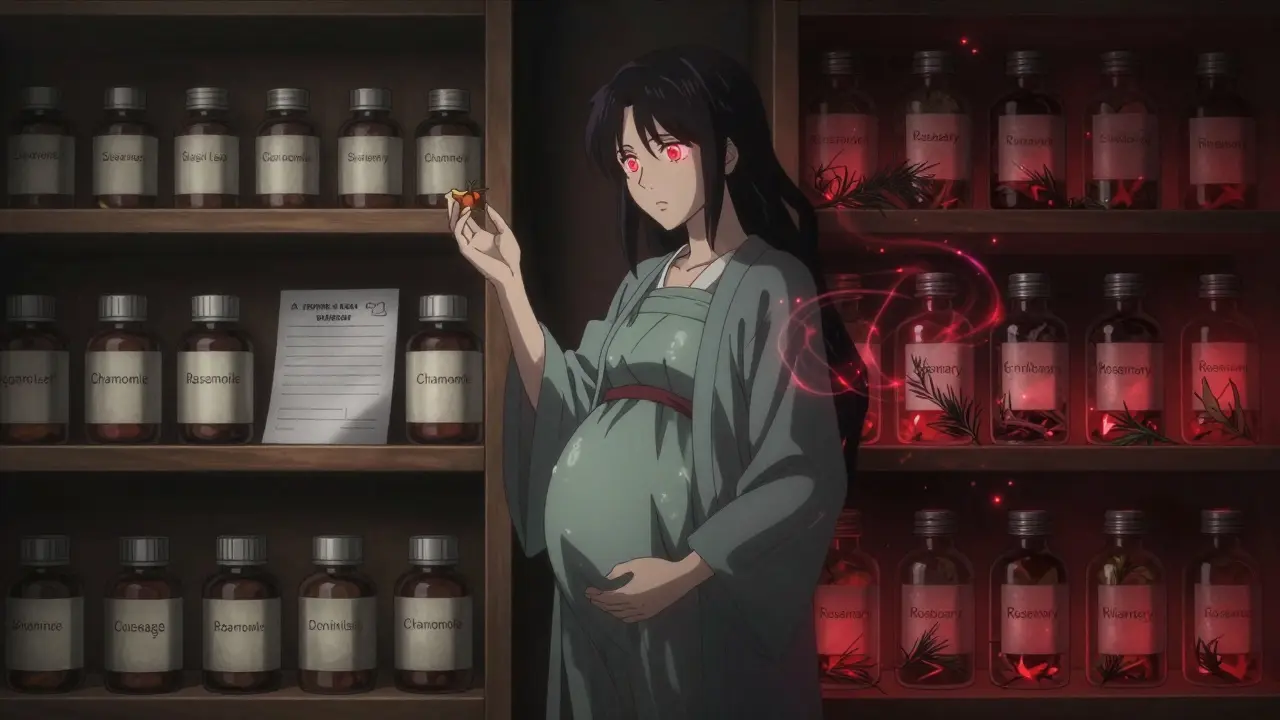
The Big Problem: No One Knows What’s Really in the Bottle
Here’s the scary part: you don’t know what you’re getting. The FDA doesn’t test herbal supplements before they hit shelves. That means a bottle labeled ‘pure raspberry leaf’ might contain other plants, heavy metals, or even prescription drugs. Studies show 20% to 60% of herbal products have contaminants or wrong dosages. One batch might be safe. The next one? Not so much. And dosing? There’s no standard. One tea bag might have 100 mg of active ingredient. Another might have 500 mg. No one’s checking. No one’s labeling it clearly. So even if a herb is generally considered safe, you could be taking too much - and not even realize it.What About Breastfeeding?
The same risks apply. Herbs don’t just affect the baby in the womb. They pass into breast milk. Raspberry leaf? Chamomile? Ginger? We have even less data on their effects on newborns than we do on fetuses. MotherToBaby, a trusted resource from the CDC, says safety information is lacking for most herbal products during breastfeeding. If you’re nursing, you’re still taking risks - even if you think you’re being careful.What Experts Really Say
The American College of Obstetricians and Gynecologists (ACOG) is clear: don’t take any herbal product without talking to your provider first. The Cleveland Clinic says pregnant women should avoid most herbal supplements entirely. The FDA says natural doesn’t mean safe - and that quality varies wildly between brands and batches. But here’s the real issue: most doctors don’t ask. In the Spanish study, 42% of women started using herbal products without telling their doctor. They got advice from their mom, a Facebook group, or a YouTube video. And if you don’t tell your provider, they can’t warn you about interactions. For example, ginger can thin your blood. If you’re on any anticoagulant - even low-dose aspirin - that’s a problem.
What Should You Do?
1. Stop assuming ‘natural’ means safe. Just because it’s a plant doesn’t mean it won’t hurt you or your baby. 2. Only use ginger - and only for nausea. Stick to 1,000 mg per day or less. Use a trusted brand. Avoid capsules if you can’t verify the dose. 3. Never use raspberry leaf to induce labor. Even if your doula says it’s fine. The risks aren’t worth it. 4. Ask your provider about every supplement - even tea. Say: ‘I’m drinking chamomile tea every night. Is that okay?’ Don’t wait for them to ask. 5. Check the label. Look for third-party testing (USP, NSF, ConsumerLab). Avoid products with ‘proprietary blends’ - you can’t know what’s in them. 6. Stop using anything you’re unsure about. If you can’t find a reliable source saying it’s safe in pregnancy, don’t take it.Why This Gap Exists - And What’s Being Done
Pregnant women are almost never included in clinical trials. It’s ethical. It’s cautious. But it leaves us in the dark. That’s why we have so little data. The NIH just launched a $12.7 million study to fix this. The FDA issued warning letters to supplement makers in early 2024 for making false safety claims. But change is slow. Until then, you’re on your own.Bottom Line
Herbal supplements in pregnancy aren’t a harmless alternative. They’re a gamble. Ginger is the only one with strong evidence of safety and benefit. Everything else? The risks are unknown - and the stakes are too high to guess. If you want relief from nausea, ginger is your best bet. If you want to sleep better, try a warm bath and a dark room. If you want to feel more in control? Talk to your doctor. Don’t trust a blog. Don’t trust a friend. Don’t trust a label that says ‘safe for pregnancy.’ Your body and your baby deserve better than guesswork.Is ginger safe during pregnancy?
Yes, ginger is considered safe for pregnancy when taken in doses under 1,000 mg per day. It’s one of the few herbal supplements with strong evidence supporting its use for nausea and vomiting. Studies show it works as well as some prescription anti-nausea medications without the same side effects. Stick to ginger tea, capsules from trusted brands, or fresh ginger in food. Avoid high-dose extracts unless approved by your provider.
Can I drink chamomile tea while pregnant?
It’s not recommended. While many women drink chamomile tea for sleep or digestion, research links it to possible risks including preterm birth, low birth weight, and interference with fetal blood vessel development. The American Academy of Family Physicians advises caution. If you want to relax, try warm milk, a warm bath, or guided breathing instead. If you do drink chamomile, limit it to one cup a day and talk to your doctor first.
Is raspberry leaf tea good for preparing for labor?
No. Despite popular belief, raspberry leaf tea is not proven to make labor easier or shorter. In fact, studies show it may increase the chance of cesarean delivery when used to induce labor. It contains compounds that can stimulate contractions - which is dangerous if used too early. Even if you’re using it in the third trimester, there’s no guarantee it’s safe. Most experts recommend avoiding it entirely. Stick to evidence-based prep methods like prenatal yoga and pelvic floor exercises.
Are herbal supplements regulated like prescription drugs?
No. Herbal supplements are not held to the same standards as prescription or even over-the-counter drugs. The FDA doesn’t test them for safety, purity, or effectiveness before they’re sold. This means two bottles of the same brand can have different ingredients or dosages. Some contain hidden drugs, heavy metals, or contaminants. Always look for third-party testing seals (USP, NSF) - but even those aren’t foolproof.
What should I do if I already took a herbal supplement during pregnancy?
Don’t panic. Most single exposures don’t cause harm. But do stop taking it immediately and tell your provider what you took, how much, and when. They can check for known risks and monitor your pregnancy more closely if needed. Keep the product label or bottle - it helps them identify the exact herb and dose. Never feel ashamed for asking. This is exactly why doctors need to ask about supplements - because most women don’t think to mention them.
Can I use herbal supplements while breastfeeding?
The same rules apply. Herbs pass into breast milk, and we have even less data on their effects on newborns than on fetuses. Ginger is generally considered low-risk in small amounts. But chamomile, raspberry leaf, and others are still uncertain. MotherToBaby states that safety information is lacking for most herbal products during breastfeeding. If you’re nursing, assume anything you take could affect your baby. Always check with your provider before using any herb, tea, or supplement.






CHETAN MANDLECHA
People still think 'natural' means safe? Bro, poison ivy is natural. Snake venom is natural. The whole premise is flawed.
Jillian Angus
I drank chamomile tea every night during both pregnancies. No issues. But then again I also ate raw sushi and drank wine in the first trimester so maybe I'm just lucky
Ajay Sangani
It's fascinating how we've detached from ancestral wisdom in the name of clinical trials. For millennia women used herbs to navigate pregnancy without modern labs. Is our current paradigm truly safer, or just more controlled? The data gap isn't just scientific-it's cultural.
Steven Mayer
Let's not conflate regulatory absence with absence of risk. The pharmacokinetic profiles of phytochemicals during gestation are understudied because ethical constraints limit human trials-not because the industry is hiding something. The burden of proof should lie with the user, not the FDA.
John Pearce CP
As a former FDA compliance officer, I can tell you this: the supplement industry is a lawless frontier. There are over 1,200 products on the market labeled 'pregnancy-safe' that contain unlisted stimulants, heavy metals, or even synthetic hormones. The FDA only steps in after someone gets hurt. That’s not oversight-that’s triage.
Third-party certifications like USP or NSF are meaningless if the lab doesn’t test for the actual phytochemicals in question. Most don’t. They test for contaminants, not potency or interaction profiles. You’re gambling with your child’s neurodevelopment on a label that says 'natural' and costs $12.99.
The only reason ginger works is because it’s been studied in double-blind RCTs. Every other herb is anecdote wrapped in marketing. And don’t get me started on 'raspberry leaf tea'-it’s not toning your uterus, it’s triggering prostaglandin surges that could induce preterm labor. Midwives who recommend it are practicing dangerous folklore.
And yes, I know you think your grandmother used it. She also smoked cigarettes and drank lead-contaminated water. Progress isn’t nostalgia. It’s evidence.
If you want to reduce nausea, try acupressure bands. For sleep, melatonin under medical supervision. For anxiety, CBT. These have data. Herbs don’t. Stop romanticizing ignorance.
Rosemary O'Shea
Oh please. You’re telling women to avoid chamomile but you’ll let them take SSRIs? That’s not safety-it’s pharmaceutical colonialism. You want to control women’s bodies with Big Pharma’s approved toxins, but a flower? That’s witchcraft. The real danger isn’t the herb-it’s the arrogance of a medical system that refuses to listen to centuries of women’s knowledge.
And don’t give me that 'FDA doesn’t regulate' line. They regulate birth control like it’s a nuclear weapon but let Big Pharma sell prenatal vitamins with 10x the folic acid and call it 'safe.' Double standards are the real epidemic.
Bhargav Patel
The epistemological gap here is profound. We demand empirical validation for herbal interventions while accepting pharmacological ones with far less rigorous gestational data. The absence of evidence is not evidence of absence-but neither is anecdotal tradition evidence of safety. The solution is not dogma, but methodological pluralism: ethnobotanical inquiry paired with pharmacovigilance, not replacement.
Consider this: if we applied the same standard to pharmaceuticals as we do to herbs-no prenatal trials, no labeling of active phytoconstituents, no batch consistency-we would have shut down the entire industry decades ago. Yet we accept it. Why? Because the power structure is aligned with profit, not parity.
Women deserve evidence-based guidance, yes-but also cultural dignity. Dismissing traditional practices as 'folklore' while prescribing untested pharmaceutical cocktails is not science. It’s hegemony.
The NIH’s $12.7M study is a start. But we need longitudinal, culturally grounded research-not just clinical trials in controlled populations. The answer lies not in banning herbs, but in studying them with the same rigor we grant to pills.
Charles Barry
THIS IS A COVERT PHARMACEUTICAL COVER-UP. The FDA has been suppressing data on herbal safety since 2012 because Big Pharma owns the patents on synthetic anti-nausea drugs. Ginger costs $0.50 per dose. Zofran costs $1,200. Who benefits? Not you. Not your baby. The corporations. The 'risks' of chamomile? Fabricated to scare you into buying their pills. The same people who told you aspartame was safe now say raspberry leaf is dangerous. Who do you trust?
And don’t you dare tell me about 'third-party testing.' USP? NSF? They’re funded by supplement companies. The whole system is rigged. The only safe herb is the one your grandmother brewed in a pot with no label, no dosage, no FDA stamp. That’s real. Everything else is a scam.
I’ve seen the leaked emails. They’re terrified of herbal data because it proves synthetics aren’t superior. That’s why they silence midwives. That’s why they label natural remedies as 'unsafe.' It’s not medicine. It’s market control.
Stop listening to your OB-GYN. They’re paid by drug reps. Start listening to your body. And if you’re reading this? Burn your Zofran prescription. Brew ginger tea. And pray they don’t come for your chamomile next.
Payson Mattes
Wait-so you’re telling me the government doesn’t test herbal supplements? But they test my baby’s vaccines? That’s not paranoia, that’s pattern recognition. I checked the bottle of my chamomile tea-no batch number, no expiration, no ingredient list. Just 'natural blend.' I Googled the company. They’ve been fined 3x for selling melatonin-laced 'sleep teas.' I called the FDA tip line. They said 'we’re overwhelmed.' So now I’m wondering: how many other moms are giving their babies unregulated neuroactive compounds and calling it 'holistic'? This isn’t wellness. It’s a public health time bomb.
I just found out my doula gave me raspberry leaf tea because 'it’s traditional.' I looked up the active compound-framboesin. It’s a uterine stimulant. Same class as pitocin. They didn’t tell me that. The label didn’t say that. The whole thing is a lie. And now I’m terrified I might’ve triggered early contractions. Why didn’t anyone warn me? Why is this allowed? Who’s protecting us?
I’m not anti-herb. I’m pro-transparency. If you want me to take something, label it like a drug. Show me the dose. Show me the study. Show me the batch test. Otherwise, I’m not taking it. My child’s life isn’t a gamble for someone’s tea brand.
John Pearce CP
Replying to the conspiracy theorist: Your 'leaked emails' don’t exist. The FDA doesn’t suppress herbal data-they lack the funding and legal authority to regulate supplements as drugs. That’s a legislative failure, not a cover-up. And yes, Zofran is expensive-but it’s been tested in over 15,000 pregnant women. Ginger? 2,000. That’s not corporate greed. That’s science. If you want herbal supplements held to the same standard, lobby Congress to reclassify them as drugs. Not Facebook rants.
And to the elitist: Yes, we should study traditional remedies. But not by romanticizing ignorance. We studied quinine. We studied willow bark. We turned them into quinine sulfate and aspirin. That’s progress. Not 'colonialism.' That’s science.
Women don’t need more mysticism. They need better access to evidence, not more myths dressed as wisdom.