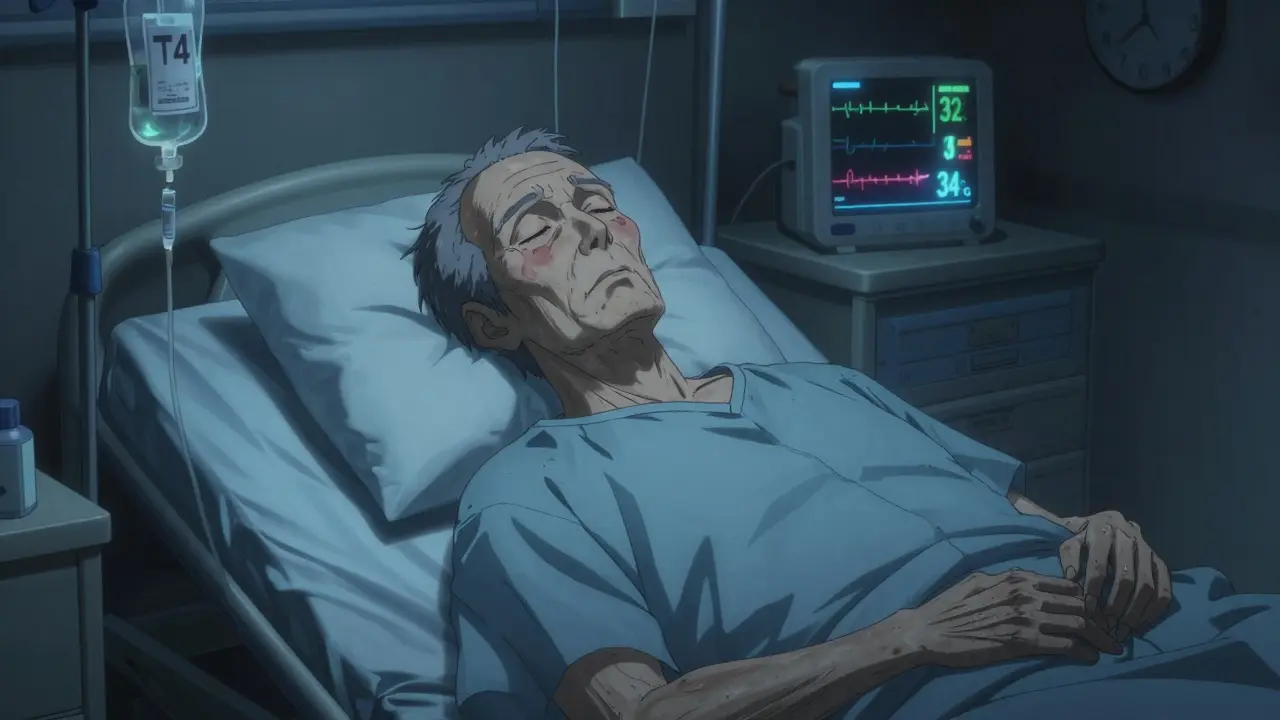
When your body runs out of thyroid hormone, it doesn’t just make you tired. It can shut down your breathing, drop your body temperature to dangerous levels, and send you into a coma - all without warning. This is myxedema coma, the most extreme form of untreated hypothyroidism. It’s rare, but deadly. And if you wait for lab results before acting, you might already be too late.
What Exactly Is Myxedema Coma?
Myxedema coma isn’t just a bad case of hypothyroidism. It’s a full-body collapse. The term used to mean a patient had to be unconscious - but that’s outdated. Today, doctors call it myxedema crisis because even severe confusion, extreme lethargy, or unresponsiveness without full coma counts. It happens when thyroid hormone levels (T3 and T4) crash so low that your organs start failing. Your heart slows, your lungs barely move, your kidneys stop filtering properly, and your body can’t keep warm.It almost always affects people with long-standing, untreated, or poorly managed hypothyroidism. Many had symptoms for years - fatigue, weight gain, cold intolerance - and thought it was just aging or stress. Then, something triggers it: an infection, stopping thyroid meds, cold exposure, or even a hospital stay. That’s when the body hits a breaking point.
Who’s at Risk?
Women over 60 make up the majority of cases - about 3 out of every 4. But men aren’t immune. In fact, men often get misdiagnosed longer because doctors don’t expect hypothyroidism in them. The condition spikes in winter. Cold weather stresses the body, and if your thyroid is already weak, you can’t adapt.People with Hashimoto’s thyroiditis, those who’ve had thyroid surgery or radioactive iodine treatment, and older adults on multiple medications are at highest risk. Even patients who’ve been on levothyroxine for years can slip into crisis if they miss doses, get sick, or start new drugs that interfere with absorption.
The Warning Signs - Not Always Obvious
The classic triad is altered mental status, hypothermia, and a trigger event. But here’s the catch: symptoms are sneaky.- Altered mental status: Not always coma. Could be confusion, sluggish speech, memory loss, or even depression-like withdrawal. In older adults, this is often mistaken for dementia.
- Hypothermia: Core temperature below 35°C (95°F). Some patients don’t shiver - their body’s too exhausted to respond.
- Slow heart rate: Under 60 bpm, sometimes as low as 30 bpm.
- Shallow breathing: Less than 12 breaths per minute. Carbon dioxide builds up. Oxygen drops.
- Swelling: Puffy face, eyelids, hands. Skin feels cool and dry.
- Constipation or ileus: Bowels stop moving. Abdomen becomes distended.
- Low sodium: Blood sodium often below 135 mmol/L. This isn’t just a lab number - it can cause seizures or brain swelling.
One study found that 30% of elderly patients showed no typical symptoms at all. They just seemed “off.” That’s why doctors are taught to ask: “Could this be hypothyroidism?” - even if the patient doesn’t fit the profile.
Why It’s So Deadly
Mortality rates range from 25% to 60%. That’s higher than diabetic ketoacidosis and close to adrenal crisis. Why? Because every system fails at once.Your heart can’t pump effectively. Your lungs can’t oxygenate. Your brain gets starved of energy. Your kidneys can’t clear toxins. And if you’re cold, your body burns through its last energy reserves trying to stay warm - then shuts down.
Delays kill. For every hour treatment is delayed, the chance of death rises by 10%. Most patients are admitted to the ICU after 6 to 12 hours. But if you act within 2 hours, survival jumps dramatically.
The Emergency Protocol - Step by Step
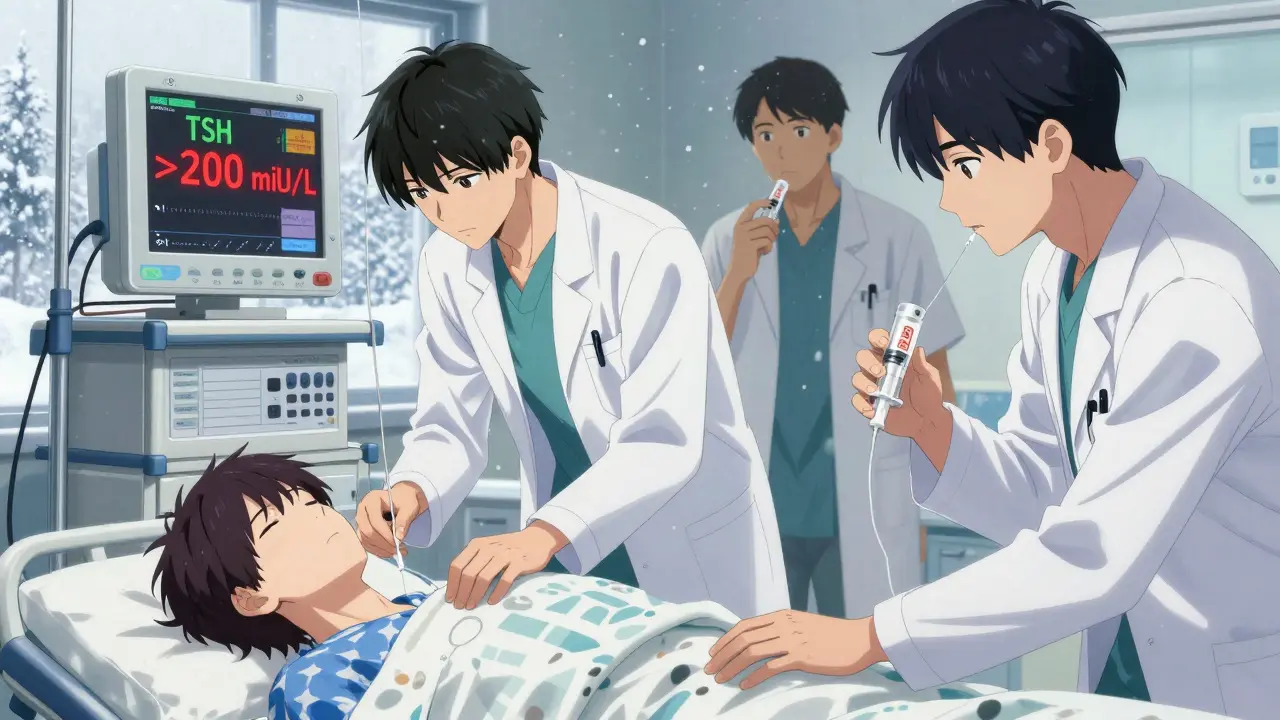
There’s no time to wait for thyroid tests. If you suspect myxedema coma, start treatment immediately - even before labs come back.- Secure the airway: Half to 70% of patients need intubation. Breathing is too weak. Don’t wait for respiratory arrest.
- Give thyroid hormone right away: Start with intravenous levothyroxine (T4) - 300 to 500 micrograms as a loading dose. Then 50 to 100 mcg daily. For severe cases with heart problems, add liothyronine (T3) - 10 to 20 mcg every 8 hours. New guidelines now recommend T3 first in critical cases because it works faster.
- Rewarm slowly: Use blankets. Keep the room warm. Do not use heating pads, warm water baths, or forced-air warmers. Rapid rewarming can cause your heart to crash. Monitor core temperature every 30 minutes.
- Treat the trigger: Infection is the #1 cause - pneumonia, UTI, sepsis. Start broad-spectrum antibiotics immediately. Don’t wait for cultures.
- Correct electrolytes carefully: Hyponatremia is common. Fix sodium slowly - no more than 4 to 6 mmol/L in 24 hours. Too fast can cause brain damage.
Remember the mnemonic DIMES to find triggers: Drugs (medication non-adherence or interactions), Infection, Myocardial infarction or stroke, Exposure to cold, Stroke (CVA).
What Not to Do
Many mistakes are fatal.- Don’t delay treatment for lab results. TSH and free T4 tests take hours. By then, it’s too late. Clinical suspicion is enough to start.
- Don’t give glucose IV without checking cortisol. Low cortisol often goes with low thyroid. Giving sugar without steroids can trigger adrenal crisis.
- Don’t use sedatives or opioids. These worsen respiratory depression. Even mild painkillers can be dangerous.
- Don’t assume it’s dementia or depression. Especially in older women. A simple TSH test could have saved a life.

Real Stories Behind the Numbers
A 68-year-old woman in Minnesota stopped her thyroid pills after a hospital stay for pneumonia. Two weeks later, her family found her unresponsive, cold, and barely breathing. She spent 11 days in the ICU. Her recovery took months. She now says: “I thought I was just getting older. No one asked about my thyroid.”A man in his 50s in Australia was dismissed as “anxious” for years. He wore three sweaters indoors in summer. He had constant brain fog. When he collapsed after a cold, his TSH was over 200 mIU/L. He survived - but lost 18 months of his life to misdiagnosis.
One survey of 427 hypothyroid patients found 18% had nearly died from missing doses or going untreated during illness. Hospital stays were the top trigger. Many said their doctors didn’t take their symptoms seriously - especially if they were men or younger.
What’s New in 2026?
In January 2023, the FDA approved a new IV thyroid hormone formulation with faster absorption. It’s already being used in trauma centers and ICUs. Research in 2023 also found that elevated thyrotropin receptor antibodies can predict decompensation - meaning we might soon have a blood test to catch this before it turns deadly.Point-of-care thyroid testing devices are in final trials. They can give accurate TSH and free T4 results in under 15 minutes. That could cut diagnosis time from hours to minutes.
By 2030, the number of myxedema coma cases is projected to rise 20% - mostly because more older adults are living with undiagnosed hypothyroidism, especially in places without routine thyroid screening.
What You Need to Remember
If you or someone you know has hypothyroidism and suddenly becomes lethargic, confused, cold, or unresponsive - call for emergency help immediately. Don’t wait. Don’t assume it’s just fatigue. Don’t assume it’s “normal” for their age.Thyroid hormone replacement is life-saving - but only if given fast. And treating the trigger - like an infection - is just as important as giving the hormone.
Myxedema coma isn’t common. But when it happens, it doesn’t ask for permission. It strikes silently. And it kills fast. The difference between life and death is recognizing it - and acting before the lab results come back.
Is myxedema coma the same as a thyroid storm?
No. Myxedema coma is caused by too little thyroid hormone (hypothyroidism), while thyroid storm is caused by too much (hyperthyroidism). They’re opposites. Thyroid storm causes high fever, fast heart rate, and agitation. Myxedema coma causes low temperature, slow heart rate, and lethargy. Treatment is completely different - one needs anti-thyroid drugs, the other needs hormone replacement.
Can you survive myxedema coma without treatment?
Survival without treatment is extremely rare. Without thyroid hormone replacement, the body’s systems shut down one by one - breathing stops, heart fails, organs stop working. Even with modern care, 25% to 60% of patients die. Without treatment, the odds are close to 100% fatal.
Why is rewarming done slowly in myxedema coma?
Rapid rewarming increases metabolic demand, but the body can’t meet it because thyroid hormone levels are still too low. This can cause sudden drops in blood pressure, heart rhythm problems, or cardiac arrest. Passive warming - blankets, warm room - lets the body recover gradually as hormone levels rise.
Can you prevent myxedema coma?
Yes. Take thyroid medication exactly as prescribed. Never stop it without talking to your doctor. Get regular TSH checks - at least once a year, or more often if you’re elderly or have other illnesses. If you get sick, especially with infection or fever, contact your doctor immediately - your dose may need adjustment. Avoid prolonged cold exposure if you have hypothyroidism.
Why do elderly patients often get misdiagnosed?
Classic symptoms like fatigue, weight gain, and cold intolerance are often blamed on aging. Elderly patients may show only confusion or depression - called “apathetic hypothyroidism.” Doctors don’t always test thyroid levels in older adults unless they’re very sick. But these subtle signs are red flags for myxedema crisis. A simple blood test can prevent disaster.





Sarah B
This is why we need mandatory thyroid screening for everyone over 50. No more waiting for symptoms. No more 'oh you're just getting old.' If your body's running on fumes, fix it before it crashes. Period.
Heather Burrows
I've seen this happen to my aunt. They told her it was depression. She was on Zoloft for two years before someone finally checked her TSH. By then, her heart was barely beating. We don't need more research. We need doctors to stop being lazy.
Savannah Edwards
There's something deeply human about how silently this kills. People don't scream for help when their thyroid fails. They just... fade. Slower than a candle in a draft. The body doesn't panic, it just resigns. And we, as a medical culture, have normalized that resignation. We call it aging. We call it laziness. We call it 'just being tired.' But it's not. It's a physiological collapse waiting for one trigger. And the trigger? Usually something as simple as a missed pill or a cold night. We treat symptoms like they're the problem. But the real problem is the silence before the crash.
Gouris Patnaik
In India, this is even worse. Elderly people stop meds because they can't afford them. Or because their kids don't understand. No one tests TSH unless they're in a coma. And even then, doctors think it's 'heat stroke' or 'diabetes.' We have no screening programs. No awareness. Just silence. And death.
AMIT JINDAL
bro i had this friend who was on levothyroxine for 12 yrs and then got sick and forgot her pills for 3 weeks... she was found in her apartment with her eyes half closed and not shivering. they thought she was high. turns out her TSH was 800. like what the f. we need to make this common knowledge. like car seat belts. everyone should know this.
Amit Jain
This article is just fear porn. You're telling people to panic over a condition that affects 0.001% of the population. Most people with hypothyroidism live normal lives. Stop scaring people into thinking every tired person is one pill away from death. Also, why is every example a woman? Men get this too, you know. But you guys like to make it about 'elderly women' because it's easier to pity them.
Eric Knobelspiesse
I work in an ER and this is 100% true. Last month we had a 72yo woman come in 'just feeling off.' No fever, no cough. Just confused and cold. TSH was 700. We started T4 and T3 stat. She woke up 4 hours later. The thing is, no one ever asks about thyroid meds. Not even in the elderly. We assume they're fine because they're on 'something.' But what? Did they forget? Did they run out? Did they stop because they 'felt fine'? We need a checklist. Just one simple question: 'Are you still taking your thyroid med?'
Jesse Lord
I've been on levothyroxine for 15 years. My doctor checks my TSH every 6 months. But I know so many people who don't. My neighbor's dad died last year from this. He hadn't seen a doctor in 7 years. He thought his fatigue was from working too hard. No one told him to get tested. I wish we had a public health campaign. Like 'Your thyroid doesn't care how old you are.'
Lakisha Sarbah
I'm a nurse. I've seen this twice. The first time, the patient was 84, quiet, didn't speak much. Family said she was 'just being stubborn.' We checked TSH. It was 900. We started treatment. She smiled the next day. I just wish we didn't have to wait for her to be near death before we did the test. A simple blood draw could've saved her 3 weeks of suffering.
Ariel Edmisten
Take your pill. Get tested. Don't ignore cold feet. Don't blame aging. It's not normal to need 3 blankets in July.
Mayank Dobhal
My mom had this. They thought it was dementia. She stopped eating. Didn't recognize me. They put her in a nursing home. I found her old med bottle in the drawer. Empty. I begged for a TSH test. They laughed. Said 'she's 80, of course she's slow.' I cried. Then I called 911. She's alive. But she lost 2 years. Don't let this happen to someone you love.
Ashley Hutchins
This is why we need to stop trusting doctors. They're too slow. Too lazy. Too focused on drugs and tests instead of listening. My cousin's husband had this. They told him to 'wait for the appointment.' He died in 3 days. The doctor didn't even show up. No one asked if he was on meds. No one checked his temp. Just 'oh he's a man, he's probably fine.' Men get ignored. Elderly get ignored. Poor people get ignored. This isn't medicine. It's neglect dressed in a white coat.
Paula Sa
I appreciate how clear this is. But I wonder... what if we made thyroid screening part of routine annual blood work? Like cholesterol? It's cheap. It's fast. It's life-saving. Why do we wait for someone to nearly die before we act? We screen for everything else. Why not this? It's not just about saving lives. It's about respecting how much someone's quality of life matters. Fatigue isn't 'normal.' Cold intolerance isn't 'just winter.' And silence isn't consent.