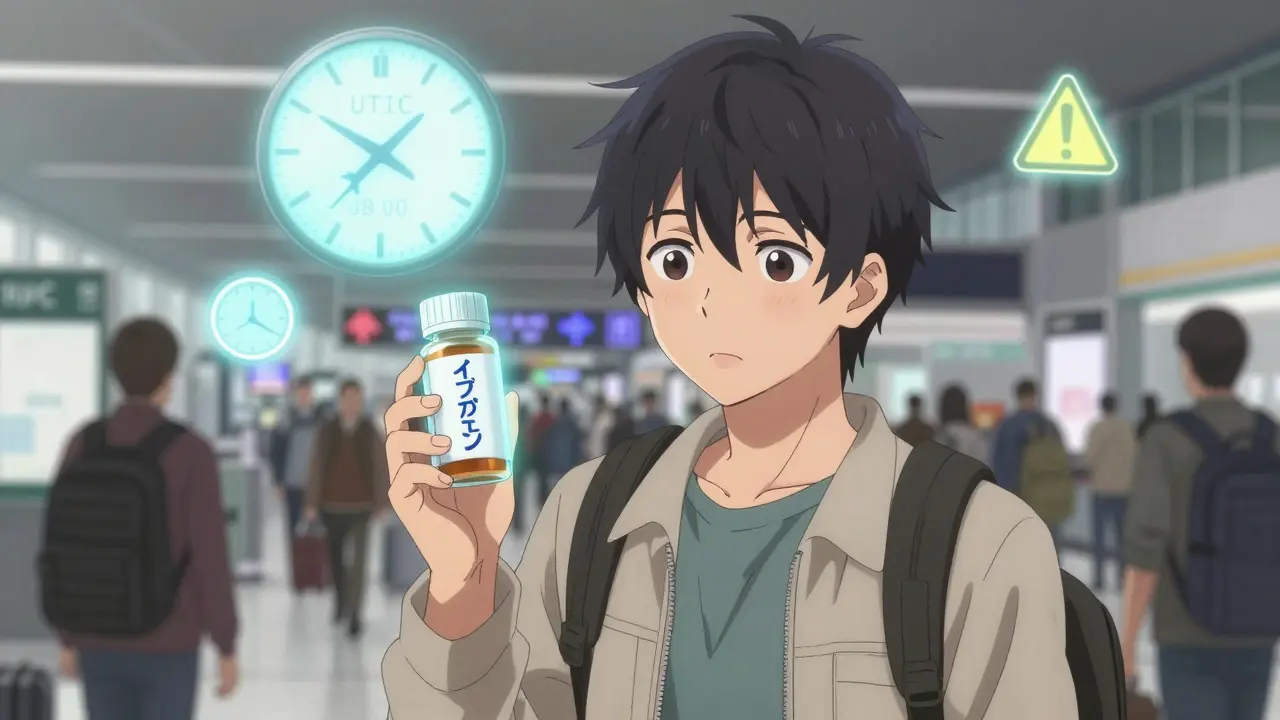
Imagine this: you land in Tokyo after a 14-hour flight, exhausted, jet-lagged, and ready to take your morning pill. You check the label: "Take one tablet daily". But was that daily at 8 a.m. New York time? Or 8 p.m. Tokyo time? If you guess wrong, you could miss a dose, overdose, or trigger side effects that land you in a foreign ER. This isn’t rare. Around 70% of medication-related travel emergencies happen because people misread their prescription labels across time zones.
What’s Actually on Your Prescription Label?
Your prescription label isn’t just a reminder to take your medicine. It’s a legal document with seven critical pieces of information you must understand before you leave home:- Patient name - Must match your passport exactly. Even a middle initial mismatch can trigger customs holds.
- Medication name - Both brand and generic. In Japan, Thailand, and Saudi Arabia, the generic name must appear in the local language. If your label says "ibuprofen," but Japan requires "イブプロフェン," you’re at risk of seizure.
- Dosage strength - Written in milligrams (mg) or International Units (IU). Don’t assume "10" means the same everywhere.
- Directions for use (the "sig") - This is the most important part. Look for "q24h," "q12h," or "every 8 hours." These mean every 24, 12, or 8 hours - not "morning" or "night."
- Prescriber info - Doctor’s name, license number, and contact. Some countries require this to verify legitimacy.
- Pharmacy details - Address and license number. This helps customs confirm the prescription is real.
- Prescription number - For tracking. Keep this handy if you need a refill abroad.
Many U.S. labels skip the UTC time reference. That’s a problem. If your label says "Take at 8 a.m.", you have no idea which time zone it means. Always ask your pharmacist to add: "Take at 08:00 UTC (03:00 EST)". Most major U.S. pharmacies now do this for free upon request.
Time Zones Are the Real Enemy
Crossing time zones doesn’t just mess with your sleep. It messes with your meds. Your body doesn’t know you’ve flown from Chicago to Singapore. It still thinks it’s 3 a.m. And if you’re on a medication with a narrow therapeutic window - like warfarin, insulin, or levothyroxine - even one missed or double-dosed pill can cause serious harm.Here’s the rule most travelers get wrong: Don’t switch to local time right away.
The CDC recommends sticking to your home time zone for the first 72 hours. Why? Because your body needs time to adjust. If you take your thyroid pill at 7 a.m. EST and land in Paris at 1 p.m. local time (7 a.m. EST), wait until 7 a.m. Paris time - which is 1 a.m. your body clock - to take it. That’s 6 hours late. But it’s safer than taking it at 1 p.m. Paris time, which is 7 a.m. your body clock. You’re not following the clock; you’re following your internal rhythm.
But here’s the twist: some meds need immediate adjustment. If you’re on antibiotics with an 8-hour schedule (like amoxicillin), you can’t wait. You need to space doses evenly in the new time zone. The key is knowing your drug’s half-life. If it’s 4 hours, you adjust fast. If it’s 24 hours, you wait. Ask your pharmacist: "What’s the half-life of this drug?" If they don’t know, find another one.
Global Rules Vary - And They’re Not Fair
Every country has its own rules. You can’t assume your U.S. label will fly - literally.- Japan: All prescription labels must include kanji for the active ingredient. No English-only labels allowed. 68% of U.S. prescriptions fail this. Seizures at Narita Airport are common.
- Thailand: Labels must have English and Thai. No exceptions. Fines start at $500.
- Saudi Arabia: Requires the Arabic name of the active ingredient. 22% of seized meds in Riyadh in early 2023 were due to missing Arabic text.
- EU countries: Follow standardized labeling under the Falsified Medicines Directive, but patient name must be in the local language. A label saying "John Smith" in France might get flagged if it doesn’t say "Jean Smith."
- Caribbean nations: Many require English and Spanish. If you’re flying to Jamaica or Barbados, your label better have both.
And don’t rely on the original bottle. TSA says you don’t need original packaging - but customs agents in 31 countries do. Keep your original prescription bottle, even if it’s not the most convenient. A doctor’s note helps, but it’s not a substitute for a compliant label.
What to Do Before You Leave
Don’t wait until the airport. Start 4-6 weeks before your trip.- Call your pharmacy and ask them to add UTC timing to your label. Example: "Take 1 tablet at 14:00 UTC (09:00 EST)." Most U.S. chains now do this.
- Get a medication summary from your doctor. List every drug, dose, frequency, and purpose. Include the generic name and half-life if possible.
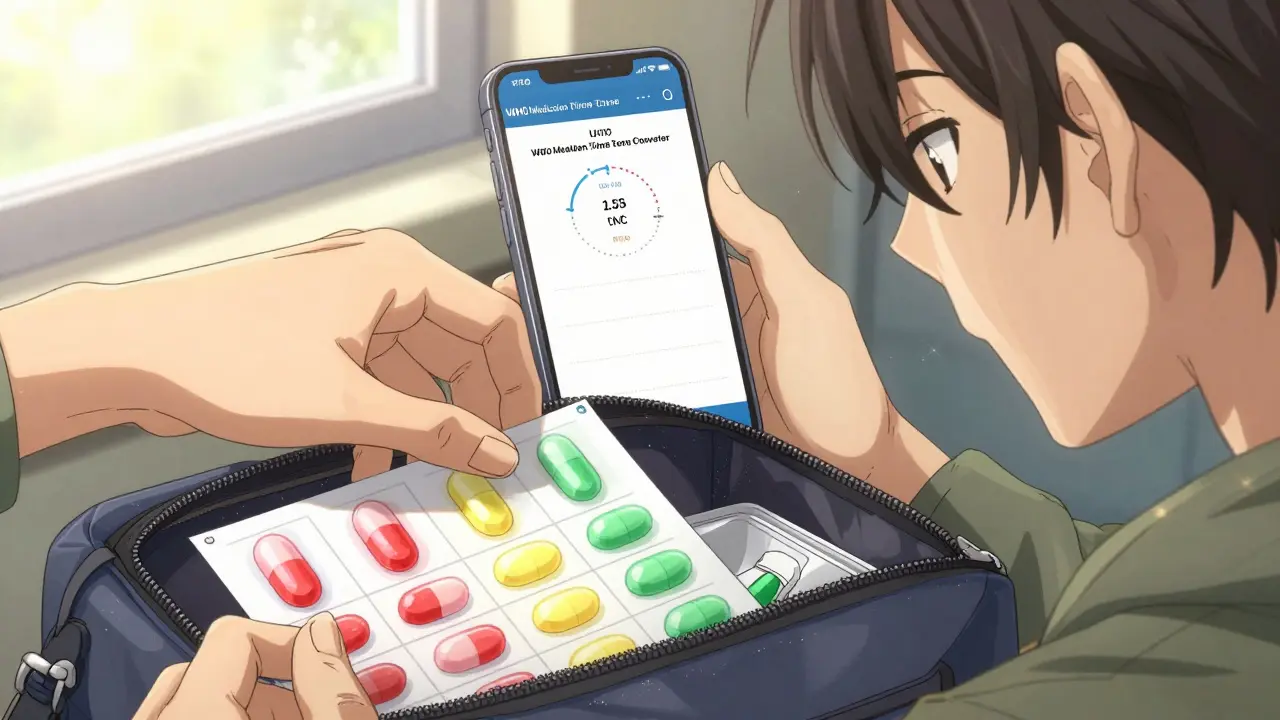
- Download the WHO Medication Time Zone Converter app. It’s free, works offline, and lets you input your meds and destination to auto-generate a schedule.
- Print a color-coded chart. Use red for critical meds (insulin, blood thinners), yellow for antibiotics, green for daily supplements. Tape it to your toiletry bag.
- Carry a copy of your prescription in both English and the destination language. Use Google Translate to generate a PDF. Print two copies.
Travelers who use UTC-based schedules report 89% fewer timing errors, according to a 2023 GoodRx survey. Those who wing it? 68% have at least one issue.
What to Do If You Get Stopped
Customs agents aren’t trained pharmacists. They see a pill they don’t recognize and panic.- Stay calm. Don’t argue.
- Hand them your printed doctor’s note and pharmacy label.
- Point to the generic name and UTC time.
- If they ask for a prescription, say: "I have the original bottle and a copy of the prescription with the doctor’s contact info."
On Reddit, a traveler named "TravelMedHelp" got detained for 45 minutes at Narita because their label said "ibuprofen" without kanji. They had a doctor’s note and the original bottle - but no translation. They lost their flight. Don’t be that person.
The Future Is Changing - But Not Fast Enough
By the end of 2025, the WHO will require all international prescriptions to include a "travel supplement" section with UTC timing and multilingual active ingredient names. Airlines like Emirates and Qantas are already testing digital medication cards that auto-update based on your flight path.Some pharmacies are testing augmented reality labels. Point your phone at the bottle, and it shows you the correct time to take your pill in your current location. Pilot programs are live in Singapore and Dubai. But for now, you can’t wait for tech to save you.
Right now, your safety depends on you. Not your doctor. Not your pharmacy. Not your airline. You.
Final Rule: When in Doubt, Wait
If you’re unsure whether to take your pill now or wait, don’t guess. Skip it. Take it 12 hours later. Better to miss one dose than risk an overdose. Especially with blood thinners, insulin, or seizure meds.Medication errors during travel aren’t just inconvenient. They cost $15,000 to $250,000 in medical evacuations, according to International SOS. You don’t need to be an expert. Just be prepared.
Do I need to keep my pills in the original bottle when flying?
Yes. While TSA in the U.S. allows meds in pill organizers, many international customs agencies require the original pharmacy bottle with your name, prescription number, and doctor’s info. Even if you’re not flying through the U.S., you might land in a country that checks. Keep the original bottle in your carry-on. Don’t risk being detained or fined.
What if my prescription label doesn’t have the generic name?
Ask your pharmacist to print a new label with both brand and generic names. If they refuse, call your doctor and ask them to write a note listing the generic name. In countries like Japan or Saudi Arabia, you won’t get past customs without it. Generic names are the universal language of medication - brand names change by country.
Can I bring liquid medications like insulin on a plane?
Yes, but you must declare them at security. Keep them in their original labeled containers. The 3-1-1 rule doesn’t apply to medically necessary liquids. Bring a doctor’s note and make sure the label shows the concentration (e.g., "100 units/mL"). IATA requires this for all liquid meds. If your insulin vial says "U-100" without the concentration, ask your pharmacy to update it.
How do I know if my medication has a narrow therapeutic window?
These are drugs where even small changes in dose or timing can cause serious side effects. Common ones include warfarin, digoxin, lithium, cyclosporine, and insulin. If you’re on one of these, your pharmacist should have flagged it. If not, ask: "Is this a narrow therapeutic index drug?" If yes, follow your home time zone for at least 72 hours after arrival. Don’t adjust timing until you’ve consulted a travel medicine specialist.
What’s the best way to track my doses across time zones?
Use the WHO Medication Time Zone Converter app. It’s free, offline-capable, and lets you input your meds, time zone changes, and dosage schedule. It then shows you exactly when to take each pill in your current location. Alternatively, create a printed chart with UTC times. Color-code by urgency. Tape it to your phone case. Set alarms on your phone for UTC time, not local. Most travelers who use UTC tracking report zero timing errors.
If you’re taking more than three medications, consider seeing a travel medicine clinic before you go. They’ll review your list, check country-specific rules, and give you a customized schedule. It’s not expensive - usually under $150 - and could save you from a hospital stay abroad.







Gina Beard
It’s wild how we treat our bodies like machines that just reset when we land somewhere new.
But your internal clock doesn’t care about time zones. It just wants consistency.
Skipping a dose because you’re too tired to think? That’s how you end up in a foreign ER.
Simple rule: UTC time. Always.
It’s not complicated. You just have to care enough to do it.
Don Foster
Most people dont even know what a half life is and yet they take warfarin like its aspirin
Pharmacies in the US print labels like theyre writing a grocery list
And then they wonder why people get detained in Tokyo
Its not the countries fault its yours for not asking for the damn UTC time
And dont even get me started on brand vs generic names
Thats basic pharmacology 101
siva lingam
So you want me to carry my whole pharmacy in my carry on just so some guy at Narita can check if my ibuprofen has kanji
And pay 500 bucks because my label says John instead of Jean
Man I love traveling
Next thing you know theyll make me memorize the arabic for metformin
At least my flight got cancelled
Shelby Marcel
wait so if my label says take at 8am but doesnt say utc… does that mean its 8am where i am or where the dr is?
i always assumed it was local but now im second guessing everything
also can someone explain what half life even means for meds like this
i think i missed the pharmacology class in high school
blackbelt security
Preparation is power.
Not luck. Not hope. Preparation.
Print the chart. Set the alarms in UTC. Carry the bottle.
Its not about being paranoid. Its about being the person who lands safely while everyone else is panicking at customs.
You dont need to be a doctor.
You just need to be the one who read the damn post.
Patrick Gornik
Here we are again with the techno-bureaucratic fetishization of pharmacological compliance
As if the real problem isnt the commodification of healthcare itself
Why should a traveler be burdened with translating their own medication into seven languages
Because the state and the pharmaceutical-industrial complex have outsourced their duty onto the individual
And now we celebrate the person who prints a color-coded chart as if they’ve achieved moral superiority
Meanwhile the WHO is still debating whether to standardize the damn thing
Its not about being prepared
Its about being a cog in a machine that refuses to fix itself
And dont even get me started on the fact that your insulin vial needs to say U-100 in triplicate
When the real tragedy is that people cant afford the meds in the first place
But sure
Keep your chart taped to your phone case
And feel good about it
Tommy Sandri
While the post presents a compelling case for standardized international labeling, it is worth noting that cultural and regulatory frameworks vary significantly based on historical, legal, and linguistic contexts.
For example, Japan’s requirement for kanji on prescription labels stems from decades of pharmaceutical regulation designed to ensure public safety and prevent misidentification.
Similarly, the EU’s emphasis on local-language patient names reflects broader data protection and identity verification norms.
It is not a matter of inconvenience, but of sovereignty and public health infrastructure.
Travelers must recognize that compliance is not optional-it is a condition of entry in many jurisdictions.
Proactive engagement with pharmacy professionals and diplomatic resources remains the most reliable path forward.
Technological solutions, while promising, are not yet universally accessible or legally recognized.
Therefore, the responsibility lies with the individual to bridge the gap between domestic practice and international requirement.
Luke Davidson
Man I used to just toss my pills in a bag and hope for the best
Then I got stuck in Dubai for 12 hours because they thought my lithium was something else
Turns out the label said "lithium carbonate" but the bottle had "Lithium"
So I spent 8 hours in a tiny room with a guy who spoke zero English and a translator who kept saying "is this for depression or magic?"
Now I print everything in English, Arabic, and Spanish
And I use that WHO app like its my lifeline
And yeah I know half-life means how long it takes for half the drug to leave your body
But honestly I just ask my pharmacist to tell me if it’s "fast or slow"
They always know
And if they don’t
Go somewhere else
Because you’re not just carrying pills
You’re carrying your own safety
And that’s worth the extra 10 minutes