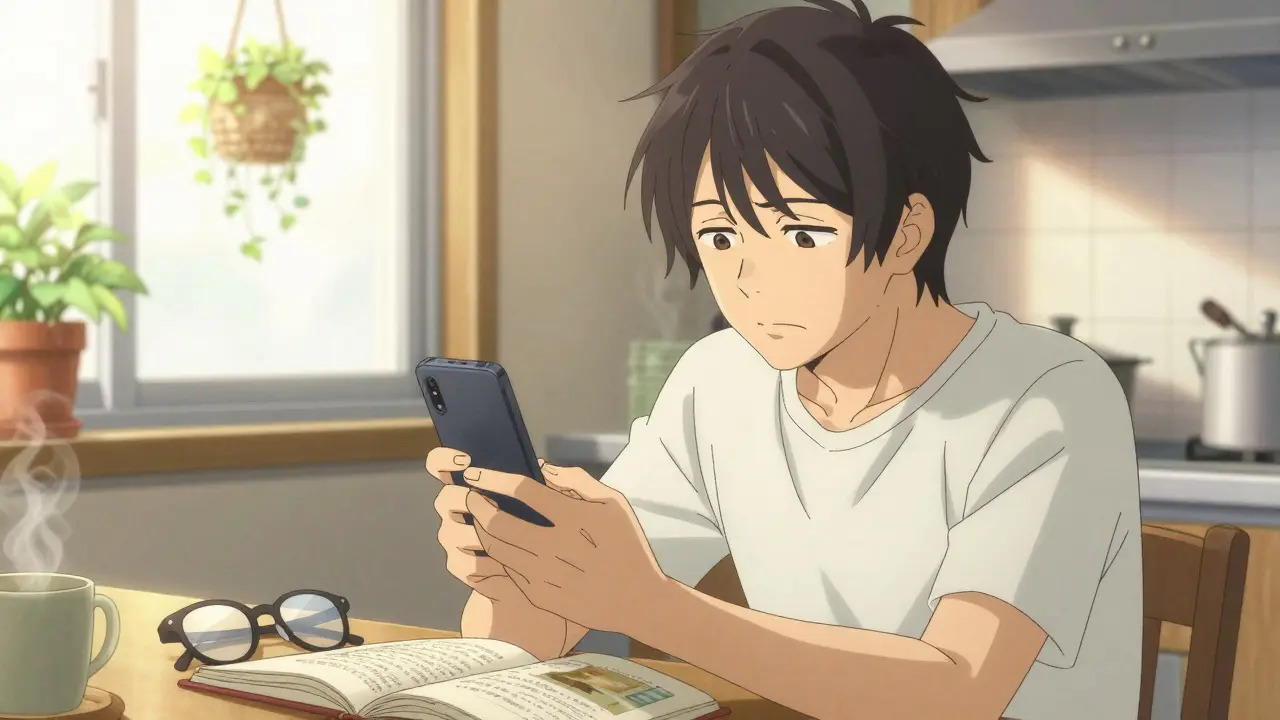
By your mid-40s, you might start holding your phone farther away to read text. Or you’re squinting at the menu in a dimly lit restaurant. You’ve tried brighter lights, bigger fonts, even cleaning your glasses-nothing helps. That’s not bad eyesight. It’s presbyopia. And it’s happening to you because your eyes are aging, not because you’re doing anything wrong.
What Exactly Is Presbyopia?
Presbyopia isn’t a disease. It’s not caused by too much screen time, poor lighting, or lack of eye exercises. It’s a natural, unavoidable change in how your eye works. Every single person gets it-no exceptions. By age 45, nearly everyone starts noticing trouble focusing on close-up things like books, recipes, or text messages. The problem starts inside your eye. Your lens, the clear part behind your pupil, used to be flexible. When you looked at something nearby, it bent and thickened to focus light perfectly on the back of your eye. Think of it like a camera lens adjusting for a close-up shot. But as you age, that lens gets stiffer. It’s like a rubber band that’s been stretched too many times-it just doesn’t bounce back the same way. By age 60, your lens has lost most of its ability to change shape. That’s why you can’t focus on things closer than 30 to 40 centimeters anymore. This is different from farsightedness. Farsightedness is about the shape of your eyeball. Presbyopia is about the lens losing its flexibility. And unlike cataracts or glaucoma, it doesn’t damage your eye. It just makes it harder to see up close.How Bad Does It Get? The Numbers Don’t Lie
The decline in near vision follows a clear pattern. At age 10, your eyes can focus on something as close as 7 centimeters. By age 60, that distance jumps to over 100 centimeters-more than a meter. That’s why you’re holding your phone at arm’s length. Your corrective power needs grow steadily:- Age 45: You likely need +1.00 diopter reading glasses
- Age 50: Around +1.50 to +2.00
- Age 60: +2.50 to +3.00 is common
- Age 65+: Many need +3.00 to +3.50
Reading Glasses: The Simple Fix
The easiest solution? Reading glasses. They’re cheap, widely available, and work immediately. You can buy them at any pharmacy, grocery store, or online for as little as $6. They come in strengths from +0.75 to +3.50, in 0.25-diopter steps. But here’s the catch: over-the-counter readers aren’t perfect. About 35% of people pick the wrong strength. Too weak, and you’re still squinting. Too strong, and your eyes strain, giving you headaches or blurry vision. If you’re using them for more than occasional reading-like scrolling through your phone or working on a laptop-you’re better off getting a proper eye exam. Prescription reading glasses are made for your exact needs. They account for differences between your two eyes, your pupillary distance, and how your glasses sit on your face. For people who need correction for both distance and near vision, single-vision readers just aren’t enough.
Progressive Lenses: The Seamless Alternative
If you already wear glasses for distance, progressives might be your best bet. These are single lenses with three zones: distance at the top, intermediate (like computer screens) in the middle, and near vision at the bottom. No lines. No switching glasses. They’re more expensive-$250 to $450-but they’re designed to mimic natural vision. Newer models, like Essilor’s Eyezen Progressive 2.0 (launched in 2023), have wider near zones based on data from 10,000 wearers. That means less head movement and fewer headaches. But they’re not magic. About 25% of first-time wearers feel dizzy or disoriented at first. Your brain needs 2 to 4 weeks to learn how to use them. You can’t just turn your head-you have to move your whole head to look down at your book or up at the screen. That’s why many people give up too soon.Other Options: Contacts, Surgery, and New Tech
Some people try monovision contact lenses. One eye is corrected for distance, the other for near. It works for about 80% of users, but 15% lose depth perception-bad news if you drive a lot or play sports. Surgery is another path. LASIK monovision costs $2,000 to $4,000 per eye and has 85% satisfaction. But 35% of patients get dry eyes afterward, and 10-15% need a second procedure within five years. Refractive lens exchange replaces your natural lens with an artificial one-like cataract surgery, but done before cataracts form. It costs $3,500 to $5,000 per eye. It’s permanent, but you might see halos at night or have reduced contrast sensitivity. Endophthalmitis (a rare but serious infection) happens in 0.04% of cases. There’s also a new option: Presbia’s Flexivue Microlens. It’s a tiny implant placed in the cornea, approved in Europe in 2022. It improves near vision without removing your natural lens. Early results show 78% of users reach 20/25 near vision after a year.What Doesn’t Work
You’ll see ads for eye exercises, supplements, or “natural cures” for presbyopia. They don’t work. The lens hardens because of biology-not lifestyle. No amount of carrot juice, yoga, or screen breaks will reverse it. Dr. Emily Chew from the National Eye Institute put it plainly: “No amount of eye exercises or dietary changes can prevent presbyopia-it’s as inevitable as gray hair.”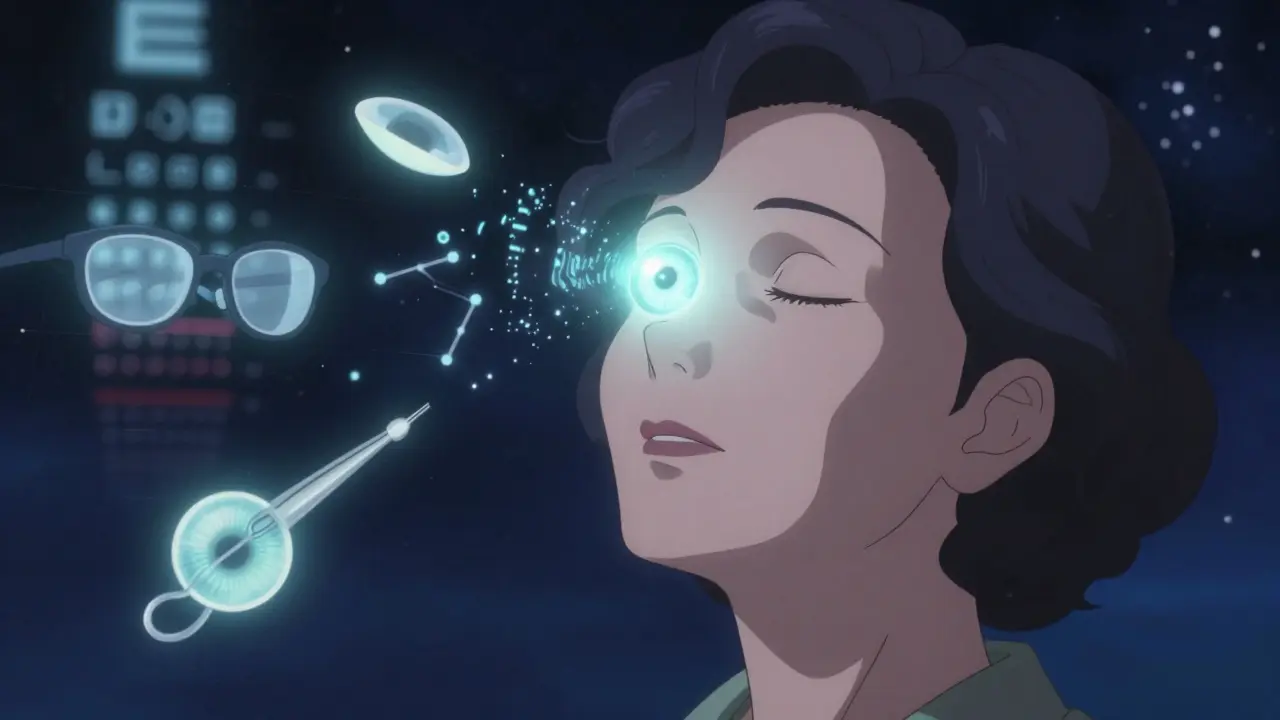
When to See an Eye Doctor
The American Academy of Ophthalmology recommends a full eye exam at age 40. That’s not just for presbyopia. It’s to catch glaucoma, macular degeneration, or diabetic retinopathy early-conditions that can steal your vision silently. If you’re over 40 and struggling with near vision, don’t just grab the first pair of readers off the shelf. Get your prescription checked. A proper exam includes cycloplegic refraction, which temporarily relaxes your eye muscles to get the true reading. Without it, your add power might be underestimated by 0.25 to 0.50 diopters-enough to make your glasses uncomfortable.What’s Coming Next
Research is moving fast. In 2023, Johnson & Johnson got FDA approval for Acuvue Oasys Multifocal with “Enhanced Near Technology,” showing 89% success in trials. The National Eye Institute is testing a new eye drop called VP-025. Early results show it can temporarily improve near vision by 1.0 to 1.5 diopters for up to six hours. That could mean a future where you don’t need glasses at all-just a drop before reading.Final Thoughts: You’re Not Broken
Presbyopia doesn’t mean you’re getting old in a bad way. It means you’re getting older in a normal, human way. Over 1.8 billion people worldwide live with it right now. By 2030, that number will hit 2.1 billion. You don’t need to suffer. You don’t need to guess. You don’t need to believe in miracle cures. You just need to know what’s happening-and how to fix it. Reading glasses are simple. Progressives are seamless. Surgery is permanent. There’s no one-size-fits-all answer. But there is a right answer-for you. Start with an eye exam. Don’t wait until you’re straining every day. Your eyes are changing. That’s okay. You just need the right tools to keep seeing clearly.Is presbyopia the same as farsightedness?
No. Farsightedness (hyperopia) happens when your eyeball is too short or your cornea is too flat, making it hard to focus on close objects even when young. Presbyopia is caused by the lens inside your eye becoming stiff with age. You can be farsighted and develop presbyopia later-but they’re two different problems with different causes.
Can I use over-the-counter reading glasses forever?
You can, but it’s not ideal. OTC readers are made for average eyes and assume both eyes need the same power. If your eyes have different prescriptions, astigmatism, or you need correction for distance too, they’ll cause eye strain, headaches, or blurry vision. For occasional use-like reading a label once a week-they’re fine. For daily tasks like reading, texting, or working on a computer, prescription lenses are better.
Why do progressive lenses make me dizzy at first?
Progressive lenses have a curved gradient of power from top to bottom. Your brain has to learn how to use the right part of the lens for each distance. Peripheral areas can be blurry or distorted, which feels like walking on a sloped floor. Most people adapt in 2 to 4 weeks. Moving your head instead of your eyes helps. If you’re still dizzy after a month, your lenses might be poorly fitted or too strong.
Do eye exercises help with presbyopia?
No. Studies show eye exercises can improve focus temporarily, but they don’t reverse lens stiffening. The hardening of the lens is a physical change caused by aging, not muscle weakness. No amount of rolling your eyes or focusing drills will restore flexibility. The National Eye Institute confirms this: presbyopia is inevitable and can’t be prevented by lifestyle.
When should I get my first pair of reading glasses?
There’s no set age, but most people notice symptoms between 40 and 45. If you’re holding books farther away, squinting at your phone, or getting headaches after reading, it’s time to get checked. Don’t wait until it’s painful. A simple eye exam can confirm if it’s presbyopia and give you the right strength. Starting with a lower power (+1.00 to +1.50) often helps ease into it.
Are progressive lenses worth the cost?
If you need correction for both distance and near vision, yes. Bifocals have a visible line and limit your intermediate vision (like computer screens). Progressives give you smooth, natural vision across all distances. They’re more expensive, but they’re the closest thing to seeing normally without switching glasses. Newer designs have wider viewing zones and less distortion, making them easier to adapt to than older versions.
Can presbyopia lead to other eye problems?
Presbyopia itself doesn’t cause other conditions. But it often appears at the same age as glaucoma, macular degeneration, or cataracts. That’s why eye exams at 40 are so important. What you think is just trouble reading might actually be an early sign of something more serious. Regular checkups catch those problems before they damage your vision.







doug b
Been there. Bought the $6 readers from CVS. Lasted two weeks before my left eye started screaming. Turned out I had astigmatism. Don’t be like me. Get an exam. Your eyes will thank you.
fiona vaz
I was skeptical at first, but after my first pair of progressives, I felt like I got my youth back. No more switching glasses when I’m cooking or scrolling. Took me three weeks to adjust, but now I can’t imagine going back.
Amber Daugs
People still buy those $6 readers like they’re buying candy? What are you, five? Your eyes aren’t a vending machine. If you can’t afford a $150 exam, you shouldn’t be reading this post. Get your head out of the sand.
Ambrose Curtis
lol i used to think eye exercises worked until i tried the "figure 8" thing and ended up dizzy for an hour. turns out your lens is like an old rubber band, not a muscle. no amount of rolling your eyes will fix that. also, i got my first readers at 42 and i’m not even mad. it’s just biology, bro.
Linda O'neil
If you’re over 40 and still holding your phone at arm’s length, congrats-you’re normal. Don’t stress. Grab a pair of readers, get a coffee, and keep living. This isn’t a crisis. It’s a upgrade.
Chris Urdilas
Progressive lenses? More like progressive headaches. I wore mine for 3 weeks, then tossed them in a drawer and went back to bifocals. The only thing ‘seamless’ about them was how seamless it was to feel like a robot trying to read a menu.
Jeffrey Carroll
It is worth noting that the physiological changes associated with presbyopia are entirely consistent with the natural aging process of the crystalline lens. The loss of elasticity is due to increased cross-linking of lens proteins, a phenomenon well-documented in gerontological optics literature.
Phil Davis
So… we’re all just gonna accept that we’re gonna need glasses to read text messages? Cool. Guess I’ll just start yelling at my phone now. ‘HEY, CAN YOU READ THIS?’
Irebami Soyinka
USA people think everything can be bought at Walmart. In Nigeria, we just squint and say ‘God will fix it.’ 😂 But seriously, if you can afford a phone, you can afford $20 readers. No need for fancy lenses or surgery. Just hold it farther. We’ve been doing it since 1998.
Rose Palmer
It is imperative that individuals over the age of forty undergo comprehensive ophthalmic evaluations, as presbyopia frequently coexists with other sight-threatening pathologies. Over-the-counter corrective lenses may exacerbate undiagnosed refractive errors and contribute to ocular fatigue. Professional refraction remains the gold standard.
Howard Esakov
I bought the $12 readers from Target. They were ‘+2.25’ but my left eye needed +2.50. So I just… squinted harder. Like a real adult. 😎
Kathy Scaman
My grandma had reading glasses on a chain. I thought that was so old-fashioned. Now I have three pairs: kitchen, car, and couch. I’m basically a walking eyewear store.
Anna Lou Chen
Presbyopia is not merely a physiological phenomenon-it’s a capitalist epistemological rupture. The commodification of vision through progressive lenses and corporate optometry reinforces the neoliberal myth that aging is a technical problem to be solved, not a phenomenological transition. The eye drop VP-025? A pharmacological illusion masking our alienation from embodied temporality.
John Rose
Just curious-has anyone tried the new Acuvue Oasys Multifocal? I’ve been using daily disposables for years and hate switching to glasses. Wondering if they’re actually worth the hype.