
Ever wondered why a pharmacist can swap your brand-name prescription for a generic one without calling your doctor? Or why, on rare occasions, they tell you a specific generic isn't a direct substitute? The answer lies in a complex but essential system of letters and numbers managed by the FDA. These therapeutic equivalence codes are the secret language that tells healthcare providers whether a generic drug will actually do the same job as the brand-name version.
At its core, the system ensures that when you get a generic, you aren't just getting a "similar" drug, but one that produces the exact same clinical effect. This isn't about guesswork; it's a rigorous scientific process documented in a massive database known as the Orange Book, or officially, Approved Drug Products with Therapeutic Equivalence Evaluations. First launched in 1980, this book acts as the gold standard for drug substitution in the U.S.
If you're a patient, a student, or a healthcare worker, understanding these codes helps demystify the pharmacy counter. Here is how the FDA determines if a drug is truly interchangeable.
The Three Pillars of Therapeutic Equivalence
The FDA doesn't just hand out "A" ratings. To get a therapeutic equivalence (TE) code, a generic drug must pass three specific hurdles. According to FDA guidance, these three factors must be met to ensure patient safety and drug efficacy:
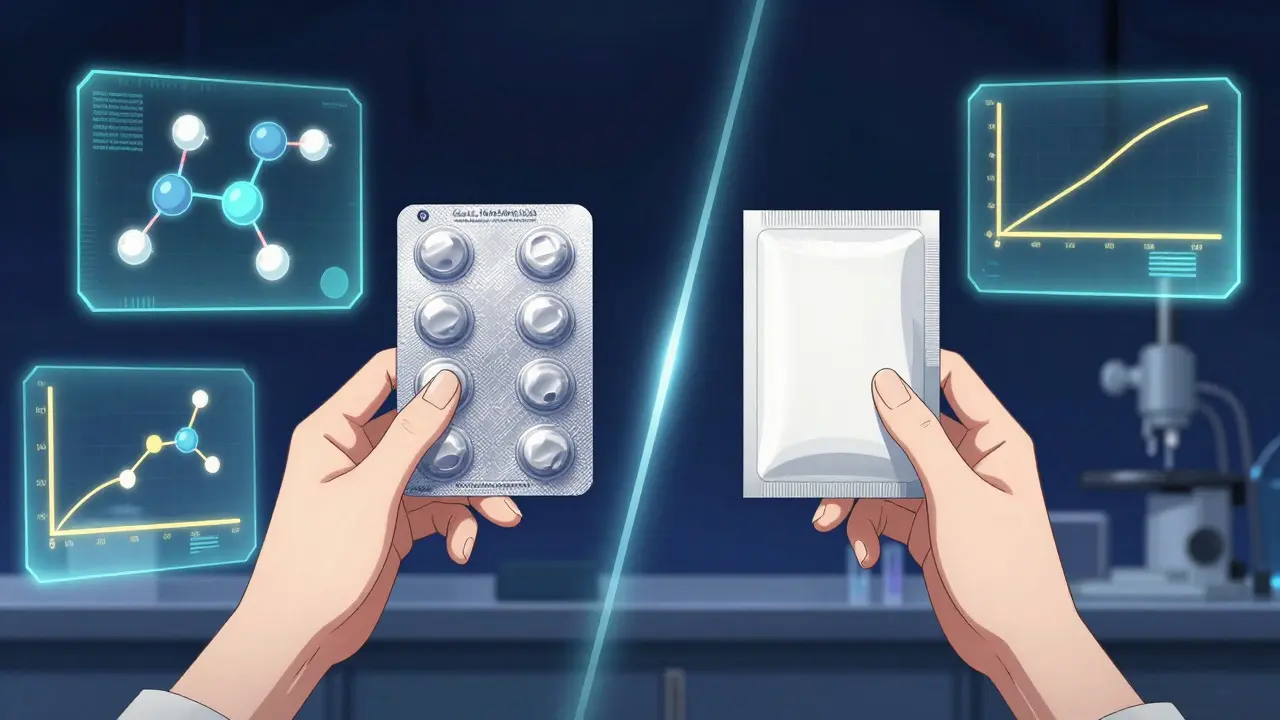
- Pharmaceutical Equivalence: The generic must have the same active ingredient, the same strength, the same dosage form (like a tablet or a capsule), and the same route of administration. If the brand name is a 20mg tablet, the generic must also be a 20mg tablet.
- Bioequivalence: This is where it gets technical. The FDA looks at how the drug is absorbed into the bloodstream. The generic must enter the body at the same rate and to the same extent as the brand-name drug. This is usually proven through in vivo (human) or in vitro (lab) studies.
- Clinical Performance: The drug must have the same safety profile and clinical effect when used for the specific condition listed on the label.
When a drug meets all three, it is deemed therapeutically equivalent. If it fails even one, it gets a different rating, which changes everything about how it can be dispensed at the pharmacy.
Decoding the Letters: What 'A' and 'B' Actually Mean
When you look up a drug in the Orange Book, you'll see a TE code consisting of one or two letters. The first letter is the most critical piece of information.
The 'A' Ratings: Safe for Substitution
If a drug starts with "A," it is considered therapeutically equivalent. The most common code you'll see is AB. This means the product is pharmaceutically equivalent and has met all bioequivalence requirements. In 49 U.S. states, pharmacists can automatically substitute an AB-rated generic for a brand-name drug without needing a new prescription from the doctor.
You might also see codes like AB1, AB2, or AB3. These suffixes are used when there are multiple Reference Listed Drugs (RLDs) for the same strength. It's essentially a way for the FDA to keep a clean ledger of which generic matches which specific brand version.
The 'B' Ratings: Proceed with Caution
A "B" rating means the FDA has not yet determined that the product is therapeutically equivalent. This doesn't necessarily mean the drug is "bad" or "dangerous," but it does mean there's a missing piece of evidence or a known variation in how the drug behaves. Because of this, a "B" rated drug cannot be automatically substituted for a brand name.
| Code | What it means | Typical Example/Context |
|---|---|---|
| BC | Extended-release forms | Drugs meant to release slowly over 12-24 hours. |
| BD | Bioequivalence problems | Active ingredients known to be tricky to absorb consistently. |
| BE | Delayed-release oral forms | Enteric-coated tablets that dissolve in the intestine. |
| BT | Topical products | Creams or gels where skin absorption is hard to measure. |
| BX | Insufficient data | The FDA hasn't received enough data to make a call. |
Why Some Drugs Struggle to Get an 'A' Rating
You might wonder why a reputable company can't just get an AB rating. The truth is, some drugs are just harder to copy. Simple tablets that dissolve quickly in the stomach are easy to prove as bioequivalent. However, complex generics-like inhaled steroids, long-acting injectables, or specialized creams-are a different story.
For instance, a topical cream (often rated BT) has to penetrate layers of skin to work. Because everyone's skin is different, proving that a generic cream is 100% identical in performance to the brand name is scientifically difficult. This is why the FDA has seen a 22% increase in "B" rated applications for complex generics between 2018 and 2022. The science is catching up, but the standards remain incredibly high to protect the patient.

The Real-World Impact on Your Wallet and Health
The TE code system isn't just academic; it has a massive impact on the economy. Generic drugs make up about 90% of all prescriptions filled in the U.S., yet they only account for 23% of total drug spending. This creates roughly $370 billion in annual savings for the healthcare system. Without the Orange Book's clear coding, pharmacists would have to spend hours researching every single swap, which would drive up costs and slow down pharmacy lines.
But it's not without friction. A survey by the American Medical Association found that 42% of physicians are confused by "B" codes. Some doctors might insist on a brand name because they don't trust a "B" rated generic, while others might not realize a "B" rating means the pharmacist can't legally swap the drug without their permission. This communication gap can lead to delays in treatment or higher costs for the patient.

What's Changing in 2026 and Beyond?
The FDA is currently moving toward a more modern approach to therapeutic equivalence. The Office of Generic Drugs has a strategic plan to reduce the number of "B" rated complex generics by 30% by 2027. How? By moving beyond simple blood tests (pharmacokinetics) and incorporating more real-world evidence and advanced Product-Specific Guidances (PSGs). These PSGs provide a detailed "roadmap" for manufacturers to prove their drug works, making it easier for them to earn that coveted "A" rating.
We are also seeing a shift toward using digital tools to update the Orange Book in real-time. Instead of relying on static editions, professionals now use searchable databases that reflect new approvals and code changes almost instantly, reducing the risk of a substitution error.
Is a 'B' rated drug unsafe?
Not necessarily. A 'B' rating means the FDA hasn't found sufficient evidence to guarantee it's therapeutically equivalent to the brand name. It could still be a safe and effective medication, but it cannot be automatically substituted without a doctor's specific approval because the clinical effect might differ slightly.
What is the difference between pharmaceutical equivalence and therapeutic equivalence?
Pharmaceutical equivalence means the drugs have the same active ingredient, strength, and form. Therapeutic equivalence goes a step further-it means the drug is pharmaceutically equivalent AND it's proven to have the same clinical effect and safety profile (bioequivalence).
Can I ask my pharmacist for an AB-rated generic?
Yes. In fact, most generics you receive are AB-rated. You can ask your pharmacist to verify the TE code in the Orange Book if you want to be sure your generic is a direct substitute for the brand name.
Why aren't over-the-counter (OTC) drugs given TE codes?
The TE code system is specifically designed for prescription drugs to regulate how pharmacists substitute medications. OTC drugs follow different regulatory pathways and don't require the same substitution framework since consumers choose them directly from the shelf.
Do all 50 states allow automatic substitution of 'A' rated generics?
Almost all of them. 49 states permit automatic substitution for 'A' rated generics. However, state laws vary on how pharmacists must notify the prescriber or patient, especially when dealing with 'B' rated products.






Quinton Bangerter
The "Orange Book" is just a convenient way for Big Pharma to keep the masses complacent while they shuffle chemicals around. You really think these "bioequivalence" studies aren't just manipulated data to benefit the highest bidder? It's all a game of corporate control and the FDA is just the referee on their payroll. The fact that 42% of doctors are confused by these codes is a feature, not a bug, because confusion keeps the profit margins high and the patients blind. Total joke.
Cynthia Didion
American standards are the only ones that actually matter here. Period.
dallia alaba
This is a great breakdown of the system. One thing to add for those who are confused is that the "B" rating often happens with Narrow Therapeutic Index (NTI) drugs. For these medications, even a tiny difference in the blood concentration can lead to a failure in therapy or toxicity. That's why the FDA is so strict with them. It's not about the drug being "bad," but about the precision required for that specific molecule to be safe. Always check with your pharmacist if you're on a high-risk med.
Lynn Smith
I totally agree with the point about the cost savings! It's so helpful that we have these generics to make healthcare more affordable for everyone.
Ms. Sara
It's vital that we emphasize the distinction between pharmaceutical and therapeutic equivalence. A lot of people see "same active ingredient" and assume it's the same drug, but the delivery system-the inactive fillers and the coating-can completely change how a drug is absorbed. We need more patient education on this so people aren't blindsided when a pharmacist can't make a swap. It's about safety first, not just convenience.
Tokunbo Elegbe
I appreciate the clarity here... truly... it helps a lot of people understand the process...!!!
Lesley Wimbush
Oh honey, it's just so precious that some people actually find the Orange Book "mysterious." It's basic pharmacology, really. But I suppose for the average person, it's a real revelation!
Still, the struggle of those physicians is just tragic. Imagine being a doctor and not understanding a simple letter code. Truly embarrassing.
Akshata Kembhavi
Interesting read. In India, we have a huge generic industry and the approach is slightly different, but the goal is the same. Nice to see how the US handles the regulatory side of things.
Venkatesh Venky
The pharmacokinetic profiles are so complex! It's amazing how the Cmax and Tmax are used to prove bioequivalence in these trials. We should all be motivated to support the move toward real-world evidence in 2026 because it will bring so much more transparency to the drug pipeline. Let's keep pushing for better access to medicine for everyone regardless of the brand!
Grace Grace
I am absolutly shook that some docters are confused by this!! It is simply unacceptable for the medical proffession to be this disorganiszed. We must demand more rigour in their training so patients do not suffer the consequences of this ignorance. It is a total travesty of justice for the sick!
julya tassi
Wait, so if my drug is BT, does that mean it's just a cream that might work differently? :) I've always wondered why some brands feel more "greasy" than others. Maybe that's the B-rating in action! 🌸
caesar simpkins
Man, imagining a pharmacist just staring at a "B" code and having to call a doctor for the fifth time today is just a vibe. The stress of those pharmacy lines is real, but the safety check is where the magic happens. Stay safe everyone.
William Young
It's a solid system for keeping people safe. Glad to see the FDA is updating the tools for the future.