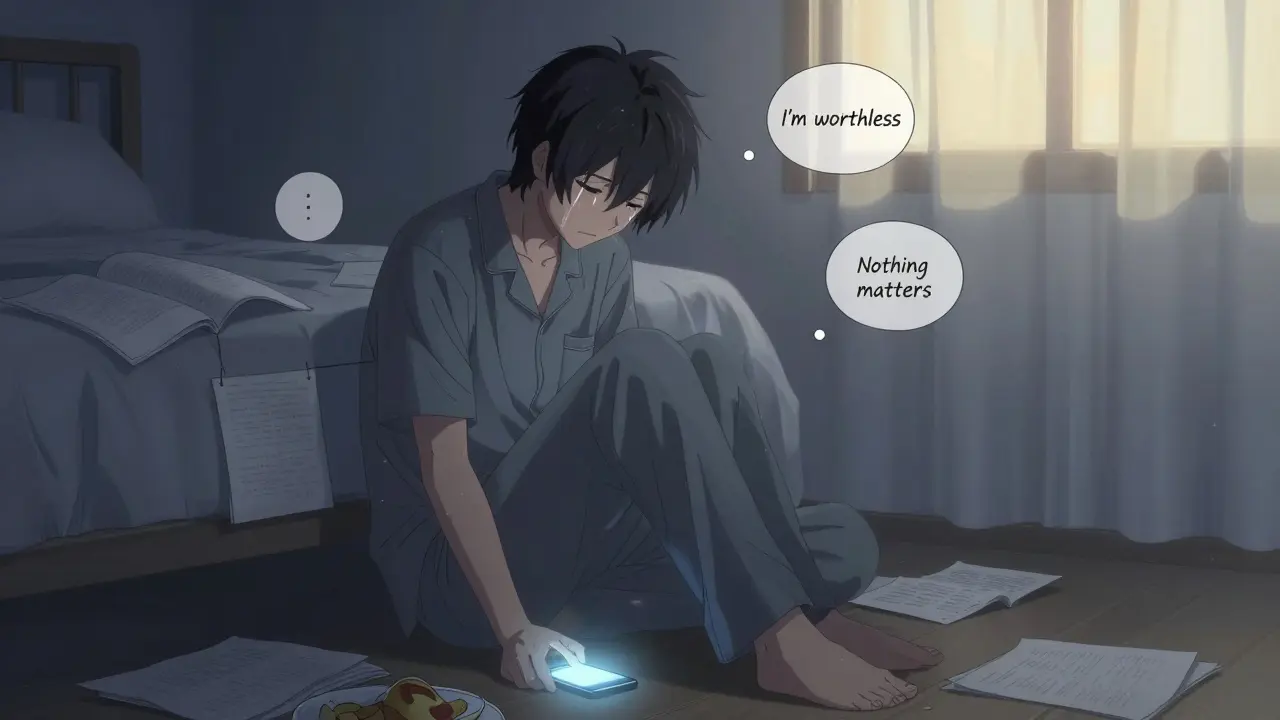
More than 1 in 6 U.S. adults experience major depressive disorder every year. That’s not just feeling sad-it’s a persistent, crushing weight that makes getting out of bed, answering texts, or even eating feel impossible. And while it’s common, it’s not something you just ‘snap out of.’ The good news? We have real, science-backed ways to treat it. Two of the most effective are antidepressants and psychotherapy. But which one works best? Can you use both? And what happens if one doesn’t help? Let’s cut through the noise.
What Major Depressive Disorder Really Feels Like
Major Depressive Disorder (MDD) isn’t a mood swing. It’s a clinical condition where low mood and loss of interest last for at least two weeks-often much longer. People don’t just cry more. They lose pleasure in things they once loved. Sleep gets wrecked. Energy vanishes. Concentration disappears. Some feel numb. Others are overwhelmed by guilt or worthlessness. It can hit after a breakup, job loss, or illness. Or it can show up with no warning at all.
It’s not weakness. It’s not laziness. It’s biology and psychology tangled together. Brain chemistry changes. Thinking patterns twist. The brain’s reward system slows down. And without treatment, it often gets worse.
Psychotherapy: Talking Your Way Out of the Dark
Therapy isn’t just chatting. Evidence-based psychotherapy is structured, goal-oriented, and backed by decades of research. It’s like mental strength training.
Cognitive Behavioral Therapy (CBT) is the most studied and widely recommended. It works by helping you spot and change distorted thoughts-like ‘I’m a failure’ or ‘Nothing will ever get better’-that feed depression. You don’t just talk about your past. You learn tools: how to challenge negative beliefs, reframe situations, and build small, doable habits. A typical course lasts 12 to 20 sessions. Many people start feeling shifts in 4 to 6 weeks.
Behavioral Activation is a simpler version of CBT. It’s all about action. When you’re depressed, you withdraw. You stop doing things that used to bring joy. Behavioral activation forces a gentle return: walk outside for 10 minutes. Call a friend. Cook one meal. These small wins rebuild your sense of control. It’s especially useful in primary care settings where time is limited.
Interpersonal Therapy (IPT) focuses on relationships. Depression often thrives in isolation or conflict. IPT helps you untangle problems with partners, family, or coworkers. It doesn’t blame anyone. It just helps you communicate better, set boundaries, and repair connections that have frayed.
Acceptance and Commitment Therapy (ACT) teaches you to stop fighting painful thoughts. Instead of trying to erase them, you learn to make room for them while still moving toward what matters. It’s not about feeling happy-it’s about living fully, even when you don’t feel great.
And now, therapy isn’t always in-person. Computerized CBT (CCBT) delivers structured programs through apps or websites. It’s a lifeline for people in rural areas, those with mobility issues, or anyone who can’t get an appointment for months. But it’s not for everyone. You need to be motivated and comfortable with technology. No app replaces a human therapist’s empathy-but it’s better than nothing.
Antidepressants: Resetting the Brain’s Chemistry
Antidepressants don’t make you ‘happy.’ They help your brain function better so you can engage with therapy, sleep, eat, and reconnect with life. They’re not addictive. They don’t turn you into a zombie. But they do come with side effects-and they take time.
First-line options are mostly SSRIs (Selective Serotonin Reuptake Inhibitors): escitalopram, sertraline, fluoxetine, paroxetine. These are the most commonly prescribed. They’re generally well-tolerated, but nausea, weight gain, and sexual side effects are common early on. Many people quit too soon because they feel worse before they feel better. That’s normal. It often takes 4 to 8 weeks to see real improvement.
SNRIs (Serotonin-Norepinephrine Reuptake Inhibitors) like venlafaxine and duloxetine are often used for more severe cases. They can help with both mood and physical pain, which often coexists with depression.
Mirtazapine and amitriptyline are older but still effective. Mirtazapine can help with sleep and appetite loss. Amitriptyline is powerful but has more side effects, so it’s usually reserved for cases that don’t respond to others.
Studies show that at eight weeks, escitalopram, mirtazapine, paroxetine, venlafaxine, and amitriptyline are among the most effective at reducing symptoms by more than half. But no single drug works for everyone. Finding the right one is trial and error-with your doctor’s help.

Combination Therapy: The Gold Standard
Here’s the clearest takeaway from recent research: for moderate to severe depression, combining medication with psychotherapy works better than either alone.
Antidepressants help stabilize your mood enough to actually do the hard work of therapy. Therapy gives you tools to prevent relapse. One study showed that people who got both CBT and an SSRI were 30% more likely to recover fully than those who got just one.
This isn’t about doubling down. It’s about synergy. Medication lifts the fog. Therapy teaches you how to stay out of it.
For mild depression, therapy alone is often enough. For severe depression (PHQ-9 score ≥16), guidelines from NICE and the AAFP strongly recommend combining both. If you’re suicidal, hospitalized, or completely unable to function, electroconvulsive therapy (ECT) may be the fastest, most effective option.
What Doesn’t Work-And Why
Some people expect therapy to ‘fix’ them in a few sessions. It doesn’t. It takes practice. You’ll have homework. You’ll feel uncomfortable. That’s part of the process.
Some expect antidepressants to work overnight. They don’t. And if you stop them suddenly, you can get withdrawal symptoms-dizziness, brain zaps, nausea. Always taper off with your doctor’s guidance.
Self-help books and apps alone? They can help, but they’re not enough for clinical depression. The same goes for supplements like St. John’s Wort. They’re not regulated. They interact dangerously with other meds. Don’t risk it.
And yes, antidepressants are overprescribed in some places. But that doesn’t mean they’re useless. The problem isn’t the drugs-it’s the lack of access to therapy. Too many people get a prescription and no follow-up. That’s not treatment. That’s bandaging a wound without cleaning it.

Choosing What’s Right for You
There’s no one-size-fits-all. Your choice depends on:
- How severe your symptoms are
- Whether you’ve tried treatment before
- Your physical health and other medications
- Your access to therapy (waitlists can be months long)
- Your comfort with medication side effects
- Your willingness to do the work in therapy
If you’re new to treatment and have moderate symptoms, start with therapy. If you’re severely depressed, can’t get to a therapist for months, or feel too overwhelmed to engage in therapy right now, start with medication. Many people begin with one and add the other later.
And if you’ve tried one antidepressant and it didn’t work? Don’t give up. There are 15+ options. Switching or adding a second medication is common and often successful.
Real People, Real Experiences
One Reddit user wrote: ‘SSRIs made me emotionally numb but functional.’ Another said: ‘CBT taught me skills I still use five years later.’ Both are true.
Medication can get you back on your feet. Therapy helps you stay there.
People in rural areas often struggle to find therapists. Telehealth has changed that. Online CBT programs are now part of standard care in the NHS and many U.S. clinics.
Cost is a barrier. But 83% of large employers now cover mental health services. If you’re insured, call your provider. Ask what’s covered. You might be surprised.
What to Do Next
If you think you have major depressive disorder:
- See your primary care doctor. They can screen you with a simple questionnaire.
- Ask about referrals to therapists or psychiatrists.
- Don’t wait for ‘the perfect time.’ Depression doesn’t pause.
- Consider telehealth if in-person options are limited.
- If you’re in crisis, call or text 988 (Suicide & Crisis Lifeline). It’s free, confidential, and available 24/7.
Recovery isn’t linear. Some days will feel like progress. Others will feel like backsliding. That’s normal. What matters is that you keep showing up-for yourself, for your treatment, for your life.
You don’t have to fix everything at once. Just start somewhere. One step. One therapy session. One pill. One day.
Can antidepressants make depression worse at first?
Yes, some people feel worse in the first 1 to 2 weeks-more anxious, restless, or emotionally raw. This is a known side effect, especially with SSRIs. It doesn’t mean the medication isn’t working. It usually passes. But if you feel suicidal or extremely agitated, contact your doctor immediately. Never stop medication without medical supervision.
How long does psychotherapy take to work?
Most people start noticing small changes in 4 to 6 weeks. Significant improvement usually takes 12 to 20 weekly sessions. CBT and IPT are time-limited by design. You’re not in therapy forever-you’re learning skills you can use for life. The goal is to become your own therapist over time.
Is online therapy as good as in-person?
For structured therapies like CBT, yes-studies show online CBT is just as effective as face-to-face for mild to moderate depression. The key is consistency. You need to complete the modules and do the exercises. The lack of personal connection can be a drawback for some, especially those with severe symptoms or trauma. But for access and convenience, it’s a powerful tool.
What if I don’t respond to the first antidepressant?
You’re not alone. About 30% of people don’t respond to the first medication tried. That doesn’t mean you won’t respond to another. Doctors often switch to a different class-like from an SSRI to an SNRI-or add a second medication. It can take 2 to 3 tries to find the right fit. Patience and persistence matter more than perfection.
Can I stop taking antidepressants once I feel better?
Not without talking to your doctor. Stopping suddenly can cause withdrawal symptoms like dizziness, nausea, and brain zaps. Most doctors recommend staying on medication for at least 6 to 12 months after you feel better to prevent relapse. For people with multiple episodes, longer-term use may be advised. Therapy can help you taper off safely.
Are there natural alternatives to antidepressants?
Exercise, sleep, sunlight, and a balanced diet help-but they’re not substitutes for clinical treatment. Supplements like St. John’s Wort can interact dangerously with other medications and aren’t regulated. Omega-3s and vitamin D may offer small benefits, but they won’t fix major depression alone. Always talk to your doctor before trying anything new.









roger dalomba
Oh great, another ‘science-backed’ guide that treats depression like a software bug you can patch with a pill and a worksheet. 🙄
Brittany Fuhs
Why do we keep letting corporations push antidepressants like soda? In my day, people just prayed and worked harder. Now we medicate kids who can’t sit still through a TikTok scroll. Sad.
Peter sullen
It is imperative to underscore that the neurochemical modulation afforded by SSRIs and SNRIs, when synergistically integrated with evidence-based cognitive restructuring protocols, yields a statistically significant improvement in functional recovery metrics, as corroborated by meta-analytic data from the JAMA Psychiatry cohort studies (2021).
Moreover, the adherence-to-treatment parameter remains the most salient predictor of longitudinal remission, with non-compliance rates exceeding 60% in primary care settings - a systemic failure of patient education and care coordination.
Steven Destiny
Stop being so passive. If you’re depressed, GET UP. Go for a run. Call someone. Stop scrolling. Therapy is for people who don’t want to fight. Medication? Fine. But don’t sit there waiting for a magic pill to fix your life - YOU have to do the work. No one’s coming to save you.
Fabio Raphael
I’ve been on sertraline for 14 months and started CBT last year. Honestly? Neither one alone would’ve saved me. The med took the edge off the screaming in my head. Therapy taught me why it was screaming.
It’s not about being fixed. It’s about learning how to carry the weight without collapsing. I still have bad days. But now I know how to breathe through them.
Thank you for writing this. I wish I’d seen it two years ago.
Amy Lesleighter (Wales)
you dont need a phd to get better. just move your body. talk to someone. sleep. eat. dont let anyone tell you its complicated. its not. its just hard. and you’re not broken.
you’re just tired.
Rajni Jain
As someone from India where therapy is still a luxury, I’m so glad this post mentions telehealth. My cousin took an online CBT course through a nonprofit - it didn’t fix everything, but it gave her a reason to get up in the morning.
Also, please stop shaming people who take meds. Some of us don’t have access to weekly therapy. We do what we can.
Natasha Sandra
OMG YES to combo therapy!! 🙌 I tried Lexapro alone and felt like a zombie. Then I got a therapist and now I’m actually… living? Who knew? Also, side note: if your therapist makes you cry every session, you’re doing it right. 💕
Erwin Asilom
For those wondering whether to start with medication or therapy: consider your current functional capacity. If you’re unable to complete basic self-care tasks, pharmacological intervention may be necessary to create the cognitive stability required to engage meaningfully in therapeutic work. The sequence is not arbitrary - it is clinically strategic.