
Every year, millions of pregnant women turn to the internet to find out if a medication is safe. They search for answers about paracetamol, antidepressants, asthma inhalers, or even herbal teas. But here’s the hard truth: online pregnancy medication advice is often wrong. A 2019 study found that only 57% of online posts about medication safety during pregnancy matched the gold-standard classifications from Teratology Information Services. That means nearly half the advice you read could be misleading, outdated, or dangerously incomplete.
Why Online Advice Gets It So Wrong
The problem isn’t just bad information-it’s how it’s presented. Social media posts, Reddit threads, and even some blog articles use emotional language: “My cousin took this and her baby had problems,” or “This drug is poison-avoid at all costs.” These stories stick because they feel real. But correlation isn’t causation. Just because someone took a medication and had a complication doesn’t mean the drug caused it. Underlying conditions, genetics, lifestyle, and timing all play roles-and most online sources ignore that. Even worse, commercial websites often hide their sponsors. A 2024 study found that 42% of sites claiming to offer “educational” pregnancy medication advice had undisclosed ties to pharmaceutical companies. These sites may downplay risks of expensive brand-name drugs while exaggerating dangers of cheaper generics. They’re not trying to help you make a safe choice-they’re trying to sell you something.The Gold Standard: What Experts Actually Use
Doctors and pharmacists who specialize in pregnancy don’t rely on Google. They use trusted, evidence-based systems built over decades. The most respected is the Teratology Information Services (TIS) a classification system used by specialized counseling centers to evaluate drug risks during pregnancy and breastfeeding. TIS doesn’t just say “safe” or “dangerous.” It breaks it down:- Safe - No known risk based on human data
- Contraindicated - Proven harm; avoid completely
- On strict indication or second-line - May be needed if benefits outweigh risks
- Insufficient knowledge - Not enough human studies to be sure
Here’s where most websites fail. If a source says “Lamotrigine is safe in pregnancy,” but doesn’t mention it falls under “strict indication,” they’re leaving out critical context. Lamotrigine is often needed for epilepsy or bipolar disorder-and stopping it can be far more dangerous than taking it. But without the full picture, women panic and quit their meds.
Another key tool is the LactMed a free, peer-reviewed database from the National Library of Medicine that details drug levels in breast milk and potential infant effects. It’s updated weekly and includes dosing recommendations for nursing mothers. If a site talks about breastfeeding safety but doesn’t reference LactMed, treat it like a rumor.
How to Spot a Reliable Source
Not all websites are created equal. Here’s how to tell the difference:- .gov or .edu domains - Sites like the CDC, NIH, or university medical centers are most trustworthy. Look for MotherToBaby (run by OTIS), which is .org but backed by the FDA and CDC.
- Author credentials - Is the writer a board-certified OB-GYN, clinical pharmacist, or teratologist? Check their credentials on the American Board of Medical Specialties website. If the author’s name is missing, walk away.
- Citations to primary research - Reliable sources link to real studies: “A 2021 JAMA Internal Medicine study of 95,000 pregnancies found no link between paracetamol and neurodevelopmental issues (DOI: 10.1001/jamainternmed.2021.1234).” If it just says “studies show,” it’s empty.
- Clear date of last update - Medical knowledge changes fast. A 2018 article on SSRIs might say they’re “likely safe,” but 2023 data shows higher risk of preterm birth at high doses. Anything older than two years needs extra scrutiny.
One red flag: phrases like “This drug has been used for decades without harm.” That’s not evidence. That’s tradition. The FDA didn’t start requiring detailed pregnancy risk summaries until 2015. Older drugs often have outdated labels that say “Category C” with no context. Don’t trust vague history-look for recent data.
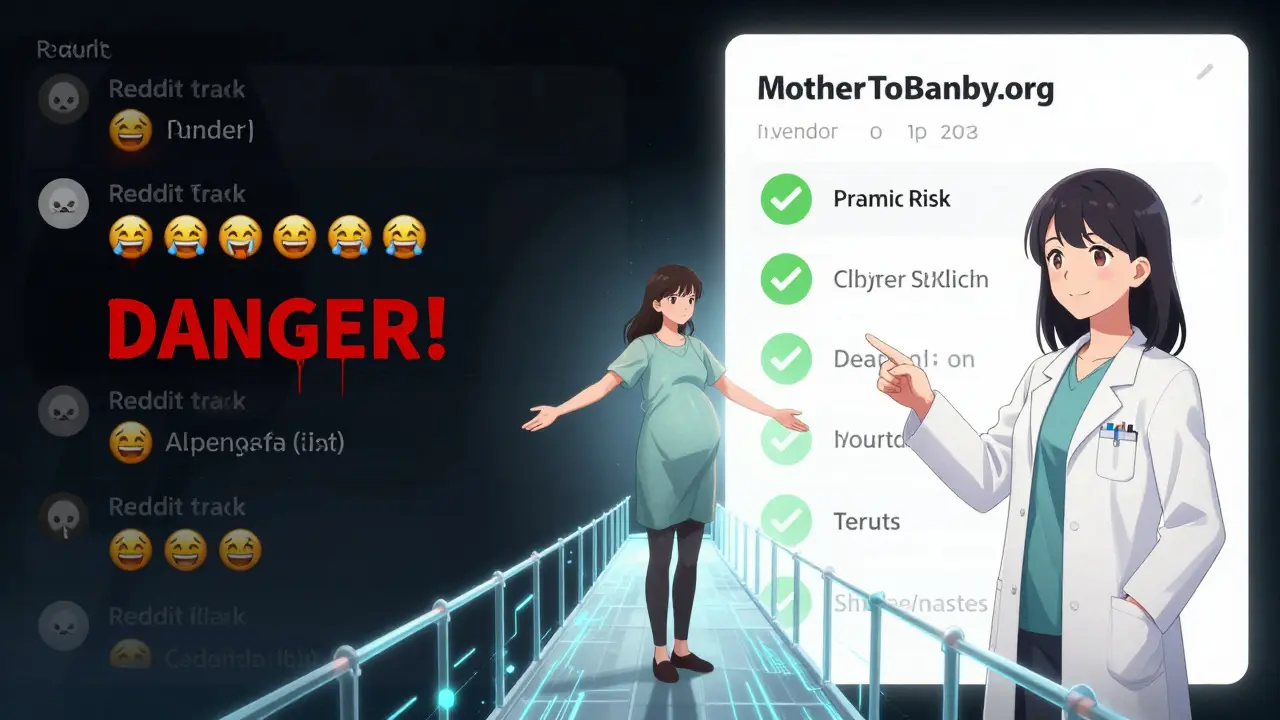
The TRIAD Method: Your Simple Verification System
You don’t need to be a doctor to check if advice is accurate. Use this three-step system called TRIAD:- Check Teratology databases - Go to MotherToBaby.org or LactMed.nih.gov. Search the exact drug name. Note the classification and any warnings.
- Review primary literature - If the source cites a study, find it. Look for the journal name, authors, sample size, and whether it was done on humans. Animal studies don’t apply to pregnant women.
- Assess the date - Is the information less than two years old? If not, check if it’s been updated or flagged as outdated. The FDA’s 2024 AI scanner found that 78% of outdated labels still circulate online.
This takes 15-20 minutes. But it’s better than risking your health-or your baby’s-on a viral post.
What to Do When You’re Still Unsure
Even after checking sources, you might still feel confused. That’s normal. Medication decisions during pregnancy are complex. You don’t have to figure it out alone.- Call MotherToBaby a free, confidential service staffed by specialists who answer questions about medications, vaccines, and exposures during pregnancy and breastfeeding at 1-866-626-6847. They’re available 24/7 and don’t sell anything.
- Ask your OB-GYN or midwife: “Can you help me check this information against the latest guidelines?” Most are happy to help-especially now that ACOG recommends 5-minute source literacy checks during prenatal visits.
- Use the NIH PRISM initiative a federal program launched in January 2025 to develop browser extensions that automatically verify pregnancy medication claims against authoritative databases. A beta browser extension is already available for Chrome and Firefox that flags inaccurate claims in real time.
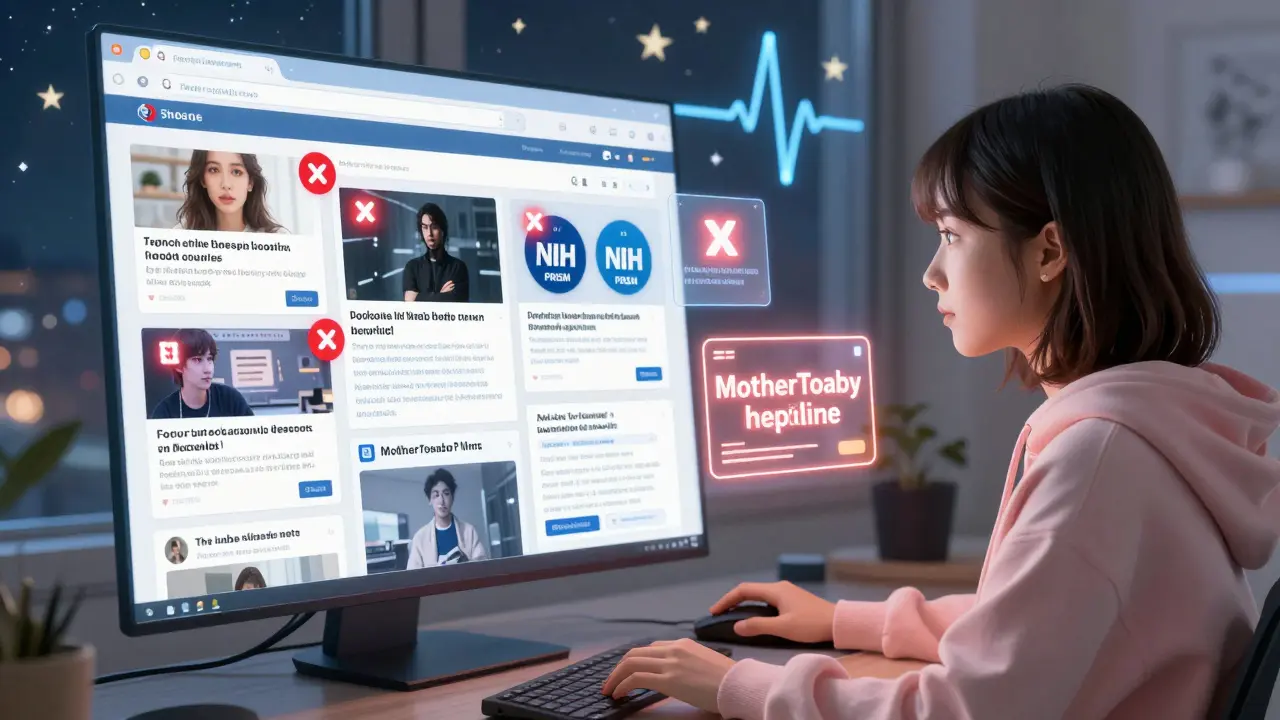
Why This Matters More Than You Think
This isn’t just about avoiding a bad drug. It’s about not stopping a good one.A 2024 Reddit analysis of the r/BabyBumps community found 87 cases where women stopped taking antidepressants after reading inaccurate posts. Twenty-nine of them ended up in emergency psychiatric care. That’s not an isolated case. The same thing happens with asthma inhalers, thyroid meds, and blood pressure drugs. Women hear “it might be risky” and assume “it’s definitely dangerous.” They quit. And then they suffer.
On the flip side, women who used structured verification tools-like the WeChat-based education program in China-saw their ability to identify credible sources jump from 52% to 68% in just four hours. Confidence didn’t just go up. Safety did too.
The Future Is Here-But You Still Need to Be Smart
New tools are coming. The FDA’s Digital Health Software Precertification Program, launching in 2026, will require pregnancy apps to prove their advice is accurate before being sold. AI scanners are already flagging 83% of false claims. But technology won’t fix everything.Why? Because social media rewards outrage, not accuracy. A 2024 JAMA study found misinformation posts get 3.7 times more shares than corrections. Algorithms don’t care if you’re safe-they care if you click.
So until the system changes, you’re still the best filter. Don’t trust a post because it feels right. Don’t trust a comment because it sounds caring. Trust data. Trust sources. Trust your right to ask for proof.
When in doubt, pause. Check. Call. Ask. Your body, your baby, and your peace of mind are worth those extra minutes.
Can I trust advice from my pharmacist about pregnancy medications?
Most pharmacists are knowledgeable, but not all specialize in pregnancy. Ask if they’ve consulted Teratology Information Services (TIS) or LactMed. If they can’t cite a source or say “I’m not sure,” ask them to look it up with you. Some pharmacies have access to specialized pregnancy drug databases-request it. Never rely on memory or general knowledge alone.
Are herbal supplements safe during pregnancy because they’re ‘natural’?
No. The term “natural” means nothing when it comes to safety. A 2023 study found 63% of pregnant women believed herbal supplements needed FDA approval-when in reality, less than 0.3% are tested for pregnancy safety. Some herbs like black cohosh, goldenseal, and pennyroyal can trigger contractions or liver damage. Always check LactMed or MotherToBaby before taking any supplement, even chamomile tea.
What if a doctor says a drug is safe but an online source says it’s dangerous?
Ask your doctor for their source. A good provider will say, “I’m referencing the 2023 OTIS update” or “This is based on the latest FDA Pregnancy and Lactation Labeling Rule.” If they can’t point to a specific database or study, ask them to check. Don’t assume your doctor knows everything-medication guidelines change constantly. The best doctors welcome questions and cross-reference with TIS databases regularly.
Is it okay to use pregnancy apps that give medication advice?
Only if they’re backed by a known medical organization like MotherToBaby, ACOG, or the CDC. Most apps-over 88%-aren’t independently verified. Even popular ones may pull data from unreliable blogs or outdated sources. Check the app’s “About” page. If it doesn’t name its medical advisors or cite sources like LactMed or OTIS, treat it as entertainment, not medical advice.
How do I know if a study cited online is real?
Look for a DOI (Digital Object Identifier), journal name, author names, and sample size. A real study will say something like, “Liew et al., JAMA Internal Medicine, 2021, n=95,000.” Paste the DOI into pubmed.ncbi.nlm.nih.gov. If it doesn’t pull up the original paper, the source is lying or misrepresenting the study. Be especially wary of studies that say “research shows” without naming the journal or authors.
What should I do if I’ve already taken a medication based on bad online advice?
Don’t panic. Most medications don’t cause harm from a single dose or short-term use. Contact your OB-GYN or call MotherToBaby at 1-866-626-6847. They can assess your exposure, review the drug’s actual risk profile, and help you decide whether to continue, adjust, or stop. Most importantly, they’ll help you avoid repeating the mistake by teaching you how to evaluate future advice properly.
Next Steps: What to Do Today
If you’re currently taking any medication during pregnancy-or thinking about it-do this now:- Write down every medication, supplement, or herb you’re using.
- Go to MotherToBaby.org and search each one.
- Compare what you found online with what TIS says.
- If they don’t match, call 1-866-626-6847 or ask your provider for clarification.
You don’t need to be an expert. You just need to be careful. The right information can save your health. The wrong one can cost you more than you know.








Sidhanth SY
Been there. Took lamotrigine during both pregnancies and nobody could give me a straight answer until I called MotherToBaby. Their info was way clearer than any Reddit thread. Seriously, if you're stressed about meds, just call them. Free, no ads, no BS.
Adarsh Uttral
lol i just googled 'is zyrtec safe pregnant' and got 3 different answers. one said yes one said no one said maybe its fine if u take it on tuesdays. i gave up and asked my midwife. she laughed and said 'google is not a doctor lol'. good post tho.
April Allen
The core issue here isn't misinformation-it's epistemic vulnerability. Pregnant individuals are systematically excluded from clinical trials, leaving pharmacokinetic and teratogenic data extrapolated from non-pregnant populations. This creates a knowledge asymmetry exploited by commercial entities and amplified by algorithmic bias. The TRIAD method is a necessary corrective, but institutional accountability must follow: regulatory bodies need to mandate real-time verification layers for health content, not just leave it to individual literacy. The burden shouldn't be on the patient to become a clinical epidemiologist.
Niamh Trihy
I used LactMed every time I started something new. Even my OB was surprised I knew the exact milk-to-plasma ratios for sertraline. It's wild how few providers even mention it. If you're on meds and breastfeeding, bookmark it. It's the only thing that doesn't sound like a horror story or a sales pitch.
Donna Fleetwood
You're not alone if this feels overwhelming. I cried reading the r/BabyBumps thread where someone stopped their antidepressants and ended up in the ER. Please don't let fear make the decision for you. Call MotherToBaby. Talk to your provider. You deserve to feel safe, not scared. You got this 💪
Sazzy De
My pharmacist didn't know about TIS classifications until I asked. He looked it up on his screen and said wow i never realized how vague those labels are. Now i bring my meds list every visit and ask 'what does TIS say' and he checks. Small thing big difference.
Gaurav Meena
Guys seriously just call MotherToBaby. I was terrified about my asthma inhaler and they walked me through the data like I was a human not a statistic. No sales pitch. No ads. Just facts. And they answered at 11pm on a Tuesday. My midwife said the same thing. If you're unsure, don't guess. Call. It's free. It's real. It's lifesaving. 🙏
Katie and Nathan Milburn
It is of paramount importance to recognize that the proliferation of unvetted medical information on digital platforms constitutes a significant public health challenge. The absence of standardized regulatory oversight for health-related content on social media and commercial websites renders the layperson particularly susceptible to cognitive biases such as anecdotal fallacy and confirmation bias. The proposed TRIAD methodology represents a cogent, evidence-based countermeasure worthy of institutional endorsement.
Natasha Plebani
The cognitive dissonance between perceived safety and actual pharmacological risk is exacerbated by the affective resonance of personal narratives. A single testimonial about a malformed infant triggers amygdala activation more powerfully than a meta-analysis of 12,000 subjects. This is why algorithmic amplification of fear outperforms dissemination of nuance. The solution isn't just better sources-it's redesigning the architecture of trust: metadata tagging for pregnancy risk, AI flagging of anecdotal claims as such, and mandatory disclaimers on commercial content. We need structural intervention, not just individual diligence.
calanha nevin
Herbal supplements are not regulated for safety in pregnancy. That’s not a suggestion. That’s federal law. The FDA does not require pre-market testing for dietary supplements. So when someone says 'it’s natural so it’s safe'-that’s not just wrong. It’s dangerous. Always check LactMed. Always. Even chamomile. Even ginger tea. The data is there. Use it.
owori patrick
I'm from Nigeria and we don't have access to MotherToBaby but we do have WhatsApp groups full of aunties giving advice. Some of it is gold, some of it is terrifying. This post helped me filter what to believe. I showed my group the TIS categories and now we check before we share. Small change. Big impact. Thank you.
Darren Gormley
LOL this is so basic. Of course Google is full of crap. But the real problem? Doctors are lazy. My OB gave me a 2010 pamphlet on SSRIs. I had to find the 2023 JAMA paper myself. If you're going to write a 2000-word guide, maybe stop pretending your provider is the solution. They're part of the problem. 🤷♂️