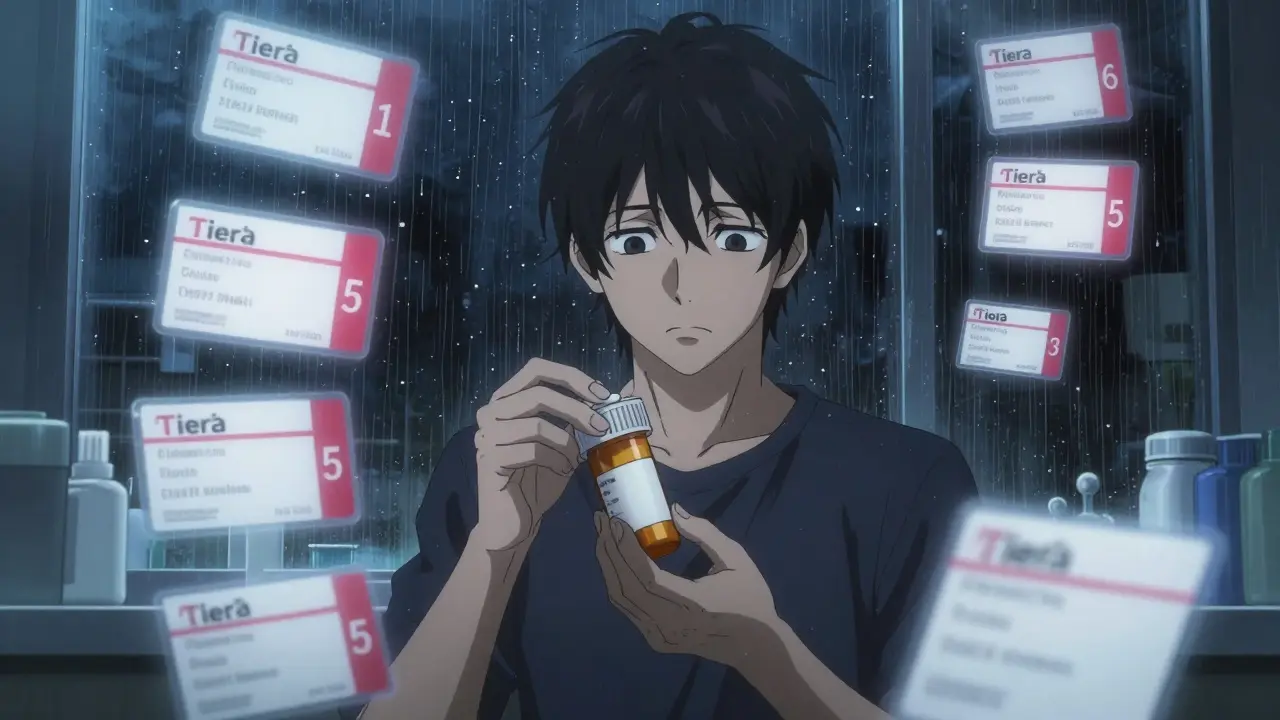
When your insurance plan suddenly stops covering your medication, it’s not just a paperwork issue - it’s a health crisis. Imagine being on a drug that keeps your blood sugar stable for years, then one day your co-pay jumps from $10 to $500. That’s not hypothetical. In 2024, formulary changes affected over 34% of Medicare beneficiaries and left nearly half of commercial plan members scrambling. These aren’t minor tweaks. They’re systemic shifts that can derail treatment, force dangerous switches, or push people to skip doses altogether.
What Exactly Is a Formulary?
A formulary is the list of drugs your insurance plan agrees to pay for. It’s not random. Every drug on it has been reviewed by a Pharmacy and Therapeutics (P&T) committee - a group of doctors, pharmacists, and sometimes patient reps - who decide what’s safe, effective, and cost-efficient. Most plans use a tiered system: Tier 1 is usually generic drugs with the lowest cost, Tier 2 is preferred brand-name drugs, Tier 3 is non-preferred brands, and Tier 4 or 5 is specialty drugs like biologics for Crohn’s, rheumatoid arthritis, or diabetes. The higher the tier, the more you pay out of pocket.Over 90% of Medicare Part D plans and 85% of commercial plans use this tiered model. But here’s the catch: insurers can change which drugs go into which tier - or remove them entirely - with as little as 30 days’ notice. And if your drug moves from Tier 2 to Tier 4? Your monthly cost could double or triple overnight.
Why Do Formularies Change?
Formularies aren’t set in stone. They change for three main reasons:- New generics enter the market - when a cheaper version of your brand-name drug becomes available, insurers push you to switch.
- Drug prices spike - if a manufacturer raises the price too high, the insurer may drop it or move it to a higher tier.
- New clinical evidence emerges - if a study shows another drug works better or has fewer side effects, the formulary may shift to reflect that.
Insurers also negotiate rebates with drugmakers. If a company offers a bigger discount, the insurer will favor that drug - even if it’s not the best fit for you. In 2023, a Health Affairs study found that patients forced to switch due to formulary changes paid an average of $587 more per year out of pocket. Meanwhile, insurers saved $1,200 per member annually by steering people toward cheaper options.
How Formulary Changes Hurt Patients
The human cost is real. In 2023, 22% of patients reported skipping doses or stopping medication entirely because of formulary restrictions. For people with diabetes, the numbers are worse: 58% abandoned their insulin or GLP-1 drugs when they moved to a higher tier, according to GoodRx data.One Reddit user, ‘ChronicCareWarrior,’ shared how their Humira - a drug they’d taken for seven years to manage Crohn’s disease - was moved to a non-preferred specialty tier. Their monthly cost went from $50 to $650. They spent three weeks fighting for temporary coverage and had to apply for manufacturer assistance just to keep taking it.
It’s not just about money. When a drug is removed from the formulary, your doctor can’t just write a new prescription. You might need prior authorization, step therapy (trying cheaper drugs first), or a formal appeal. And if you’re elderly, disabled, or low-income, navigating this system is exhausting. A 2024 Medicare Rights Center survey found that 62% of beneficiaries didn’t understand how to appeal a formulary decision.
How to Prepare for Formulary Changes
You don’t have to wait until your pill bottle is empty to act. Here’s how to stay ahead:- Check your formulary every fall - during Medicare’s Annual Enrollment Period (Oct 15-Dec 7) and when you renew your commercial plan. Look up your exact drug name, not just the brand. Generic names matter.
- Use official tools - Medicare beneficiaries can use the Plan Finder tool (used by 68% of users in 2023). Commercial plan members should log into their insurer’s website - 92% of them have formulary search tools.
- Ask your pharmacist - they get daily updates on formulary changes. If they say, “Your drug’s changing next month,” take it seriously.
- Set calendar alerts - if your plan sends a notice about changes, mark the date. You typically have 15 business days to file an exception request.
What to Do When Your Drug Is Removed
If your medication gets pulled or moved to a higher tier, you have options - but you need to act fast.- Request a formulary exception - this is your right. You can ask your doctor to submit a letter explaining why you need the specific drug. In 2023, 64% of medically justified exceptions were approved by CMS. For urgent cases (like insulin dependence), plans must respond within 72 hours.
- Try therapeutic alternatives - ask your doctor: “Is there another drug in the same class that’s still covered?” For example, if your GLP-1 is dropped, there might be another one that works similarly.
- Use manufacturer assistance - drugmakers like Eli Lilly, Novo Nordisk, and AbbVie offer co-pay cards and patient assistance programs. In 2024, these programs covered $6.2 billion in patient costs nationwide.
- Appeal with help - if your exception is denied, contact your State Health Insurance Assistance Program (SHIP). Medicare beneficiaries who used SHIP had 37% higher success rates on appeals.

How Providers Can Help
Doctors and clinics aren’t powerless. Large medical groups that use e-prescribing systems with real-time formulary checks have cut patient disruptions by 40%. If your provider checks your coverage before writing a script, you avoid the surprise at the pharmacy.Best practice: Ask your doctor to use a system like Surescripts that flags formulary status at the point of prescribing. If your clinic doesn’t, request it. You’re not being difficult - you’re preventing a medical emergency.
What’s Changing in 2025 and Beyond
The rules are shifting. Starting in 2025, the Inflation Reduction Act caps out-of-pocket drug costs for Medicare beneficiaries at $2,000 per year. That means insurers can’t keep pushing high-cost drugs into the highest tiers without consequences. Expect more drugs to be moved to lower tiers to stay under the cap.Also, by 2025, Medicare Part D must standardize its formulary exception criteria - meaning less confusion and more consistency across plans. And insurers are starting to use AI to predict how formulary changes affect patient adherence. One 2024 study showed AI models could forecast non-adherence with 89% accuracy.
Long-term, we’re moving toward personalized formularies - ones that consider your genetics, past response to drugs, and even your income. But for now, the system is still blunt. It’s built on cost, not care.
Final Advice: Don’t Wait for the Letter
Waiting for a notice from your insurer is like waiting for a storm to hit before checking your roof. Formulary changes are predictable. They happen every year. The key is to stay informed, ask questions, and know your rights. You’re not just a policy number. You’re someone who needs a drug to live.Keep a printed copy of your current formulary. Save your doctor’s contact info. Know how to reach your plan’s customer service. And if you’re on a chronic medication - especially for diabetes, heart disease, or autoimmune conditions - make checking your coverage part of your annual health routine. Because when your drug disappears, your health doesn’t pause. Neither should you.
What should I do if my insurance drops my medication?
First, contact your doctor to request a formulary exception. They’ll need to submit documentation showing why you need that specific drug. You can also check if the manufacturer offers patient assistance programs. If your exception is denied, file an appeal through your insurer’s formal process - and consider reaching out to your State Health Insurance Assistance Program (SHIP) for free guidance. Don’t stop taking your medication without a replacement plan.
How much notice do insurers have to give before changing my drug coverage?
For Medicare Part D plans, federal law requires at least 60 days’ notice for non-urgent changes. For commercial plans, it varies by state - but most require 30 days. Some states, like California and New York, require 60 days. Always check your plan’s documents. If you get less notice than required, you can file a complaint with your state’s insurance department.
Can I switch plans mid-year if my drug is dropped?
Generally, no - you can only switch Medicare or commercial plans during open enrollment unless you qualify for a Special Enrollment Period. Qualifying events include moving out of your plan’s service area, losing other coverage, or if your plan drops your drug and doesn’t offer a suitable alternative. In those cases, you can enroll in a new plan mid-year. Contact Medicare or your state’s exchange for help.
Are generic drugs always safer or better than brand-name drugs?
For most medications, yes - generics are bioequivalent and just as effective. But for drugs with narrow therapeutic windows - like certain antiseizure meds, blood thinners, or biologics - even small differences in formulation can affect how your body responds. If you’ve been stable on a brand-name drug for years, switching to a generic isn’t always safe. Always discuss this with your doctor before making a change.
Why do some drugs get removed from formularies even if they work well for me?
It’s not about whether the drug works for you - it’s about cost and overall plan strategy. If a cheaper alternative exists, or if the manufacturer stops offering a rebate, the insurer will remove the drug to save money. Formularies are designed to manage spending across thousands of members, not to personalize care for individuals. That’s why you need to advocate for yourself.






steve ker
This whole system is rigged. I don't care about tiers or rebates. My drug works. That's it.
gary ysturiz
You're not alone. I've been there too. But here's the good news: you have rights. And you can fight back. Start with your doctor and use the tools they gave you. You got this.
Bryan Wolfe
Let me tell you something important: don't panic, but DO act! I helped my mom navigate this last year. She was on Humira too. We got her exception approved in 11 days. Call your SHIP. Talk to your pharmacist. Use the manufacturer cards. It's not magic-it's just knowing the steps. You can do this!
Sumit Sharma
The systemic inefficiency is staggering. Formularies are cost-optimization engines, not clinical decision-support tools. The P&T committees are incentivized by rebate structures, not patient outcomes. This is a classic principal-agent problem: insurers are agents of shareholders, not patients. Until we decouple drug pricing from profit motives, this will persist. The Inflation Reduction Act is a band-aid, not a cure.
Lawrence Jung
People think medicine is about health. It's not. It's about money. Always has been. Always will be. You think your insulin matters? To them it's a line item. You're just noise in the algorithm.
Alice Elanora Shepherd
I'm a pharmacist, and I see this every day. Please, please, please-don't wait for the letter. Check your formulary every October. Even if your drug is covered now, it could change. I keep a printed copy for my high-risk patients. It saves lives. And if you're struggling with an appeal, I can walk you through the template. Just DM me.
Christina Widodo
Wait-so if a drug gets removed, can I switch plans mid-year even if I didn't move or lose other coverage? Or do I have to wait until next year? I'm confused.
Prachi Chauhan
I'm from India. We don't have this tier system here. Drugs are cheap. But people still can't afford them. Maybe the problem isn't the formulary. Maybe it's that drugs are too expensive everywhere. We need real price control. Not tricks with tiers.
Katherine Carlock
I just want to say thank you for writing this. I was about to stop my medication because I couldn't afford it. I didn't know about manufacturer programs. I just called my doctor and they helped me apply. I'm back on my drug now. You're not just giving info-you're saving lives.