
When you hear the word substitution, you might think of swapping one ingredient for another in a recipe. But in law and regulation, substitution isn’t optional-it’s mandatory. Across the world, governments force institutions and individuals to replace one thing with another, often against resistance, tradition, or even personal freedom. This isn’t about convenience. It’s about control, safety, and rights. And the rules? They’re wildly different depending on where you are.
Banking’s Hidden Rule: Who Holds the Risk?
In Europe, banks can’t just lend money and call it a day. Under the Capital Requirements Regulation (CRR), they must swap the risk of a borrower with the risk of the middleman-the tri-party agent-in certain repurchase deals. This is mandatory substitution in finance. If a bank lends against collateral, and a third party manages that deal, the bank must treat the agent as the actual counterparty, not the original borrower. It sounds technical, but the goal is simple: reduce systemic risk. If the borrower defaults, the agent is supposed to be more reliable. But here’s the catch: the U.S. doesn’t do this. American regulators like the Federal Reserve and the OCC decided the standardized approach wasn’t good enough. They kept their own internal models. The result? A regulatory split. European banks face stricter rules. U.S. banks have more flexibility. This gap isn’t just paperwork-it’s a $2.1 billion market for compliance software, and it’s why some EU firms moved repo operations to London after Brexit. J.P. Morgan reported a 15-20% jump in operational costs just to track these swaps. Mid-sized banks spent up to €1.2 million upgrading systems. And despite all that, the Association for Financial Markets in Europe (AFME) warned that forcing this substitution could actually make things riskier-by pushing banks to hide exposure behind agents instead of facing it head-on.Mental Health: Who Decides for You?
Now shift from balance sheets to bedrooms. In mental health, mandatory substitution means someone else-family, court-appointed guardian, or doctor-makes decisions for a person deemed incapable of doing so themselves. This happens in Ontario, Victoria, England, Wales, and Northern Ireland. Each place has its own law: Ontario’s Substitute Decisions Act, Victoria’s Guardianship and Administration Act, England and Wales’ Mental Capacity Act. These laws were designed to protect people with severe mental illness or cognitive decline. But they’re under fire. The United Nations’ Convention on the Rights of Persons with Disabilities (CRPD) says no one should be forced to have a substitute decision-maker. It’s about autonomy. Even if someone has schizophrenia or dementia, the CRPD argues, they still have the right to make their own choices-with support. Canada and Australia signed the CRPD but added reservations. They said: "We still allow substitute decision-making." Meanwhile, countries like Sweden and New Zealand are moving toward supported decision-making-helping people make their own calls, not making calls for them. In Ontario, since shifting toward this model, coercive interventions dropped 12%. But frontline workers say it’s hard to apply when someone is in full psychosis. The system isn’t broken-it’s stuck between old rules and new ideals. The CRPD’s General Comment No. 1 (2014) didn’t just nudge-it challenged. It said substitute decision-making violates human rights. That’s why legal scholars like Harvard’s Michael Ashley Stein say these laws must be abolished. Others argue that’s unrealistic. You can’t expect someone in a catatonic state to choose their own medication. The tension isn’t going away.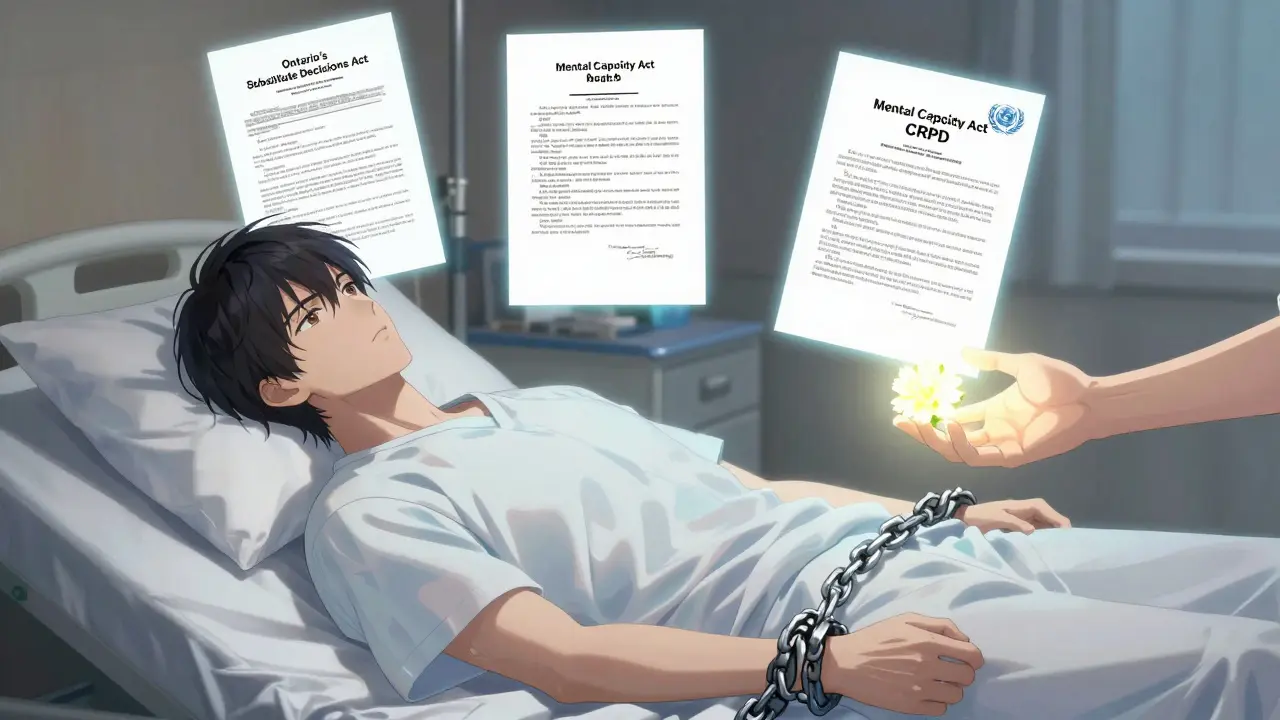
Chemicals: What You Can’t Use Anymore
In the EU, if your product contains a substance linked to cancer, infertility, or environmental damage, you can’t just keep using it. Under REACH-the Registration, Evaluation, Authorisation and Restriction of Chemicals regulation-you must find a safer alternative. That’s mandatory substitution in action. The EU doesn’t ban these substances outright. It forces companies to prove they’ve tried and failed to replace them. This is called substitution planning. You need to show your alternatives are technically feasible, economically viable, and safer. If you can’t? Your product gets blocked. BASF, one of the world’s largest chemical makers, cut substances of very high concern by 23% since 2016. But small businesses? They’re drowning. The average cost per authorization application is €47,000. Many SMEs can’t afford the toxicology experts or the time. ECHA, the EU’s chemical agency, rejected 62% of early applications because the alternatives weren’t properly assessed. Sweden and NGOs like ChemSec created voluntary lists-SIN List, PRIO List-to flag dangerous chemicals early. The EU is now making these mandatory. By 2025, substitution planning will be required for every restricted chemical, not just authorized ones. That’s a massive expansion. And it’s working. The global market for safer chemical alternatives is now $14.3 billion. But it’s uneven. Companies in the U.S. or China don’t face these rules. So multinationals make EU-specific versions of their products just to comply.Why Do These Rules Exist?
Each of these systems-finance, mental health, chemicals-tries to solve a different problem. But they share a core belief: the current system is too risky, too unjust, or too toxic. Mandatory substitution is the hammer. It’s blunt. It doesn’t care if you’re ready. In banking, it’s about preventing another 2008 crash. In mental health, it’s about preventing abuse under the guise of care. In chemicals, it’s about preventing long-term harm to people and ecosystems. The logic is sound. The execution? Messy. The EU leads in all three areas. It’s the only region that made substitution mandatory in finance and chemicals. It’s also the most aggressive in pushing mental health reform toward supported decision-making. The U.S. prefers flexibility. Canada and Australia sit in the middle-signed the UN treaties but kept the old systems. The result? A global patchwork.








Demetria Morris
Let’s be real-mandatory substitution is just bureaucratic overreach dressed up as "progress." They don’t care if it breaks small businesses, upends mental autonomy, or forces banks into ridiculous compliance theater. It’s not about safety-it’s about control. And the EU? They’re the world’s favorite nanny state.
Meanwhile, the US just lets companies figure it out. Maybe that’s the smarter move. Let the market decide, not some regulator who’s never run a business.
I’m not saying we shouldn’t protect people or the planet. But forcing everyone into the same box? That’s tyranny with a spreadsheet.
Geri Rogers
Okay but have y’all seen the actual data on how substitution in chemicals has reduced cancer rates in EU workers? 📊
BASF cut SVHCs by 23%? That’s not a number-it’s lives saved. And yes, SMEs struggle, but programs like ECHA’s technical assistance grants are helping. This isn’t about punishment-it’s about prevention.
And mental health? The CRPD isn’t saying "let people die in psychosis." It’s saying "support them to choose." We’ve done it in Norway with peer advocates. It works. 🙌
Stop framing this as "freedom vs control." It’s about dignity vs. paternalism. And honestly? We owe people with disabilities better than what we’ve given them for 50 years.
Samuel Bradway
I work in compliance for a mid-sized bank and honestly? The CRR substitution rules are a nightmare. We spent over a year retraining staff just to track who’s the counterparty now. And for what? We haven’t seen one less default.
It’s like they built a fancy lock on a door that was already closed. The real risk was never the tri-party agent-it was the dumb loans they were pushing in the first place.
Also, why does the EU get to set the global standard? We’re not even in the EU. Why are we paying for their regulatory choices?
Caleb Sutton
They’re using "mandatory substitution" to destroy capitalism from the inside. The EU doesn’t want banks to lend. They don’t want people to make their own mental health decisions. They don’t want chemicals made at all.
This is the Great Reset. The UN, the WHO, the Basel Committee-all controlled by the same shadow elite. They want you dependent on state-approved systems.
They banned your favorite chemicals. They’re taking away your right to choose your doctor. Soon they’ll force you to use their bank. And you’re just sitting here debating costs?
Wake up. This isn’t regulation. It’s a coup.
pradnya paramita
From a regulatory architecture standpoint, the EU’s REACH substitution framework represents a paradigmatic shift from risk-based to hazard-based regulation, which inherently triggers the precautionary principle as a governance heuristic.
The cost structure for SMEs is indeed suboptimal, but the dynamic efficiency gains from innovation in green chemistry-measured via patent filings and LCA adoption-suggest a net positive externality over a 10-year horizon.
Moreover, the CRR’s counterparty substitution is a form of credit risk re-allocation under Article 239, which mitigates systemic contagion via tri-party repo fragmentation. U.S. internal models, while flexible, lack the transparency required for macroprudential oversight.
CRPD’s abolitionist stance on substitute decision-making, while normatively compelling, ignores the neurocognitive heterogeneity of decisional incapacity. Supported decision-making requires infrastructure that most jurisdictions lack.
Jamillah Rodriguez
So… the EU forces companies to change chemicals, forces banks to pretend a middleman is the real guy, and now they’re telling families they can’t decide for their loved ones?
And we’re supposed to be impressed?
It’s like they took every rule in a middle school handbook and turned it into international law.
Also, why is everyone acting like this is new? We’ve been doing this since the 80s with DDT. People just forget until it hits their wallet.
Anyway, I’m out. 😴
Susheel Sharma
Let’s not romanticize the EU’s "progressive" stance. They’ve created a regulatory labyrinth that’s crushing SMEs while multinationals just offshore production to China or the US.
REACH? More like REACH-for-the-Top. The big boys have legal teams that eat compliance for breakfast. The little guys? They either fold or start smuggling chemicals through the Balkans.
And mental health? "Supported decision-making" sounds lovely until you’re the nurse trying to sedate a screaming patient with no legal backup.
This isn’t reform. It’s performative virtue signaling wrapped in legal jargon. And the cost? Paid by the vulnerable.
Also, Jhoantan Moreira is clearly an EU shill. 🤡
Janice Williams
It is not merely regrettable, but profoundly alarming, that society has come to accept coercive substitution as a legitimate instrument of public policy. The normalization of state-mandated replacement in finance, mental health, and environmental regulation constitutes a systemic erosion of individual sovereignty.
One does not need to be a libertarian to recognize that when institutions are empowered to compel substitution, they are, by definition, empowered to define what is "better"-and history has shown that such definitions are invariably shaped by ideological agendas, not empirical outcomes.
Moreover, the EU’s unilateral imposition of its standards as de facto global norms is not leadership-it is regulatory imperialism.
The notion that "safety" justifies this is a fallacy. Safety without consent is slavery by another name.
Rachel Kipps
i think the mental health part is so important but also so hard. like, i have a cousin with schizoaffective disorder and sometimes she can make good choices, but other times she literally can’t tell if she’s safe or not.
the crpd sounds amazing in theory, but real life isn’t a podcast. we need better support systems, not just laws that say "you can decide!" when the person can’t even remember their own name.
also, typos are a thing. sorry.
caroline hernandez
For those saying "it’s too expensive"-look at the ROI on substitution in chemicals. Every $1 spent on safer alternatives yields $3.50 in avoided healthcare and environmental cleanup costs (EPA, 2023).
And in mental health, supported decision-making reduces involuntary holds by 12%? That’s not just ethical-it’s cost-effective. Fewer ER visits, fewer court hearings, fewer staff burnouts.
This isn’t about ideology. It’s about smart systems design. The EU is building the infrastructure for the next 50 years. The U.S. is still arguing about whether the problem exists.
Stop thinking in terms of cost. Think in terms of consequence.
Jhoantan Moreira
I’m from the UK and I’ve seen both sides of this.
Yes, the EU rules are strict. But they’ve saved lives-chemicals, yes, but also in finance after 2008. And in mental health? I’ve worked with people who were forced into care under old laws. It broke them.
Change is messy. It’s expensive. It’s frustrating.
But if we don’t keep pushing for systems that respect dignity, safety, and fairness… what are we even doing?
Let’s not hate the tool. Let’s fix the way we use it. 🌍❤️
Geri Rogers
Samuel Bradway, you’re not wrong about the compliance nightmare-but that’s why we need better tech, not less regulation. Look at what JPMorgan did with AI-driven counterparty mapping. It cut their costs by 30% after year one.
And to the person saying "it’s tyranny"-if you think forcing banks to track who’s really on the hook is tyranny, you’ve never lived through a financial crisis.
Also, the EU didn’t invent this. Sweden did it with chemicals in the 90s. We just took longer to catch up.
Stop blaming the map. Fix the terrain.