
When you first start using an insulin pump, it can feel overwhelming. You’re not just switching from injections-you’re taking on a new daily responsibility that affects every meal, every workout, every night’s sleep. But for many people with type 1 diabetes, or those with unstable type 2 diabetes who need tight control, insulin pump therapy changes everything. It gives you flexibility, precision, and often better blood sugar results. But only if you get the settings right-and know what to do when things go wrong.
How Insulin Pumps Actually Work
Insulin pumps don’t replace your pancreas. They deliver rapid-acting insulin-like Humalog or Novolog-through a tiny tube under your skin. There’s no long-acting insulin involved. Instead, the pump gives you two kinds of insulin doses: a steady background trickle called the basal rate, and bigger bursts called boluses for food or high blood sugar.
Basal rates are programmed to change throughout the day. Your body needs more insulin in the early morning (dawn phenomenon) and less overnight. Most pumps let you set up to eight different basal profiles. You might have one for weekdays, another for weekends, and a third for when you’re sick or exercising. The total basal insulin usually makes up 40-50% of your daily insulin dose, spread out hour by hour.
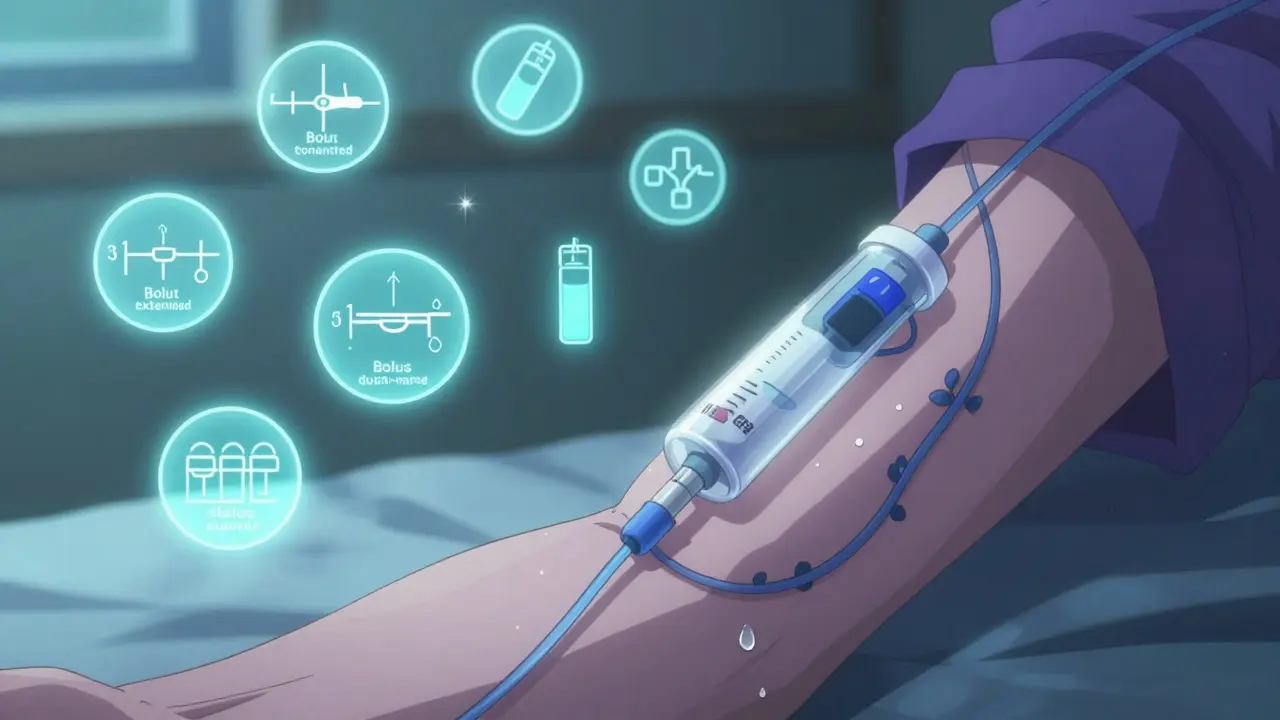
Boluses are trickier. You don’t just press a button and forget it. You need to count carbs accurately. If you eat a pizza, you might need an extended bolus-a slow delivery over 2-4 hours-because fat slows digestion. For a bowl of rice or fruit, a standard bolus works fine. Some pumps even let you split the bolus into two parts: immediate + extended. That’s called a dual-wave bolus.
The Three Core Settings You Must Get Right
There are three numbers that make or break your pump therapy: basal rate, insulin-to-carbohydrate ratio (ICR), and insulin sensitivity factor (ISF). Mess up any one of these, and your blood sugar will swing wildly.
- Basal rate: This is your background insulin. Test it by fasting for 8-12 hours without food or correction boluses. If your blood sugar drops more than 1 mmol/L, your basal is too high. If it rises, it’s too low. Do this test at different times of day-morning, afternoon, night.
- Insulin-to-carb ratio (ICR): How much insulin you need per gram of carbs. A common starting point is 1 unit per 10-15g of carbs, but it’s personal. If you’re eating 40g of carbs and your blood sugar stays high after a bolus, your ratio might be 1:12 instead of 1:15. Track it for a week and adjust.
- Insulin sensitivity factor (ISF): How much 1 unit of insulin lowers your blood sugar. Most people see a drop of 2-4 mmol/L per unit. If your blood sugar is 12 mmol/L and you want it at 6 mmol/L, you need about 2 units-but only if your ISF is 3 mmol/L per unit. Test it by correcting a high reading when you haven’t eaten in 4 hours.
Don’t guess these numbers. Use your pump’s download history. Your diabetes educator can pull your data and show you patterns. If your blood sugar spikes every morning at 3 a.m., your basal is too low. If you crash after lunch, your ICR might be too high.
Infusion Sets and Site Care
Your pump doesn’t work if the insulin can’t get into your body. The infusion set-a tiny plastic cannula under your skin-needs to be changed every 2-3 days. Leaving it in longer increases infection risk and causes insulin absorption problems.
Rotate your sites: abdomen, thighs, upper arms. Avoid scar tissue or areas that feel lumpy-that’s lipohypertrophy. Studies show 27% of new pump users develop it because they reuse the same spots. If you notice your insulin isn’t working like it used to, check your site. A red, swollen, or painful spot? Change it immediately.
Always prime the tubing before inserting a new set. Air bubbles mean you’re not getting the full dose. And never skip the 10-unit test bolus after insertion. It confirms flow and catches blockages early.
Safety First: What Happens When Things Go Wrong
The biggest fear with pumps? Diabetic ketoacidosis (DKA). It can happen in as little as 2-4 hours if your infusion set kinks, your tubing disconnects, or your reservoir runs dry. You won’t always feel it coming. That’s why checking your blood sugar every 2-4 hours is non-negotiable.
If your blood sugar stays above 13 mmol/L for two readings in a row, check your pump. Is the tubing kinked? Is the reservoir empty? Is the site red or swollen? If everything looks fine but your sugar won’t drop, give yourself a correction shot with a pen. Then call your diabetes team. Never wait.
For hypoglycemia, remove the pump if your blood sugar drops below 4 mmol/L and stays low. The pump will keep delivering insulin-even if you’re asleep. That’s why many newer pumps have predictive low-glucose suspend features. They stop insulin delivery for 30-120 minutes if your glucose is dropping fast. But even these aren’t foolproof. You still need to carry fast-acting glucose tablets.
Special Situations: Surgery, Pregnancy, and Illness
If you’re having surgery, your pump settings change. For minor procedures where you’ll eat within a few hours, your pump can stay on-if your site is accessible, your insulin reservoir is full, and your glucose is between 4-12 mmol/L. For major surgery? The pump comes off. You’ll get IV insulin until you’re eating again.
After giving birth, your insulin needs drop fast. Many women need to reduce their basal rate by 10-20% within hours. If you’re breastfeeding, you might need even less. Track your sugars closely. Your body’s changing fast.
When you’re sick, your insulin needs go up-even if you’re not eating. Your basal rate might need a 20-50% increase. Check ketones every 4 hours. If you have moderate to large ketones, call your doctor. Don’t wait.
Technology Is Getting Smarter-But You Still Have to Be Involved
The latest pumps, like the Tandem Mobi or Medtronic MiniMed 670G, can adjust basal insulin automatically. They’re called hybrid closed-loop systems. They use your CGM to tweak insulin delivery overnight and between meals. But they still need you to tell them when you’re eating. You still have to count carbs. You still have to check your blood sugar.
Dr. Anne Peters says it best: “CSII is not an artificial pancreas.” It’s a tool. A powerful one. But it doesn’t think for you. The pump can’t tell if you ate a muffin or a whole cake. It can’t know if you’re stressed or running a fever. That’s your job.
And yes, tech fails. About 45% of users report a pump malfunction in the first year. Batteries die. Tubing cracks. Algorithms glitch. That’s why every pump user needs a backup plan: extra infusion sets, insulin pens, syringes, glucagon, and glucose tabs. Keep them in your bag, your car, your desk drawer. Always.

Training and Realistic Expectations
Most people think they’ll master the pump in a week. Reality? It takes 3-6 months to feel confident. You’ll make mistakes. You’ll have high blood sugars after meals. You’ll forget to bolus. You’ll get frustrated.
Good training matters. The Association of Diabetes Care & Education Specialists recommends at least 15 hours of education before you start. That includes: how to insert a set, how to program a bolus, how to troubleshoot alarms, and how to respond to DKA. Don’t rush it. Start your pump on a Monday, not a Friday. That way, you have support through the week.
After four weeks, you’ll have a follow-up with your diabetes team. They’ll download your pump data and look at your patterns. That’s when real adjustments happen. Don’t skip it.
Who Should Use a Pump?
Not everyone needs one. The American Diabetes Association says you’re a good candidate if:
- You have type 1 diabetes and want tighter control
- You’re willing to check your blood sugar at least four times a day
- You can count carbs consistently
- You’re not afraid of technology
- You don’t have severe hypoglycemia unawareness without a CGM
If you’re not ready to manage this level of detail, injections might be better. There’s no shame in that. The goal isn’t to use the fanciest tech-it’s to stay healthy.
What Comes Next?
The future of insulin pumps is exciting. Bi-hormonal pumps that deliver both insulin and glucagon are in trials. Interoperable systems let you mix and match pumps with any CGM. The smallest pump yet, the Tandem Mobi, is designed for kids. But none of this matters if you don’t understand the basics.
Insulin pump therapy isn’t magic. It’s a daily commitment. It requires attention, patience, and a willingness to learn. But for those who stick with it, the payoff is real: fewer lows, more freedom, and better long-term health.
Start with the numbers. Master the basics. Keep backups. And never stop asking questions.









Nat Young
Everyone’s acting like this pump thing is some kind of miracle cure, but let’s be real - it’s just a fancy injector with more ways to fail. I’ve had mine for three years and I’ve spent more time troubleshooting tubing kinks than I have enjoying ‘freedom.’ And don’t even get me started on the cost. Insurance won’t cover the good ones, so you’re stuck with devices that beep like a microwave when it’s done popping popcorn.
Niki Van den Bossche
There’s a metaphysical dimension to insulin delivery that no algorithm can quantify - the silent pact between human vulnerability and machine precision. The pump doesn’t just administer insulin; it administers *identity*. You become a hybrid organism, a cyborg of necessity, tethered to a device that mirrors your internal chaos. The basal rate? It’s not just a number - it’s the rhythm of your soul’s surrender to metabolic tyranny. And yet… somehow, in this surrender, you find autonomy. Isn’t that the great paradox of modern medicine?
Diane Hendriks
Let me correct a few things. The term is ‘insulin sensitivity factor,’ not ‘sensitivity factor.’ Also, the dawn phenomenon is not a ‘phenomenon’ - it’s a physiological reality driven by cortisol and growth hormone surges. And you cannot say ‘you might need an extended bolus’ - you *must* account for fat’s delay in gastric emptying. This article reads like a marketing brochure written by someone who’s never had a CGM alarm at 3 a.m. while their kid screams for juice.
Amy Ehinger
I started my pump last year after 18 years of injections, and honestly? It’s been life-changing. I used to dread every meal because I’d have to calculate everything on paper and hope I didn’t mess up. Now I just tap my phone, and it tells me how much to bolus. I still mess up - I once ate a whole pizza and only gave half the insulin because I was tired - but the safety nets are there. The predictive suspend feature saved me twice when I fell asleep after a late workout. It’s not perfect, but it’s the closest thing to a normal life I’ve ever had with T1D. Just remember: it’s a tool, not a wizard. You still have to show up.
RUTH DE OLIVEIRA ALVES
It is imperative to underscore the critical importance of structured education prior to initiation of continuous subcutaneous insulin infusion therapy. Empirical evidence from peer-reviewed literature consistently demonstrates that patients who undergo comprehensive, multidisciplinary training - including carbohydrate counting, insulin kinetics, and emergency protocol simulation - achieve significantly improved glycemic outcomes and reduced hospitalization rates. Furthermore, the Association of Diabetes Care & Education Specialists’ recommendation of fifteen hours of pre-initiation education is not merely a guideline; it is a clinical standard of care. Failure to adhere to this protocol constitutes a systemic vulnerability in patient safety. Institutions must prioritize this investment in human capital over cost-cutting measures.
Crystel Ann
I remember the first week with my pump - I cried more than I ever did during diagnosis. I felt like I was failing every time my sugar spiked. But then I started journaling: what I ate, how I felt, what the pump did. Slowly, patterns emerged. I stopped blaming myself and started learning. It’s not about being perfect. It’s about showing up, even when you’re tired, even when you’re mad, even when the pump beeps at 2 a.m. You’re not broken. You’re adapting. And that’s brave.
Jan Hess
Guys I just want to say if you're thinking about getting a pump just do it. Yeah it's scary and yeah you'll mess up but you're not alone. I had a kinked tube during a road trip and I panicked but I had my pen with me and I got through it. The tech isn't perfect but it's way better than needles. Just keep your supplies in your car and your phone charged and you'll be fine. I'm living my life now and I'm not hiding from food or parties anymore. You got this.
Iona Jane
They don’t want you to know this but the pumps are rigged. The companies know you’ll panic when your sugar spikes so they program the alarms to go off just often enough to keep you dependent. And the algorithms? They’re trained on data from healthy white people. What happens when you’re brown, or fat, or female? Your numbers get ignored. The ‘predictive suspend’? It’s a placebo. I’ve had mine shut off and still gone into DKA. They’re selling hope, not science. Don’t trust the machine. Trust your instincts. And maybe… stop using it.
Jaspreet Kaur Chana
As someone from India where insulin access is still a luxury for many, seeing this level of detail about pump tech is both inspiring and heartbreaking. We have people here who reuse syringes because they can’t afford new ones every day. But I also know friends who got pumps through family abroad and their lives changed - they could go to college, work late shifts, even travel. The problem isn’t the tech - it’s the inequality. If we can make these devices affordable and train community health workers to support users, this could be a game-changer globally. Don’t just see this as a personal tool - see it as a human right waiting to be scaled.
Haley Graves
Stop waiting for perfection. Start with what you know. If your basal is off, test it for 48 hours. If your carb ratio is wrong, adjust by 1 gram at a time. You don’t need to understand every algorithm or have the latest pump. You need consistency. You need data. You need to stop listening to the people who say ‘just inject’ and start listening to your own body. You’re not behind. You’re learning. And every high, every low, every pump alarm - it’s all part of the process. Keep going.
Annie Choi
Hybrid closed loop is the future but let’s be real - the CGM drift is still a nightmare. I had mine say I was 6.2 when I was actually 14.5. The pump didn’t bolus. I woke up in ketoacidosis. The algorithm doesn’t know your sweat, your stress, your sleep deprivation. It just sees numbers. And if your CGM’s off by 10%, the whole system collapses. We need better sensors, not just better math. And someone needs to fix the damn adhesive on these infusion sets - I’ve lost three in a week because the tape peeled off during yoga.
Mike Berrange
Most of this is obvious. You don’t need a 2000-word essay to say ‘change your site every 3 days’ or ‘check for kinks.’ Also, the part about ‘don’t guess’ - well, everyone guesses. That’s how you learn. This reads like a corporate training manual written by someone who’s never had a low at 2 a.m. while their dog barked and their kid cried. I’m tired of people treating diabetes like a puzzle you solve with perfect data. It’s messy. It’s human. Stop pretending otherwise.
Nishant Garg
I’ve been on a pump for 10 years. I’ve had DKA three times. I’ve cried over bolus errors. I’ve missed my daughter’s birthday because I was in the ER. But I’ve also hiked mountains, traveled across continents, and danced at my wedding with my sugar in range. This isn’t about the pump. It’s about you. The machine doesn’t give you freedom - your discipline does. Your patience. Your willingness to learn from every mistake. If you’re scared? Good. That means you care. Now go change your site. Drink some water. And try again tomorrow.