You might assume that because generic drugs are cheaper than their brand-name counterparts, the government is actively capping their prices. The reality is much more nuanced. For generic drugs, governments rarely set direct price limits. Instead, they engineer a market environment where competition drives prices down naturally. This approach stands in stark contrast to how policymakers handle expensive, patented brand-name medications.
Understanding this distinction is crucial for anyone navigating healthcare costs, from patients worried about monthly copays to policymakers debating the next round of health reforms. While headlines often scream about drug price negotiations, those efforts mostly target high-cost branded biologics and small-molecule drugs. Generics operate on a different economic engine entirely-one fueled by rapid entry, regulatory shortcuts, and fierce manufacturer rivalry.
The Economic Engine Behind Generic Pricing
To understand why direct price controls are rare for generics, you first need to look at the numbers. Generic drugs account for approximately 90% of all prescriptions filled in the United States, yet they make up only about 23% of total drug spending. This disparity exists because prices typically plummet by 80% to 85% once a generic version hits the market. According to data from the Congressional Budget Office (CBO), this massive drop happens without the government telling manufacturers what to charge.
This price collapse is not an accident; it is the result of structural changes in the market. When a patent expires, multiple manufacturers can produce the same active ingredient. Unlike brand-name drugs, which face no competition for years, generics enter a crowded arena immediately. A 2022 analysis by the Food and Drug Administration (FDA) showed that generic drug prices usually drop by 75% within six months of market entry. If two or more competitors appear, prices can fall by 90% within two years.
The Federal Trade Commission (FTC) has observed that markets with three or more generic manufacturers see prices stabilize at just 10% to 15% of the original brand price. In these mature markets, there is simply no room for profiteering. Manufacturers compete on thin margins, often relying on volume rather than high per-unit profits. This competitive pressure serves as a natural price control, rendering direct government intervention unnecessary-and potentially harmful-to the supply chain.
The Legal Framework: Hatch-Waxman and the ANDA Pathway
The cornerstone of this competitive model is the Hatch-Waxman Act of 1984. Before this legislation, bringing a generic drug to market was nearly impossible. Manufacturers had to repeat costly clinical trials to prove safety and efficacy, even though the drug’s chemical structure was identical to an existing product. These trials could cost hundreds of millions of dollars, wiping out any potential profit margin.
Hatch-Waxman created the Abbreviated New Drug Application (ANDA) pathway. This regulatory shortcut allows generic manufacturers to skip full clinical trials. Instead, they must prove bioequivalence-showing that their version delivers the same amount of active ingredient into the patient’s body at the same rate as the brand-name drug. This reduces development costs from roughly $2.6 billion for a new brand to approximately $2-3 million for a generic.
By lowering the barrier to entry, the law invited more players into the market. More players mean more competition, and more competition means lower prices. The FDA’s Generic Drug User Fee Amendments (GDUFA), reauthorized in 2022, further accelerated this process. With $750 million in industry fees funding faster reviews, the FDA aims to cut approval times from 18 months to 10 months. Since 2017, this efficiency boost has led to a 35% increase in generic drug approvals, ensuring that cheaper alternatives reach pharmacies quickly.
Why Government Negotiation Programs Exclude Generics
If competition works so well, why do we hear so much about government price negotiations? Because those negotiations target a different problem. The Inflation Reduction Act of 2022 established the Medicare Drug Price Negotiation Program, but it explicitly excludes generic drugs. The Department of Health and Human Services (HHS) determined that generics already experience sufficient market competition to keep prices low.
CMS documentation from April 2024 clarifies that the negotiation program focuses solely on "single source brand-name drugs or biological products without therapeutically-equivalent generic or biosimilar alternatives." In other words, the government steps in only when there is no competition. Applying these negotiation tools to generics would be redundant. A Stanford Medicine White Paper estimated that extending drug price negotiations to generic drugs would yield minimal savings-only $1.2 billion annually-compared to $9.5 billion from branded drug negotiations.
Even the Most-Favored-Nation (MFN) Executive Order signed in May 2025 focused primarily on branded drugs like Ozempic and Wegovy. The administration highlighted the disparity in pricing for identical medicines made in the same factories but offered no specific provisions for generics. This policy alignment reflects a broader consensus among experts: direct price regulation of generic drugs faces significant legal hurdles and offers little financial benefit compared to fostering competition.
Regulatory Vigilance: Stopping Anti-Competitive Practices
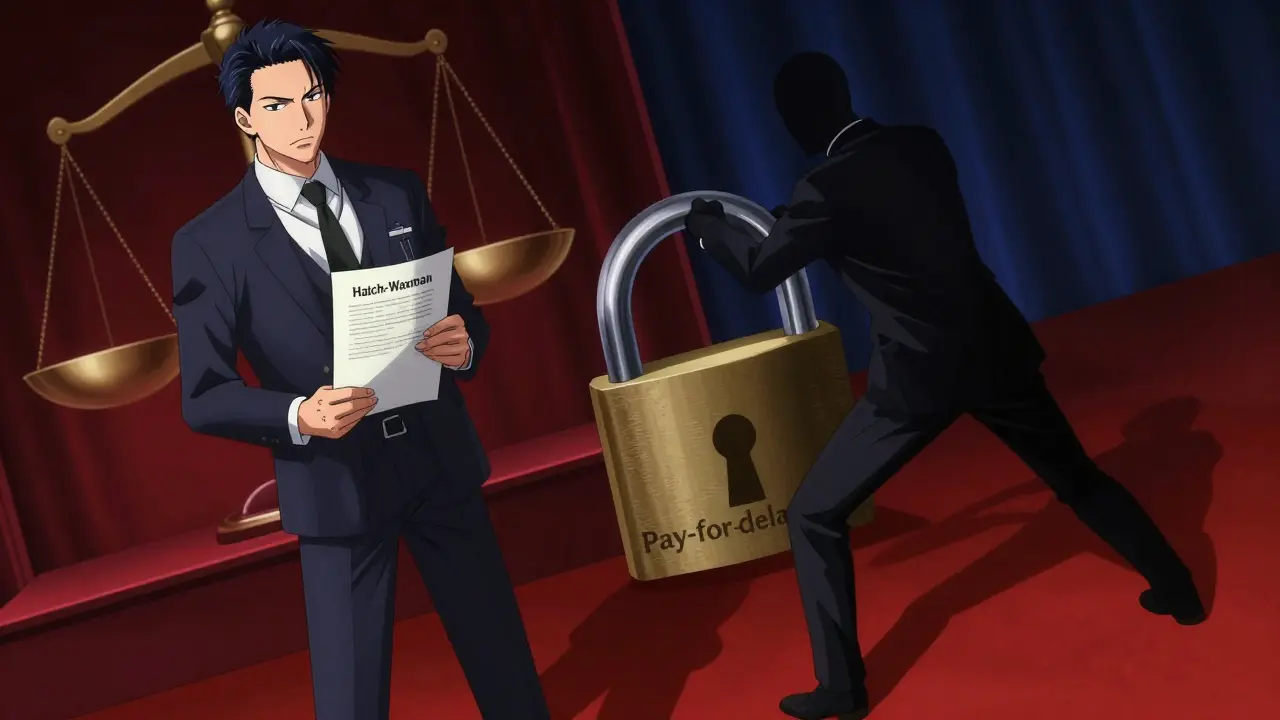
While the government doesn’t set generic prices, it does police the behavior of companies that try to manipulate them. One major threat to low generic prices is "pay-for-delay" agreements. In these deals, brand-name manufacturers pay generic companies to delay launching their cheaper versions. This keeps the brand monopoly intact longer, allowing consumers to pay higher prices.
The FTC takes these practices seriously. In 2023 alone, the commission challenged 37 such settlement agreements. By restoring generic competition, the FTC estimates these actions save consumers $3.5 billion annually. Another example is the blocked merger between Teva and Sandoz in January 2024. Regulators intervened because the consolidation would have reduced competition for 13 specific generic products, likely leading to price hikes.
This vigilance extends to complex generics-drugs with difficult formulations or delivery mechanisms. These products often face fewer competitors, making them vulnerable to price gouging. To address this, the FDA created a submission template for complex generics in late 2023, reducing review times by 35%. Additionally, the Generic Pharmaceutical Association’s Competitive Generic Therapy designation provides expedited review for generics entering markets with insufficient competition, ensuring that even niche drugs remain affordable.
The Hidden Risks: Shortages and Unsustainable Margins
The reliance on competition isn’t without downsides. When prices fall too low, manufacturers may stop producing certain drugs altogether. The American Society of Health-System Pharmacists (ASHP) reported in May 2024 that 43% of hospital pharmacists saw manufacturers discontinue products because prices fell below production costs. This creates a paradox: the very mechanism that keeps prices low can also threaten supply stability.
Drug shortages are a growing concern. The FDA’s 2023 Drug Shortage Report noted that while most generic price increases stayed below inflation, isolated spikes did occur. For instance, one Reddit user reported seeing the generic version of sertraline jump from $4 to $45 per month. While this affected only 0.3% of generic drugs, it highlights the fragility of the system. When manufacturing costs rise due to raw material shortages or regulatory compliance (such as the Drug Supply Chain Security Act adding 2.5% to distribution costs), thin margins can vanish overnight.
Despite these risks, consumer satisfaction remains high. A 2024 KFF Consumer Survey found that 76% of respondents paid $10 or less for generic prescriptions through Medicare Part D. Generic users reported 82% satisfaction with affordability, compared to just 41% for brand-name users. The trade-off is clear: we accept occasional supply volatility in exchange for dramatically lower everyday costs.
Comparison: Brand vs. Generic Pricing Mechanisms
| Feature | Brand-Name Drugs | Generic Drugs |
|---|---|---|
| Pricing Mechanism | Patent monopoly; limited competition | Fierce market competition |
| Government Intervention | Price negotiations (Inflation Reduction Act) | Regulatory streamlining (GDUFA) |
| Approval Pathway | New Drug Application (NDA); full clinical trials | Abbreviated New Drug Application (ANDA); bioequivalence only |
| Average Price Drop | Minimal until patent expiration | 75-90% within 2 years of entry |
| Primary Risk | High out-of-pocket costs | Supply shortages due to low margins |
What This Means for Patients and Policymakers
For patients, the current system generally works. You are likely paying significantly less for your medications than you would if every drug required a new clinical trial. However, awareness of the supply chain’s fragility is important. If a generic drug becomes unavailable, it is often not due to a conspiracy, but because the price dropped so low that no company could afford to manufacture it.
For policymakers, the lesson is clear: protect competition, don’t cap prices. Efforts like the FTC’s enforcement against pay-for-delay agreements and the FDA’s push for faster generic approvals are far more effective than arbitrary price ceilings. As Dr. Aaron Kesselheim of Harvard Medical School testified before the Senate Finance Committee, generic drugs have demonstrated the ability to achieve substantial price reductions through competition alone. Adding price controls could disrupt this delicate balance, potentially reducing the number of manufacturers willing to enter the market.
Looking ahead, the CBO projects generic drug prices will continue declining at 3.5% annually through 2030, driven by competitive forces. Meanwhile, branded drug prices are expected to grow slightly. This divergence confirms that the best tool for keeping generic drugs affordable is not a government mandate, but a robust, competitive marketplace protected by vigilant regulators.
Does the government set the price for generic drugs?
No, the U.S. government does not directly set prices for generic drugs. Instead, it fosters competition through regulatory frameworks like the Hatch-Waxman Act and GDUFA, which allow multiple manufacturers to enter the market quickly. This competition naturally drives prices down, often by 80-90% compared to brand-name equivalents.
Why are generic drugs excluded from Medicare price negotiations?
Generic drugs are excluded from programs like the Medicare Drug Price Negotiation Program because they already benefit from intense market competition. The Department of Health and Human Services determined that generics do not require direct price setting since market forces keep their costs low. Negotiations focus instead on single-source brand-name drugs where no competitive alternatives exist.
What is an ANDA and why is it important for pricing?
An Abbreviated New Drug Application (ANDA) is the regulatory pathway for generic drugs. It allows manufacturers to prove bioequivalence without repeating expensive clinical trials. By reducing development costs from billions to millions, the ANDA pathway encourages many companies to produce the same drug, creating the competition that lowers prices for consumers.
Can generic drug prices spike unexpectedly?
Yes, though it is rare. Prices can spike if there are few manufacturers left in the market, often due to previous price drops forcing companies out of business. Supply chain disruptions, raw material shortages, or anti-competitive practices like "pay-for-delay" agreements can also cause temporary price increases. However, 97% of generic price increases between 2019-2022 remained below the inflation rate.
How does the FTC help keep generic drug prices low?
The Federal Trade Commission (FTC) monitors and enforces antitrust laws to prevent anti-competitive behavior. This includes challenging "pay-for-delay" settlements where brand companies pay generics to stay off the market, and blocking mergers that would reduce competition. By ensuring a level playing field, the FTC helps maintain the competitive pressure that keeps generic prices low.