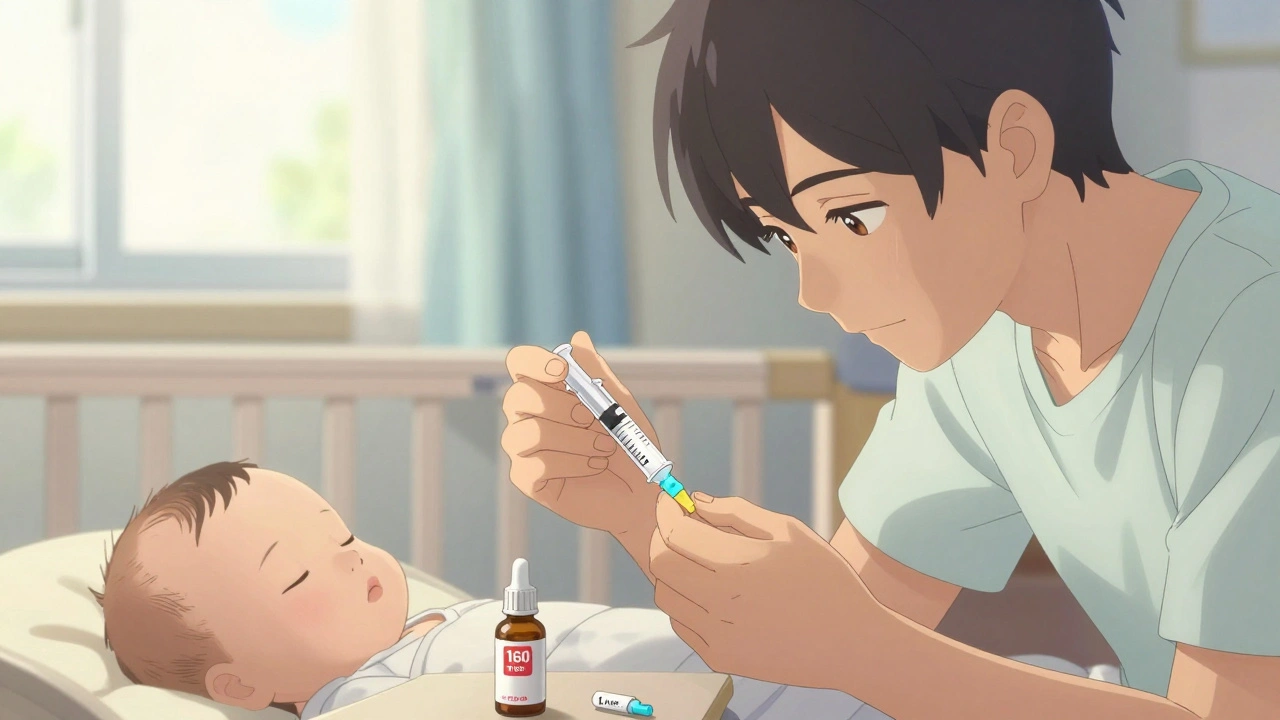
Every year, thousands of babies end up in emergency rooms because someone gave them the wrong amount of medicine. Not because they were careless-but because they didn’t know how to read the label. A single teaspoon mistake can turn a harmless dose into a life-threatening overdose. For infants under one year, there’s no room for guesswork. The difference between safety and danger often comes down to a few milliliters-and whether you’re using the right tool to measure it.
Why Infant Medication Is So Dangerous
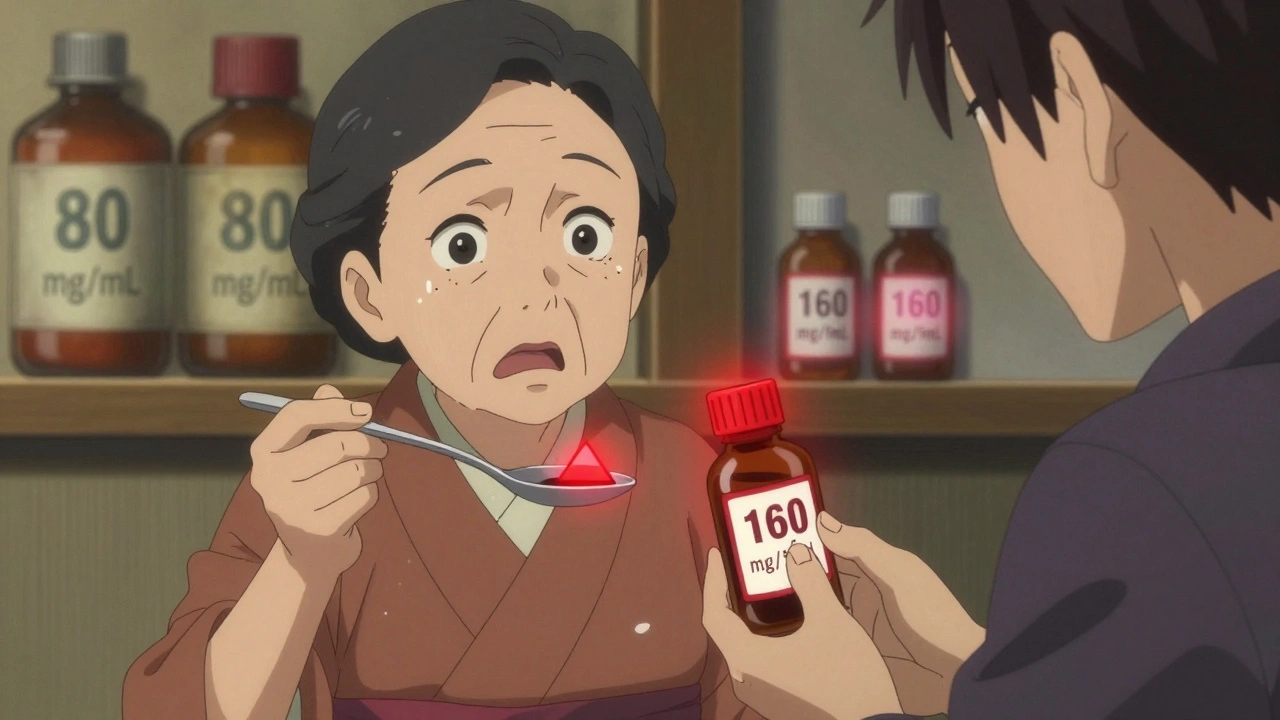
Babies aren’t small adults. Their bodies process medicine differently. A dose that’s safe for a 3-year-old could kill a 4-month-old. The biggest danger? Confusing concentrations. For years, infant acetaminophen came in two forms: one labeled 80 mg per mL (concentrated drops), and another at 160 mg per 5 mL. Parents mixed them up. One mom gave her baby 1 mL thinking it was the weaker version-but it was the strong one. That’s five times the intended dose. In 2010, the Institute for Safe Medication Practices found that half of all infant liquid medicine overdoses happened because of this exact confusion. The FDA stepped in in 2011 and banned the 80 mg/mL drops. Now, all infant acetaminophen must be 160 mg per 5 mL. Same for ibuprofen. But here’s the catch: children’s versions (for ages 2-11) are still 160 mg per 10 mL. If you grab the wrong bottle, you’re giving double the dose. And many parents don’t notice the difference until it’s too late.The Three Ways Medication Comes-and Why One Is Risky
Infant meds come in three forms: drops, syringes, and bottles with droppers. Each has its own risks.- Drops (like infant acetaminophen): These come with a tiny plastic dropper. The problem? A drop isn’t a standard unit. One person’s drop is 0.05 mL, another’s is 0.07 mL. That’s a 40% error right there. A 2018 study in Clinical Pediatrics found 74% of parents using droppers gave the wrong dose.
- Oral syringes: These are plastic syringes with clear mL markings. They’re the gold standard. A 2020 study at Cincinnati Children’s Hospital showed 89% accuracy when parents used them. That’s way better than cups or droppers.
- Bottles with measuring cups: These are the worst. Even if the cup says “5 mL,” most parents can’t read it right. A 2021 survey found 44% of parents used kitchen spoons. A regular tablespoon holds 15 mL-not 5. That’s three times too much.
How to Calculate the Right Dose (Step by Step)
You can’t just go by age. You need weight. Always. Here’s how to do it right:- Get your baby’s weight in kilograms. Most pediatricians give this at checkups. If not, convert pounds to kg: divide pounds by 2.2. A 10-pound baby = 4.5 kg.
- Check the concentration on the bottle. It should say “160 mg per 5 mL.” If it doesn’t, don’t use it. That’s not infant formula anymore.
- Calculate the dose. For acetaminophen, use 10-15 mg per kg per dose. For a 4.5 kg baby: 4.5 × 10 = 45 mg minimum. 4.5 × 15 = 67.5 mg maximum. So, you need between 45-67.5 mg.
- Convert mg to mL. Since it’s 160 mg per 5 mL, that’s 32 mg per mL. So 45 mg ÷ 32 = about 1.4 mL. 67.5 mg ÷ 32 = about 2.1 mL.
- Use an oral syringe. Draw up exactly 1.4 mL. Don’t eyeball it. Don’t use the dropper that came with the bottle.
The 5-Step Safety Checklist (CDC-Approved)
The CDC recommends this five-step process for every dose:- Confirm weight in kg (not pounds).
- Calculate dose using mg/kg (10-15 mg/kg for acetaminophen).
- Verify concentration on the label (160 mg/5 mL).
- Use only an oral syringe with 0.1 mL markings.
- Double-check with another adult before giving it.
What to Avoid at All Costs
Some mistakes are so common, they’re almost expected. Don’t let them happen to you.- Never use kitchen spoons. A teaspoon from your drawer is not 5 mL. It’s often closer to 7-10 mL. That’s a 40-100% overdose.
- Never mix medications. Cold and cough syrups often contain acetaminophen or diphenhydramine. If you’re already giving Tylenol, you’re doubling up. Between 2004 and 2005, over 7,000 kids under 2 went to ERs from these combos. The FDA banned them for kids under 2-and still advises against them for under 6.
- Never trust old bottles. If the label says “80 mg/mL,” throw it out. That’s outdated. If it says “for children 2-11,” don’t use it for babies.
- Never assume grandparents know. A 2023 study showed caregivers over 65 made 3.2 times more errors than younger parents. Vision, memory, outdated knowledge-they’re not at fault. The system failed them.

What’s Changing in 2025
The system is improving, slowly. In 2023, the FDA approved the first “smart” oral syringe-MediSafe SmartSyringe. It connects to an app, scans the bottle, and tells you the exact dose. Clinical trials showed 98.7% accuracy. It’s not cheap, but it’s a game-changer. The CDC’s 2023 National Action Plan wants to cut infant dosing errors in half by 2026. New rules are coming: color-coded labels (blue for infants, green for kids), QR codes that link to dosing calculators, and mandatory warnings on every bottle. Meanwhile, tools like the National Poison Control Center’s Help Me Choose tool (at poison.org) let you type in your baby’s weight and the medicine name-and it tells you the exact dose. They handled over 14,000 infant queries in 2022. Not one led to an ER visit.What to Do If You Think You Made a Mistake
If you gave too much-or the wrong medicine-don’t wait. Don’t Google it. Call Poison Control immediately: 1-800-222-1222. It’s free, 24/7, and they’ve helped over 50,000 families this year alone. Even if your baby seems fine, don’t assume safety. Acetaminophen overdoses can take 12-24 hours to show symptoms. Liver damage starts silently. Time matters.Final Rule: When in Doubt, Don’t Give It
If you’re unsure about the dose, the concentration, the tool, or the label-call your pediatrician. Or go to the ER. Better safe than sorry. One wrong drop can change everything. But one careful step-reading the label, using the syringe, double-checking-can save a life.Can I use a kitchen teaspoon to measure baby medicine?
No. A kitchen teaspoon holds 7-10 mL, not 5 mL. That’s 40-100% more than the prescribed dose. Even a small overdose can cause liver damage in infants. Always use an oral syringe with mL markings.
Is infant Tylenol the same as children’s Tylenol?
No. Infant Tylenol is 160 mg per 5 mL. Children’s Tylenol is 160 mg per 10 mL. Using children’s formula for a baby gives half the dose you need. Using infant formula for a toddler gives double the dose. Always check the label and never assume.
What should I do if my baby spits up the medicine?
Don’t give another dose unless your pediatrician says so. It’s hard to know how much was absorbed. Giving more could lead to overdose. Call your doctor for advice.
Are there any medicines I should never give my baby?
Never give aspirin, cough and cold medicines (under age 6), or adult painkillers like ibuprofen tablets. Even a single pill can be deadly. Opioids, heart meds, and iron supplements are also high-risk. Always check with your pediatrician before giving anything new.
How do I know if the medicine is still safe to use?
Check the expiration date and the liquid’s appearance. If it’s cloudy, discolored, or has particles, throw it out. Even if it’s not expired, liquid medicine loses potency over time. Store it in a cool, dry place-not the bathroom or car.
Can I give medicine to my baby if they’re breastfeeding?
Most infant-safe medications are also safe for breastfeeding mothers, but not all. Some drugs pass into breast milk and can make babies sleepy or irritable. Always ask your doctor or pharmacist if a medicine is safe for both you and your baby.






Sadie Nastor
just used the dropper that came with the medicine last week… i feel so dumb now. i thought it was fine since the bottle said ‘teaspoon’ but now i’m paranoid every time. got an oral syringe today. god, why is this so complicated?? 😅
Kurt Russell
THIS. THIS RIGHT HERE. I almost killed my daughter because i grabbed the kids’ Tylenol instead of infant. 160mg/5mL vs 160mg/10mL - same number, different danger. I cried in the pharmacy aisle. Don’t be me. Use the syringe. Always. No excuses.
Olivia Hand
the fact that we’re still having this conversation in 2025 is a national scandal. Labels should be color-coded, QR-coded, voice-activated, and accompanied by a trained nurse. We’re asking parents to be pharmacists while sleep-deprived, emotionally shattered, and under constant pressure. It’s not negligence - it’s systemic failure.
Kyle Oksten
the real tragedy isn’t the dosing errors - it’s that we treat medicine like a DIY project. You wouldn’t wire your house without a license. Why are we letting untrained people administer neurotoxic compounds to infants based on a bottle label? This isn’t parenting - it’s Russian roulette with acetaminophen.
Helen Maples
Step 5: Double-check with another adult. This is non-negotiable. I’ve seen too many parents say ‘I’m sure I got it right’ - and then they didn’t. If you’re alone, text a friend, call your mom, read the label out loud. Don’t rely on memory. Don’t rely on intuition. Write it down. Even if you’re tired. Even if you’re in the middle of the night. Write. It. Down.
Ashley Farmer
my grandma gave my son medicine with a spoon and swore it was ‘just a little.’ she meant well. but we need to stop blaming grandparents. we need to give them the tools. printed cards. big-font labels. phone apps with audio instructions. they’re not lazy - they’re left behind by a system that forgot them.
David Brooks
my baby spit up the medicine and i panicked. i gave more because i thought ‘she didn’t get enough.’ turned out she got almost all of it. i called poison control. they said ‘don’t redose.’ i cried. then i bought the syringe. you don’t need to be a genius to save a life - you just need to listen.
Jennifer Anderson
soo many ppl think the dropper is fine… but it’s not. i measured my drops with a syringe and one drop was 0.08ml, another was 0.04ml. like… what?? we’re gambling with our babies’ livers and no one talks about it. buy the syringe. please. just buy it.
Sangram Lavte
in India, we use the same medicine bottles. no color coding, no QR codes, no syringes. just a dropper and hope. i wish someone had told me this earlier. thank you for writing this. sharing with my cousin who just had a baby.
Oliver Damon
the pharmacokinetic variability in neonates is profound - hepatic metabolism is immature, plasma protein binding is reduced, and renal clearance is 30-50% lower than in adults. thus, mg/kg dosing is not merely a recommendation - it’s a pharmacological imperative. failure to adhere to this paradigm constitutes a clinically significant deviation from evidence-based practice. the oral syringe isn’t a convenience - it’s a pharmacokinetic control mechanism.
Stacy here
the FDA banned the 80mg/mL drops? yeah right. that’s just PR. Big Pharma still sells the same stuff under new labels. the ‘smart syringe’? $120? that’s a scam. they want you to buy gadgets so you don’t question why the system is this broken in the first place. they’re not protecting babies - they’re protecting profits.
Kyle Flores
my sister used a kitchen spoon and her baby got sick. we all blamed her… but then i realized - no one ever showed her how to read the label. i made a little card with the steps and taped it to my medicine cabinet. simple. free. lifesaving. maybe we need to start doing that for everyone.
Ryan Sullivan
you’re all missing the point. this isn’t about droppers or syringes. it’s about the commodification of pediatric care. we’ve outsourced parenting to corporate labels, and now we’re shocked when people misread them. the real solution isn’t education - it’s dismantling the pharmaceutical-industrial complex that profits from confusion.
Wesley Phillips
lol at all these ‘use the syringe’ posts. i used a dropper and my kid’s fine. you people are overthinking this. i’m not a pharmacist, i’m a dad. if the medicine didn’t kill him, it worked. chill out.