
When you pick up a prescription at the pharmacy, you might see a name like omeprazole or metformin. These are generic drugs - the same active ingredients as brand-name pills, but often costing a fraction of the price. But behind those simple names is a complex system that determines how doctors prescribe them, how insurers cover them, and even whether they’re legal to use. Understanding how generic drugs are classified isn’t just for pharmacists or regulators. It affects your access, your safety, and your out-of-pocket costs every time you fill a script.
Therapeutic Classification: What the Drug Is Used For
The most common way drugs are grouped is by what they treat. This is called therapeutic classification. Think of it like sorting books by genre instead of author. A drug that lowers blood pressure goes in the Cardiovascular Agents category. One that relieves pain goes in Analgesics. The FDA and USP (United States Pharmacopeia) use this system to guide prescribing decisions in hospitals and clinics across the U.S.
It’s simple and practical. If you have diabetes, your doctor doesn’t need to know the exact chemical structure of metformin. They just need to know it’s an Antidiabetic Agent. This system works because it mirrors how doctors think - by condition, not by molecule. The USP lists over 300 therapeutic categories, with each broken down into subgroups. For example, under Analgesics, you’ll find Non-opioid (like ibuprofen) and Opioid (like oxycodone). This helps avoid dangerous mix-ups.
But it’s not perfect. Some drugs do more than one thing. Aspirin, for instance, reduces pain, thins blood, and can even help prevent heart attacks. Which category does it belong to? In practice, it’s often listed under multiple groups. The FDA’s 2023 update to its Therapeutic Categories Model tried to fix this by allowing a primary and secondary indication. That way, a drug like duloxetine - used for depression and nerve pain - can be properly tracked in both categories without confusing prescribers.
Pharmacological Classification: How the Drug Works
While therapeutic classification tells you what a drug does, pharmacological classification tells you how it does it. This is where things get scientific. Drugs are grouped by their mechanism of action - the specific biological process they interfere with.
Take beta-blockers. Drugs like propranolol and metoprolol all end in “-lol.” That’s not a coincidence. The USP adopted a naming system in 1964 that embeds clues into the generic name. “-lol” means it blocks beta receptors in the heart. “-prazole” means it shuts down stomach acid production. These naming conventions aren’t just for show. Studies show they reduce medication errors by 18%, because pharmacists and nurses can spot patterns quickly.
There are over 1,200 pharmacological classes recognized today. For example, drugs like imatinib and erlotinib are both called Epidermal Growth Factor Receptor Kinase Inhibitors. They treat different cancers - one for leukemia, another for lung cancer - but they work the same way at the molecular level. This classification is vital for researchers developing new drugs and for specialists managing complex cases. But for most patients and even many primary care doctors, it’s too technical to be useful on a daily basis.
DEA Scheduling: Legal Status and Abuse Risk
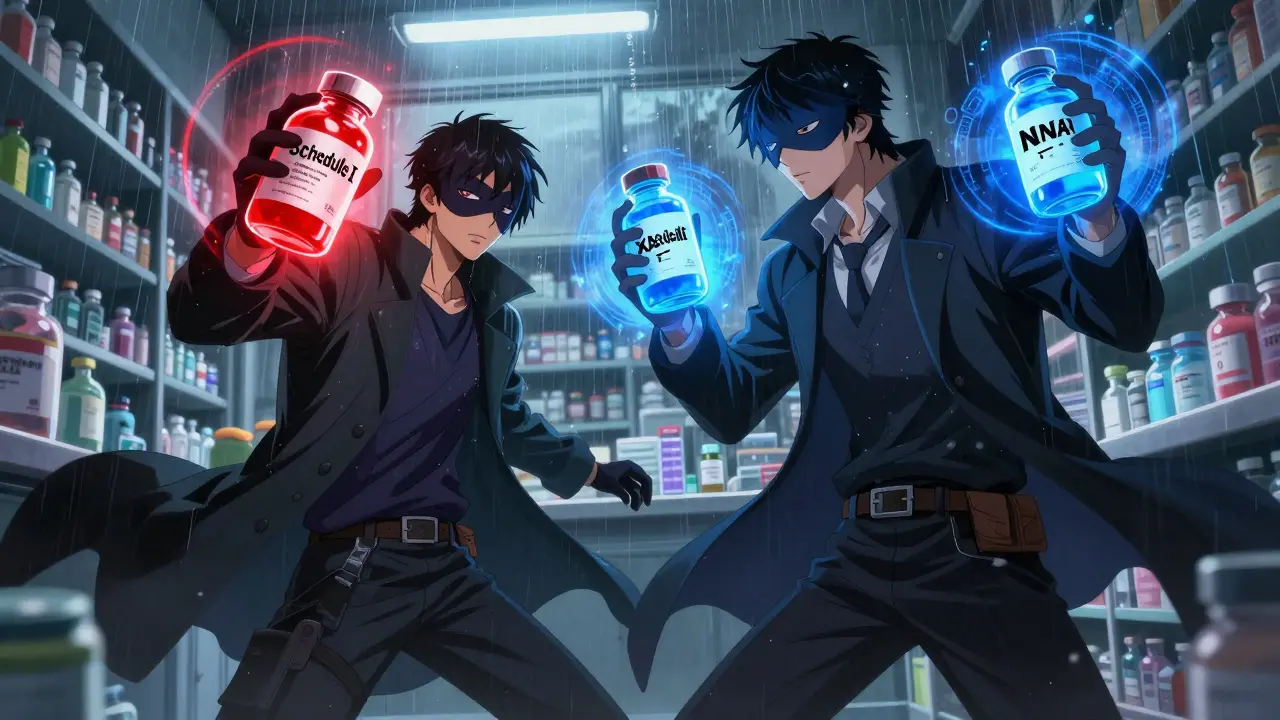
Not all drugs are treated the same under the law. The DEA classifies controlled substances into five schedules based on their potential for abuse and medical use. This system, created in 1970, still shapes how prescriptions are written, how pharmacies store drugs, and whether refills are allowed.
- Schedule I: No accepted medical use. High abuse potential. Examples: heroin, LSD, marijuana (at the federal level).
- Schedule II: High abuse potential, but accepted medical use. Examples: oxycodone, fentanyl, Adderall.
- Schedule III: Moderate abuse potential. Examples: hydrocodone with acetaminophen, ketamine.
- Schedule IV: Low abuse potential. Examples: Xanax, Ambien.
- Schedule V: Very low abuse potential. Examples: cough syrups with small amounts of codeine.
This system has real-world consequences. A Schedule II drug like oxycodone can’t be refilled without a new prescription. A Schedule IV drug like alprazolam can be refilled up to five times in six months. And despite marijuana being legal for medical use in 38 states, it’s still Schedule I federally - a glaring inconsistency that hinders research and creates legal gray zones for patients and providers.
Experts point out flaws. In 2021, oxycodone caused more overdose deaths than heroin - yet heroin is Schedule I, while oxycodone is Schedule II. Critics argue the system is outdated and doesn’t reflect actual harm. Still, for pharmacies and prescribers, DEA scheduling isn’t optional. It’s the law.
Insurance Tiers: What You Pay Out of Pocket
Even if two drugs are chemically identical, your insurance might treat them differently. That’s because insurers use their own classification system: tiered formularies.
Most plans have five tiers:
- Tier 1: Preferred generics - lowest cost. These are the drugs insurers push you toward. About 75% of generic drugs fall here.
- Tier 2: Non-preferred generics - slightly higher cost. Often because they’re not on the insurer’s preferred list, even if they’re the same active ingredient.
- Tier 3: Preferred brand-name drugs - you pay more than for generics.
- Tier 4: Non-preferred brand-name drugs - high cost, often requiring prior authorization.
- Tier 5: Specialty drugs - the most expensive, usually for rare or complex conditions. These make up just 5-7% of prescriptions but account for over 50% of drug spending.
Here’s the kicker: Two identical generic versions of the same drug - same manufacturer, same dose, same pill - can be in different tiers. Why? Because of contract deals between insurers and drug manufacturers. One version might be cheaper for the insurer to buy, so it gets placed in Tier 1. The other, even though it’s the same medicine, ends up in Tier 2 - and you pay 25-35% more.
Pharmacists report that 43% of prior authorization requests are due to tier disputes. Patients often don’t realize they’re being charged more for the exact same drug just because of insurance paperwork. This isn’t about safety or effectiveness. It’s about cost control.
The ATC System: Global Standard for Drug Tracking
While U.S. systems focus on clinical or legal needs, the World Health Organization created a global standard: the Anatomical Therapeutic Chemical (ATC) classification system. It’s used in 143 countries and is the backbone for tracking drug use in public health research.
ATC uses a five-level code. For example, metformin is coded as A10BA02:
- A: Alimentary tract and metabolism (anatomical group)
- 10: Anti-diabetic agents (therapeutic subgroup)
- B: Biguanides (pharmacological subgroup)
- A: Metformin (chemical subgroup)
- 02: Specific chemical identifier
This system is precise. It links drugs across borders, making it easier to compare prescribing patterns between Australia, Germany, and Canada. The WHO updates it quarterly, adding 200+ new codes each year. In 2022 alone, 217 new drugs got ATC codes - including newer biologics for cancer and autoimmune diseases.
While most U.S. clinicians don’t use ATC codes daily, they’re embedded in electronic health records and research databases. If you’re ever looking at global drug data, this is the system behind it.

Why All This Matters to You
You might think classification systems are bureaucratic noise. But they shape your care in real ways.
When your doctor prescribes a generic drug, they’re not just picking a cheaper option. They’re choosing based on:
- What condition it treats (therapeutic class)
- How it works in your body (pharmacological class)
- Whether it’s legally allowed to be prescribed (DEA schedule)
- What your insurance will cover (tier)
Confusion between these systems leads to errors. A 2022 study found that 27% of medication errors in hospitals were tied to classification mismatches. One nurse might think a drug is safe because it’s a generic. Another might flag it because it’s a Schedule III controlled substance. Without clear, consistent labeling, mistakes happen.
And if you’re paying for prescriptions out of pocket, knowing your drug’s tier can save you money. Ask your pharmacist: “Is this the preferred generic?” If it’s not, ask if there’s an equivalent in Tier 1. Sometimes, switching brands - even if the name changes - can cut your bill in half.
What’s Changing in 2025
The system is evolving. The FDA’s Therapeutic Categories Model 2.0, launching in January 2025, will let drugs have multiple primary indications. This matters if you’re on a drug for both depression and chronic pain - your provider won’t have to choose one label over the other.
Meanwhile, the DEA is under pressure to reclassify marijuana. If the MORE Act passes, marijuana could move from Schedule I to III, opening the door for more research and legal prescriptions.
And AI is stepping in. Tools like IBM Watson’s Drug Insight platform are using machine learning to predict the best classification for new drugs - with 92.7% accuracy in trials. In five years, classification may no longer be a static list. It could be dynamic, personalized, and linked to your genetics.
For now, the system is messy. But understanding the pieces - therapeutic, pharmacological, legal, and financial - gives you power. You’re not just a patient. You’re someone who can ask the right questions and make smarter choices about your care.
What’s the difference between generic and brand-name drugs?
Generic drugs contain the same active ingredient, dosage, and intended use as their brand-name counterparts. The only differences are in inactive ingredients (like fillers or dyes), packaging, and price. Generics must meet the same FDA standards for safety and effectiveness. They’re typically 80-85% cheaper because manufacturers don’t have to repeat expensive clinical trials.
Why is one generic drug cheaper than another if they’re the same?
Even if two generics have the same active ingredient, they can be priced differently based on insurance contracts. One might be in Tier 1 (preferred), while the other is in Tier 2 (non-preferred). This isn’t about quality - it’s about which manufacturer the insurer negotiated a better deal with. Always ask your pharmacist if there’s a lower-cost alternative.
Can a drug be in more than one classification?
Yes. Many drugs have multiple uses. Aspirin is both an analgesic (pain reliever) and an antiplatelet (blood thinner). Duloxetine treats both depression and nerve pain. Modern classification systems are starting to allow multiple categories to reflect this reality. The FDA’s new 2.0 model will officially recognize primary and secondary indications.
Why is marijuana still a Schedule I drug?
Despite being approved for medical use in 38 states and having FDA-approved cannabinoid medications like dronabinol (Schedule II), marijuana remains federally classified as Schedule I - meaning no accepted medical use and high abuse potential. This creates a legal conflict and blocks research. Advocates argue the classification is outdated, and legislation like the MORE Act could change it to Schedule III in the coming years.
How do drug names tell you what they do?
The U.S. Adopted Names Program uses standardized suffixes. If a drug ends in “-lol,” it’s a beta-blocker (like propranolol). “-prazole” means it’s a proton pump inhibitor (like omeprazole). “-sartan” indicates an angiotensin II receptor blocker (like losartan). These naming rules help clinicians quickly identify drug class and reduce prescribing errors.
What’s the ATC code and why should I care?
The ATC (Anatomical Therapeutic Chemical) code is a global standard used by the WHO to classify drugs. It’s not something you’ll see on your prescription, but it’s used in research, international drug tracking, and electronic health records. If you’re comparing drug use across countries or looking up clinical data, ATC codes are how systems communicate. For example, metformin’s ATC code is A10BA02 - it tells you exactly what it’s for and how it works.
Next Steps: What You Can Do Today
When you get a new prescription:
- Ask: “Is this the preferred generic?” - if not, ask if there’s a cheaper option.
- Check the drug’s name for suffixes like “-lol” or “-prazole” - they tell you the class.
- Ask your pharmacist if the drug is a controlled substance - it affects refills and storage.
- If you’re on multiple medications, ask if any have overlapping uses - that can help avoid duplication.
You don’t need to memorize every classification. But knowing how these systems work helps you navigate the system - not just as a patient, but as someone who deserves clear, safe, and affordable care.








Daz Leonheart
Just wanted to say this article really clarified a lot for me. I’ve been on metformin for years and never realized how much goes into why my insurance covers one generic but not another. It’s not about quality-it’s about contracts. Knowing that helps me ask the right questions at the pharmacy.
Kunal Kaushik
India’s formulary system is wild compared to this. We have generics everywhere, but no tier system. You just get what’s in stock. Still, I’m impressed how detailed the U.S. system is-even if it’s confusing. Thanks for breaking it down 🙏
Caleb Sutton
They’re lying. The FDA doesn’t care about safety. They just let Big Pharma push generics so they can control the market. The real reason for tiered formularies? To make you dependent on their deals. You’re not saving money-you’re being manipulated.
Janice Williams
It is, indeed, a most regrettably convoluted and unnecessarily opaque system. One cannot help but observe that the conflation of therapeutic, pharmacological, legal, and financial classifications constitutes an egregious abdication of coherent pharmaceutical policy. This is not healthcare. This is corporate theater.
Roshan Gudhe
It’s funny how we treat medicine like a puzzle when it’s really about people. The ATC code for metformin is A10BA02-but what does that mean to someone skipping meals because they can’t afford the Tier 2 version? Systems matter, sure. But so does compassion. Maybe we need a sixth classification: ‘Human Access Tier.’
Rachel Kipps
I didn’t know aspirin was in multiple categories. That’s interesting. I guess I always just thought of it as pain relief. Wonder if my doctor knew that.
Prajwal Manjunath Shanthappa
...And yet, despite the FDA’s ‘2.0’ model, the DEA’s archaic scheduling, and the insurers’ tiered extortion, we are still expected to navigate this labyrinth with a smile and a co-pay. The very notion that ‘you’re not just a patient-you’re someone who can ask the right questions’ is, frankly, a grotesque joke. What a privileged delusion.
Wendy Lamb
My pharmacist just told me to switch to the other generic. Same pill. $30 cheaper. I didn’t even know that was possible. This post helped me understand why.
Antwonette Robinson
Wow. A 92.7% accurate AI system? That’s cute. Next they’ll use ChatGPT to write prescriptions. I’m sure the FDA will love that.