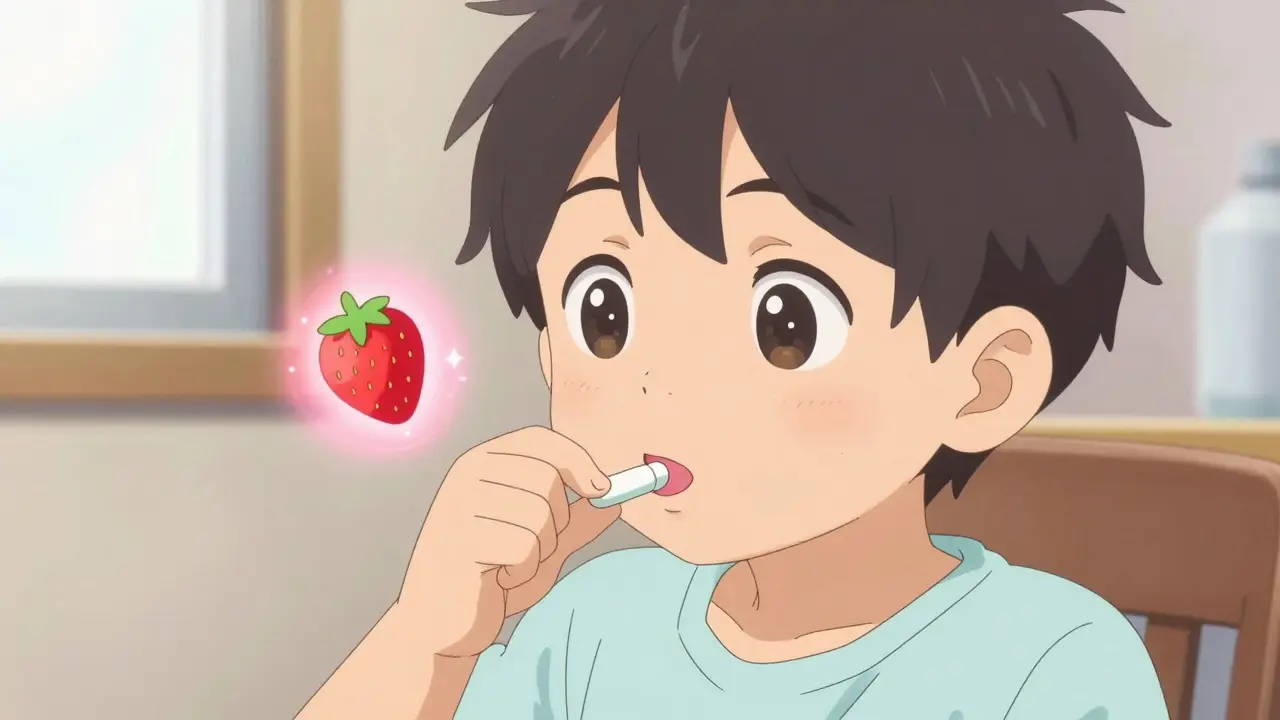
When your child is sick, the last thing you want is a battle over medicine. You’ve got two options: a sweet-tasting liquid you have to measure out with a syringe, or a tiny tablet you hope they can swallow without choking. Which one is really better? The answer might surprise you. For years, doctors and parents assumed liquids were the only safe, reliable choice for kids. But new research, real-world data, and even parent reviews are flipping that idea on its head. The truth? Tablets - especially modern mini-tablets - are often the smarter, safer, and more effective option for most children.
Why Liquids Used to Be the Default
It makes sense why liquids became the go-to. Babies can’t swallow pills. Toddlers gag on anything bigger than a pea. So for decades, doctors reached for the medicine dropper or oral syringe. Liquids allowed for precise dosing based on weight - perfect for infants. They also came in flavors like strawberry, grape, or bubblegum, which seemed like a win. But here’s the catch: many of those flavors don’t actually taste like anything real. A 2023 study from BC Children’s Hospital found that kids rejected 7 out of 10 "strawberry-flavored" liquids because they tasted like chemical syrup, not fruit. That’s not just annoying - it’s a reason kids refuse meds, leading to missed doses and longer illnesses.
Then there’s the mess. Spilled doses. Syringes that leak. Bottles that need refrigeration. A 2021 American Academy of Pediatrics report found that 15-20% of parents accidentally give the wrong dose of liquid medicine because they misread the markings or use kitchen spoons. Even a 10% overdose on antibiotics or fever reducers can be dangerous. And liquids? They don’t last. Most need to be used within 14-30 days after opening. If your kid doesn’t finish the bottle, you’re throwing away money - and potentially a lifesaving drug.
The Rise of the Mini-Tablet
Modern pediatric tablets aren’t what you remember. Gone are the large, bitter, crushable pills. Today’s options include mini-tablets as small as 2mm - smaller than a grain of rice - and orodispersible tablets that dissolve on the tongue in 30 seconds, no water needed. A 2012 study by Spomer et al. followed 60 kids aged 6 months to 6 years. The result? Kids as young as 1 year old swallowed mini-tablets more easily than liquids. Why? Because liquids can be overwhelming - too much volume, too strange a taste. A tiny tablet? It’s like swallowing a sugar pellet. One parent on Reddit put it simply: "My 4-year-old would rather swallow a mini-tablet than take the "strawberry" antibiotic that tasted like chemicals."
And it’s not just about size. These tablets are coated to mask bitterness, designed to be chewed or swallowed whole, and stable for years at room temperature. No refrigeration. No expiration worries after a week. A 2018 study in PMC6483770 showed solid forms had 3-5 times lower degradation rates than liquids. That means the medicine you buy today is still potent when you need it six months from now.
Accuracy: Why Tablets Win
Dosing accuracy is where tablets really pull ahead. Liquid medications rely on parents measuring with syringes, cups, or - worst of all - kitchen teaspoons. The FDA found that 12-18% of liquid doses are given incorrectly. That’s not just a small mistake. A child who gets 20% too much acetaminophen risks liver damage. Too little antibiotic? The infection doesn’t clear, and resistance grows.
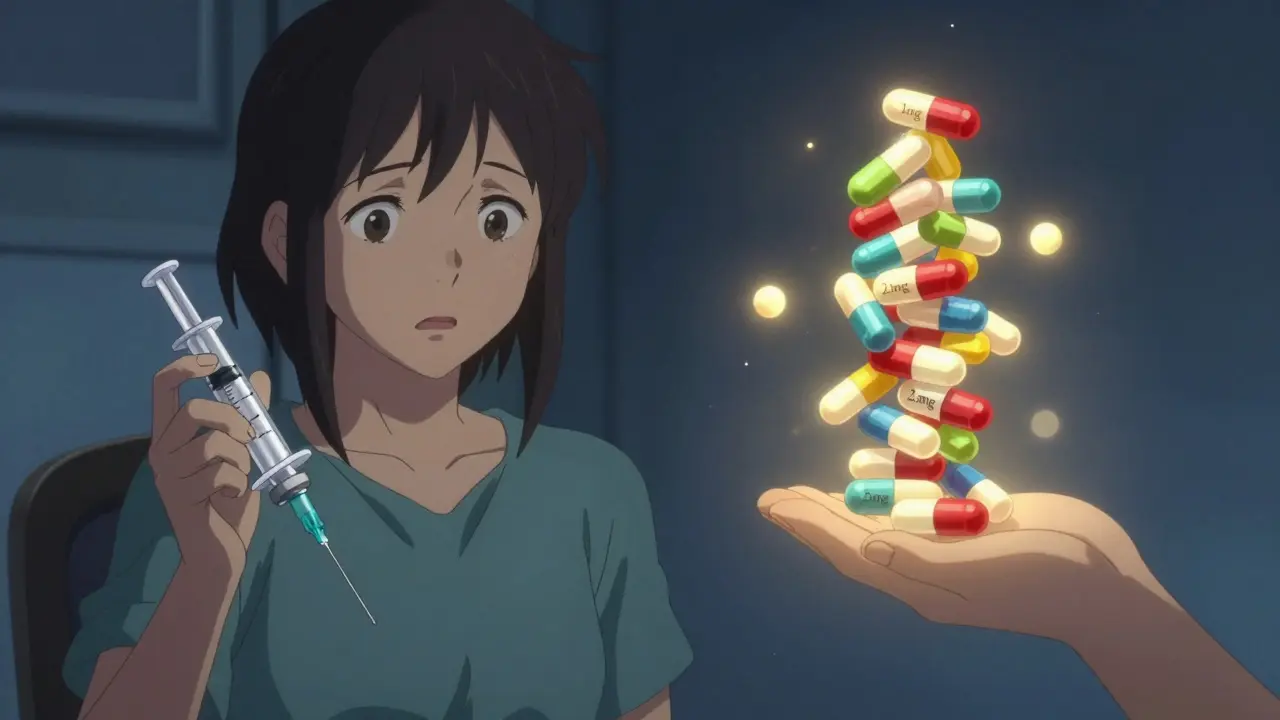
Tablets, on the other hand, come in fixed doses. You give one. Not half. Not a little more. One. And if your child needs a lower dose? There are now 5mg, 2.5mg, even 1mg mini-tablets available for common drugs like amoxicillin or ibuprofen. You don’t have to guess. You don’t have to pour. You just hand them a tablet that’s already been precisely made.
Cost and Waste
Let’s talk money. A single bottle of liquid amoxicillin for a 2-year-old might cost $15. The same total dose in mini-tablets? $4. Why? Liquids need preservatives, flavorings, and stabilizers. They’re bulkier to ship. They expire faster. The NHS in the UK estimated that switching just 10,000 pediatric liquid prescriptions to tablets saves £7,842 per year. For a hospital, that’s tens of thousands. And it’s not just about cost - it’s about waste. How many times have you thrown out half a bottle because your child got better before finishing it? With tablets, you only buy what you need.
When Liquids Still Make Sense
Let’s be clear: liquids aren’t obsolete. For babies under 6 months, they’re often the only option. For kids who need exact, daily dose adjustments - like those on levothyroxine or warfarin - liquids allow fine-tuning down to 0.1mL. Also, if your child has a swallowing disorder, neurological condition, or is on a feeding tube, liquids remain essential.
But for the vast majority of kids - especially those over 2 years old - there’s rarely a medical reason to choose liquid. A 2022 JAMA Pediatrics meta-analysis showed 22% higher adherence rates with solid forms for chronic conditions like asthma or ADHD. That means fewer hospital visits. Fewer missed school days. Fewer stress-filled mornings.
How to Train Your Child to Swallow Pills
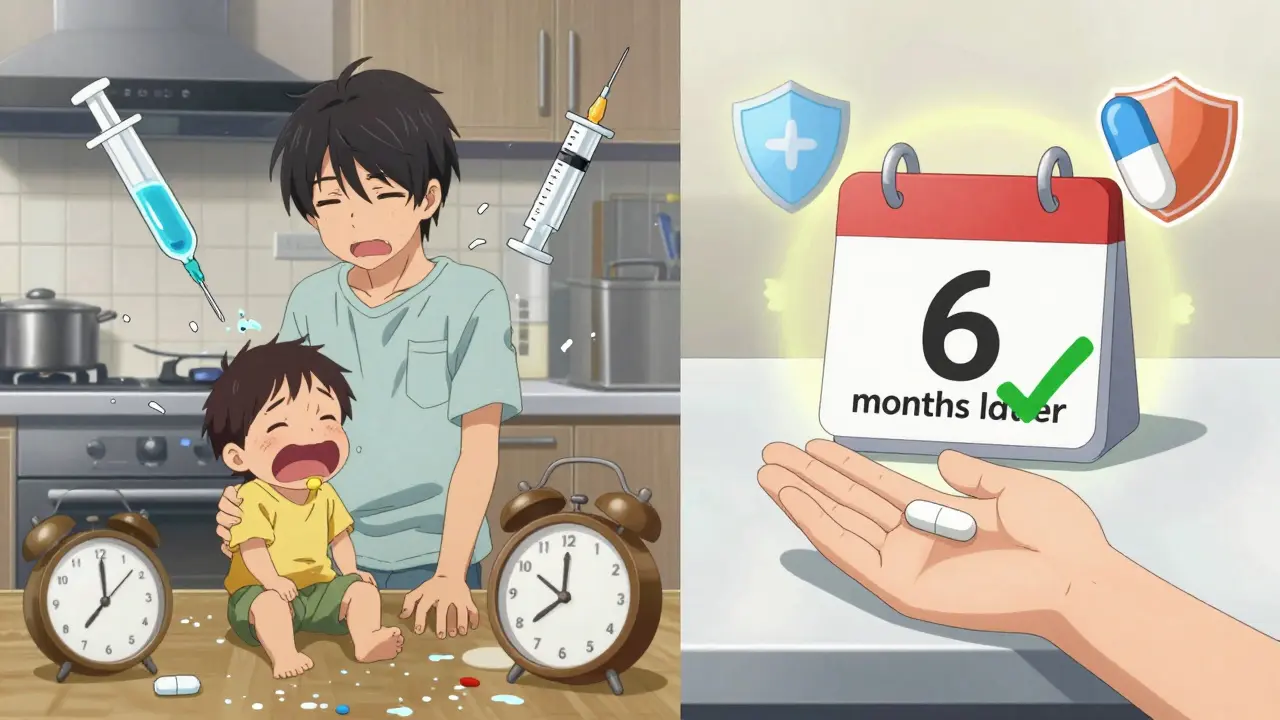
Many parents panic at the idea of a tablet. They worry about choking. But choking on a properly sized pediatric tablet is extremely rare. The FDA tracked adverse events from 2010 to 2020 and found less than 0.002% of cases involved actual choking. Most "choking" incidents are just coughing or gagging - which happens with liquids too.
Training works. Start around age 3. Use practice tricks: mini-marshmallows, bread balls, or even sugar beads. Teach the "pop-bottle method" - have your child take a sip from a water bottle, then place the tablet on their tongue right before swallowing. Most kids master this within a few days. A 2023 report from BC Children’s Hospital showed success rates over 90% in kids as young as 3 with just 5 minutes of daily practice.
And don’t forget: ask your pharmacist. Many now stock mini-tablets in common strengths. If your child’s prescription is only available as a liquid, ask if a tablet version exists. Pharmacists can often order them or suggest an equivalent solid alternative.
What to Look for When Choosing
- For kids under 2: Stick with liquids unless a doctor recommends otherwise. Use an oral syringe - never a spoon.
- For kids 2-5: Try mini-tablets (2-4mm). Start with sugar-free, flavor-coated ones. Practice daily with soft foods.
- For kids 6 and up: Standard tablets are fine. Look for film-coated or chewable versions if taste is an issue.
- Avoid crushing tablets unless the label says it’s safe. Crushed time-release pills can cause dangerous overdoses.
- Check storage - if it needs refrigeration, ask if a tablet form is available.
The Bottom Line
The old rule - "kids need liquids" - is outdated. Modern pediatric tablets are safe, accurate, stable, affordable, and easier for most children to take. The European Medicines Agency has been recommending tablet training since 2013. The WHO updated its guidelines in 2024 to include solid forms for children as young as 2. And parents? They’re voting with their experiences. On pharmacy review sites, tablets average 4.5 stars. Liquids? Just 2.7.
That doesn’t mean you have to force a tablet on a terrified 2-year-old. But it does mean you should ask: "Is there a tablet version?" Don’t accept "this is how we’ve always done it" as an answer. Your child deserves medicine that’s not just effective - but easy, safe, and reliable.
Can my 1-year-old swallow a tablet?
Yes - if it’s a properly sized mini-tablet (under 3mm). A 2012 study showed that 85% of 1-year-olds successfully swallowed mini-tablets, while 40% refused liquid due to taste. Always supervise and start with a soft food like banana to practice.
Are liquid medications more accurate than tablets?
No - tablets are more accurate. Liquids require measuring, and 12-18% of doses are given incorrectly due to misreading syringes or using kitchen spoons. Tablets come in fixed doses, eliminating measurement errors.
Why do some doctors still prescribe liquids for older kids?
Many doctors default to liquids out of habit or because parents ask for them. A 2021 survey found 62% of U.S. pediatricians still prescribe liquids for children under 8, even though evidence supports tablets. Ask if a tablet version exists - it’s often just as effective and cheaper.
Do tablet medications taste better than liquids?
Yes - especially modern ones. Many tablets now have smooth, fruit-flavored coatings that taste like real fruit. Liquids often contain artificial flavors that kids reject. One parent described a "strawberry" liquid as tasting like "chemicals," while the tablet tasted like actual strawberries.
How long do liquid medications last compared to tablets?
Liquid medications typically expire 14-30 days after opening and often require refrigeration. Tablets last 2-3 years at room temperature. That means less waste, less cost, and more reliable dosing over time.







Davis teo
Okay but let’s be real - I gave my 3-year-old a mini-tablet and she gagged for 10 minutes like she’d been poisoned. Then she laughed and asked for more. I swear, kids are wild. I thought I was going to need an EMT. Now? She begs for her "medicine candy."
Michaela Jorstad
Thank you for this! I’ve been terrified of tablets since my daughter choked on a grape. But after reading this, I tried the "pop-bottle method" with sugar beads - and it worked. Two days later, she swallowed her amoxicillin like a champ. I cried. I’m so glad someone finally said this out loud.
Arshdeep Singh
Look, I’m not a doctor, but I’ve raised three kids and read every study since 2010. Liquids are a scam. The pharmaceutical industry makes more money off syrup because it’s bulkier, expires faster, and requires repeat purchases. Tablets? One bottle lasts a year. That’s why they don’t advertise them. The system wants you dependent. Wake up.
Chris Beeley
As a pediatric pharmacist in Lagos, I can confirm: liquid formulations are a logistical nightmare. Refrigeration? In a place where power cuts last 12 hours? No. Shelf stability? Tablets win. Parents in Nigeria are switching en masse - even when doctors resist. The real issue isn’t medical - it’s institutional inertia. We’re still using 1980s protocols in 2024.
James Roberts
Wow. This post is basically the anti-liquid manifesto. And you know what? It’s right. I used to think tablets were for "tough kids" - turns out, I was just lazy. My 5-year-old took her first 2.5mg tablet like it was a Skittle. No drama. No measuring. No spilled medicine. I feel like I’ve been doing parenting wrong for five years.
Jayanta Boruah
While the data presented is statistically compelling, it fails to account for pharmacokinetic variability in pediatric populations, particularly with regard to gastric emptying times and first-pass metabolism. Liquids, by virtue of their homogenous dispersion, offer superior bioavailability in underdeveloped gastrointestinal tracts, which are common in children under five. Moreover, the assumption that all mini-tablets are bioequivalent to their liquid counterparts is not universally validated - especially in low- and middle-income countries where manufacturing standards vary. Thus, while tablets may be convenient, they are not universally superior - context is paramount.
Ellen Spiers
The meta-analysis cited is methodologically flawed. The JAMA Pediatrics study excluded non-English-speaking populations, had a sample size of under 800, and did not control for socioeconomic variables that heavily influence adherence. Furthermore, the 4.5-star tablet rating is sourced from pharmacy review sites - a self-selecting, non-representative cohort. The WHO guidelines referenced? They’re advisory, not regulatory. This post reads like pharmaceutical marketing disguised as evidence.
Oana Iordachescu
Are you aware that some tablet coatings contain titanium dioxide? It’s banned in the EU for food products due to carcinogenic concerns. And the "fruit flavoring"? Often derived from phthalates. The FDA doesn’t regulate flavor additives in pediatric meds the way it does in candy. I’m not saying avoid tablets - but please, check the ingredient list. And if your pharmacist says "it’s fine," ask for the SDS. :)
Marie Crick
My child was hospitalized because a nurse gave her crushed extended-release tablets. I’m not letting you parents play Russian roulette with their kids’ livers. If you don’t know what you’re doing, stick to liquids. You’re not a pharmacist. Don’t be a hero.
madison winter
I read this. I agree with some of it. I’m still giving my 4-year-old liquid. Not because I’m stubborn. But because she cries when I even hold up a pill. And I’m tired. So I’ll take the mess over the trauma.
Jeremy Williams
In Japan, pediatric tablets have been standard since 2015. No syringes. No refrigeration. Kids take them with rice balls. We don’t have "medicine battles" because we train early. Culture matters. The West clings to liquids because we infantilize kids. Maybe we need to stop treating them like fragile lab rats.
Maddi Barnes
As a mom of a kid with sensory issues, I’ll say this: some kids can’t handle tablets. Texture is a nightmare. For us? Still liquid. But with a flavor like real orange juice - not "chemical strawberry." Also, I use a syringe. Not a spoon. And I label the bottle. So… yeah. You’re not wrong. But you’re not the whole story either. 🤷♀️
Benjamin Fox
Tablets are the future. America needs to stop being soft. My son swallowed his first pill at 2.5. Now he’s 7 and takes 3 a day. No drama. No mess. No crying. You want your kid to be tough? Stop coddling them with syrup. This isn’t a daycare. It’s medicine. 💪
Davis teo
Replying to @7776 - you’re my hero. My kid used to scream when she saw the syringe. Now she grabs the tablet like it’s a prize. I did the pop-bottle thing too. Took three days. Worth every second. Thank you for normalizing this. I thought I was the only one who felt guilty for not forcing it sooner.