When you take opioids for pain and benzodiazepines for anxiety or sleep, you might think you’re just managing two separate problems. But what you’re really doing is putting your breathing at serious risk - and it’s not a small one. The combination doesn’t just add up; it multiplies danger. This isn’t a theory. It’s a proven, deadly reality that has killed thousands of people in the U.S. over the past two decades.
Why This Combination Is So Dangerous
Both opioids and benzodiazepines slow down your central nervous system. Opioids like oxycodone, hydrocodone, and fentanyl act on opioid receptors in your brainstem, the part that controls automatic breathing. Benzodiazepines like alprazolam, lorazepam, and diazepam boost GABA, a calming neurotransmitter that also suppresses brain activity - including the signals that tell you to breathe. When taken alone, each drug can cause drowsiness or shallow breathing. But together? They don’t just add up - they lock each other in. The result is a dangerous synergy that can turn a normal night’s sleep into a silent, fatal event. Studies show that people taking both drugs are 10 times more likely to die from an overdose than those taking opioids alone. In 2020, benzodiazepines were involved in 16% of all opioid-related overdose deaths, according to the CDC. This isn’t just about street drugs. It’s happening in prescriptions. A 2021 study found that nearly 15% of Medicare patients on long-term opioid therapy were also prescribed benzodiazepines - even though the FDA and CDC have warned against this for years.How It Kills: The Silent Breathing Failure
The biggest danger isn’t immediate. It’s quiet. You might feel fine during the day. Your oxygen levels might look normal in a doctor’s office. But when you lie down to sleep, your body relaxes - and so does your breathing. In one study, 85% of people who took both drugs together dropped below 90% oxygen saturation - a level that can lead to brain damage or death if sustained. That’s compared to 45% of people who took opioids alone. What’s worse? People who’ve been on opioids for months think they’ve built up tolerance. They assume they’re safe. But tolerance to opioids doesn’t protect you from benzodiazepines. Your brain still can’t respond to rising carbon dioxide levels - the signal that tells you to breathe deeper. This is why overdoses often happen at night. Someone goes to bed after taking their usual dose. No one hears them struggle. No one knows they’ve stopped breathing until it’s too late.Pharmacokinetic Traps: When Your Body Can’t Clear the Drugs
Some opioids - like fentanyl, methadone, and oxycodone - are broken down by an enzyme in your liver called CYP3A4. Certain benzodiazepines, including alprazolam and midazolam, block that same enzyme. So when you take them together, your body can’t process the opioid properly. The opioid builds up in your bloodstream, staying active longer than expected. This means a dose that was once safe can suddenly become toxic. A patient on a steady dose of oxycodone might start taking alprazolam for anxiety. Within days, they’re not just sleepy - they’re struggling to breathe. Their doctor didn’t change the opioid dose. But the benzodiazepine did the damage anyway. Pfizer’s own labeling for lorazepam injection warns that airway obstruction can occur in patients who are excessively sedated. That’s not a rare side effect - it’s a predictable outcome when these drugs mix.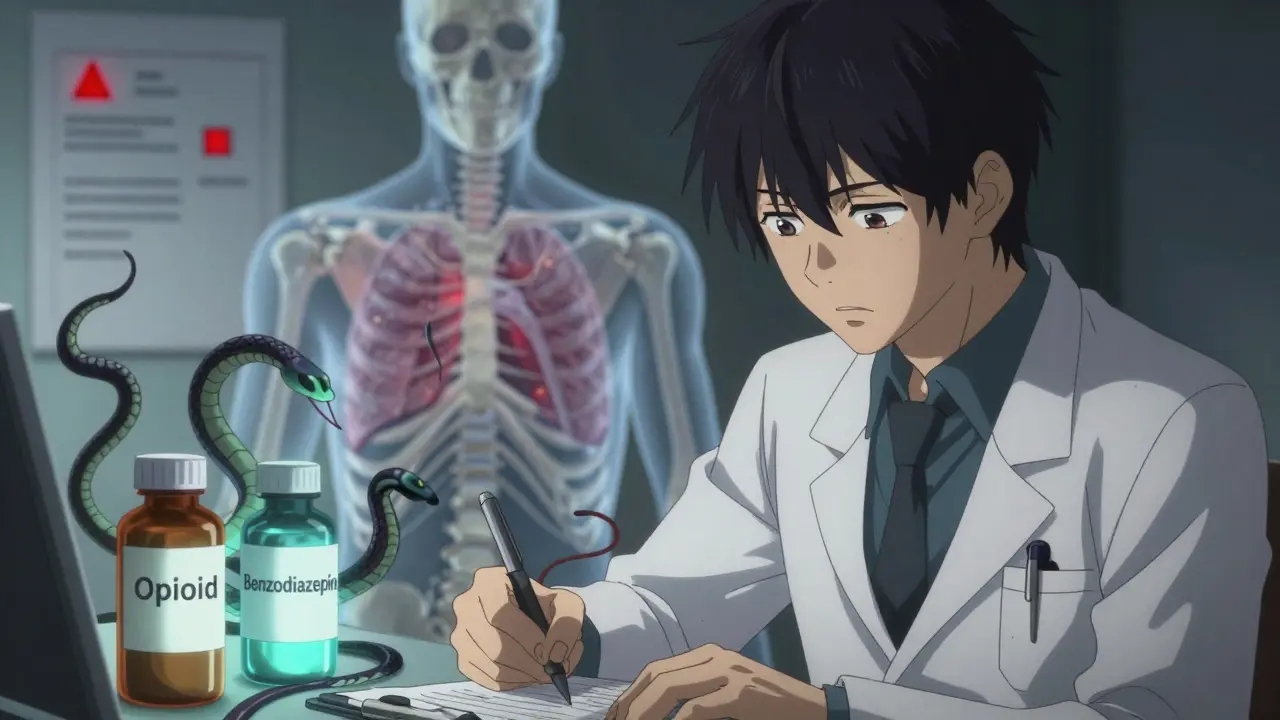
Who’s at Highest Risk?
It’s not just people with substance use disorders. The biggest group affected? Older adults. The American Geriatrics Society lists this combination as a potentially inappropriate medication for seniors in their Beers Criteria. Why? Because aging slows drug metabolism, reduces lung capacity, and increases sensitivity to sedatives. A single dose of diazepam and oxycodone can send an 80-year-old into respiratory arrest. People with sleep apnea are also at extreme risk. Opioids and benzodiazepines worsen obstructive apnea - the kind where your airway collapses while you sleep. The result? Longer pauses in breathing, deeper drops in oxygen, and a higher chance of cardiac arrest. Even people who take these drugs as prescribed - for chronic pain and anxiety - are in danger. The FDA’s 2019 warning made it clear: this combination should only be used if no other options exist.What Doctors Should Do - And What They Often Don’t
The FDA says: avoid prescribing these together. If you must, start with lower doses. Monitor closely. Warn patients and caregivers. But in practice? Many doctors still write these prescriptions. Why? Because anxiety and pain are hard to treat. Benzodiazepines work fast. Opioids relieve pain well. It’s easier to prescribe both than to find alternatives. That’s changing. Electronic health records now have alerts that pop up when a doctor tries to prescribe both drugs. One study showed these alerts reduced dangerous co-prescribing by 27%. That’s progress - but not enough. The CDC’s 2022 Clinical Practice Guideline says it plainly: Avoid prescribing benzodiazepines concurrently with opioids whenever possible. Yet, as of 2022, nearly 4.3% of long-term opioid users were still getting high-risk combinations - extended-release opioids with long-acting benzodiazepines.
What to Do If You’re Already Taking Both
If you’re on both medications, don’t stop suddenly. Withdrawal from benzodiazepines can cause seizures. Withdrawal from opioids causes intense flu-like symptoms, anxiety, and insomnia. Abruptly quitting both can be deadly. Talk to your doctor about a taper plan. This means slowly reducing one drug at a time - usually the benzodiazepine first - under medical supervision. Your doctor may switch you to non-addictive alternatives: gabapentin for nerve pain, CBT for anxiety, or non-opioid pain relievers like acetaminophen or NSAIDs. If you’re caring for someone on these drugs, learn the signs of overdose: extreme drowsiness, slow or shallow breathing, blue lips or fingertips, unresponsiveness. Keep naloxone on hand. It won’t reverse benzodiazepine effects - but it can save a life if opioids are the main cause of respiratory failure.The Bottom Line: No Safe Dose
There is no safe level of combining opioids and benzodiazepines. Even low doses, taken as prescribed, carry serious risk. The data is clear: this combination kills. Not occasionally. Not rarely. Consistently. At a rate ten times higher than opioids alone. The FDA, CDC, and medical societies agree: avoid this combination. If you’re on both, talk to your doctor now - not tomorrow, not next month. Your breathing is at stake. And it’s not something you can afford to gamble with.There are safer ways to manage pain and anxiety. You don’t need to risk your life to find relief.






Gloria Parraz
This is the kind of post that makes you stop scrolling. I used to think if you're prescribed it, it's safe. I was wrong. My uncle took oxycodone and Xanax for years after his back surgery. He never touched street drugs. One morning, he didn't wake up. No struggle. No noise. Just gone. The coroner said it was the combo. No one warned him. No one warned us.
Doctors act like these are just pills. They're not. They're silent killers disguised as relief. If you're on both, talk to your doctor today. Not tomorrow. Today.
I'm not here to scare you. I'm here because someone should have told us.
Sahil jassy
India too has this problem now. Doctors give tramadol + alprazolam like candy. No monitoring. No follow up. People die at home. No one checks. No one cares. This needs to be taught in med schools. Not just in the US.
Kathryn Featherstone
I work in ER. Saw this too many times. Patient comes in unconscious. Family says they took their meds like usual. We find both prescriptions. Always the same story: 'I thought it was fine.'
It's not fine. It's a ticking clock. And most people don't even know the clock is running.
Also-naloxone doesn't fix the benzo part. That’s the scary part. You bring someone back, but they’re still not breathing right. It’s not over.
William Storrs
My grandma was on hydrocodone and lorazepam for chronic pain and anxiety. She was 82. Her doctor never mentioned the risk. I found out by accident while reading her meds list. I called the pharmacy. They said 'We flag it now.'
So why didn’t they flag it before?
I got her off the benzo first. Took 6 weeks. She cried every day. But she’s breathing better now. And she sleeps better without the chemical haze.
This isn’t about willpower. It’s about doctors being lazy and patients being too scared to ask.
Nina Stacey
so like i was on oxycodone for like 3 years after my accident and then i started taking xanax because i couldnt sleep and i thought it was fine because i wasnt doing drugs or anything and then one night i woke up gasping and my heart was racing and i thought i was having a heart attack but it was just my body screaming because the drugs were fighting each other and i didnt even know it was happening until it almost killed me
my dr just shrugged and said oh you shouldnt have taken them together but she never told me that before
so now im on gabapentin and cbt and i feel way more awake and alive like i actually remember what sunshine feels like
if youre on both stop reading and call your dr right now i mean it
Kevin Motta Top
China doesn’t allow this combo. Japan doesn’t. UK has strict guidelines. US still treats it like a suggestion. We lead in opioid deaths. And we’re proud of it? No. We’re negligent.
Chris porto
It’s not just the drugs. It’s the system that lets this happen. We treat pain like an enemy to be crushed, not a signal to be understood. We treat anxiety like a glitch to be silenced, not a story to be heard.
These drugs are bandages on bullet wounds. We’re not healing. We’re numbing. And then we’re surprised when the body shuts down.
Maybe the real question isn’t how to stop the combo-but how to stop needing it in the first place.
William Liu
My sister’s doctor gave her 30mg of oxycodone and 2mg of Xanax. Said it was ‘standard.’ She’s 34. She’s alive because her roommate found her blue and called 911. Now she’s in rehab. And her doctor still prescribes this combo to others.
Someone needs to hold these people accountable.
mary lizardo
It is astonishing that such a well-documented, statistically catastrophic interaction continues to be permitted under the guise of clinical autonomy. The FDA has issued multiple warnings since 2016. The CDC has published peer-reviewed meta-analyses. Yet, physicians continue to prescribe this lethal cocktail with the same casualness as recommending aspirin. This is not medical negligence-it is institutional malpractice. Accountability must be enforced, not merely suggested.
jessica .
Big Pharma knows this kills people. That’s why they push it. They make billions off the deaths. The FDA is bought. The doctors are paid. They don’t care about you. They care about your insurance card.
They want you dependent. They want you dying. Then they sell you the funeral plan.
They’re not your doctors. They’re the enemy.
Sajith Shams
You think this is bad? Try combining opioids with barbiturates. That’s a death sentence in 10 minutes. Benzodiazepines are mild compared to that. Also, most people who die from this combo are already addicted. They’re not ‘innocent patients.’ They’re junkies who didn’t know how to stop. Stop coddling them. Enforce abstinence. That’s the real solution.
Adrienne Dagg
i just found out my therapist prescribed me klonopin with my pain meds 😭 i feel so stupid
but like… i was so anxious i didn’t even think to ask
just deleted the script and called my dr
thank you for this post 💙